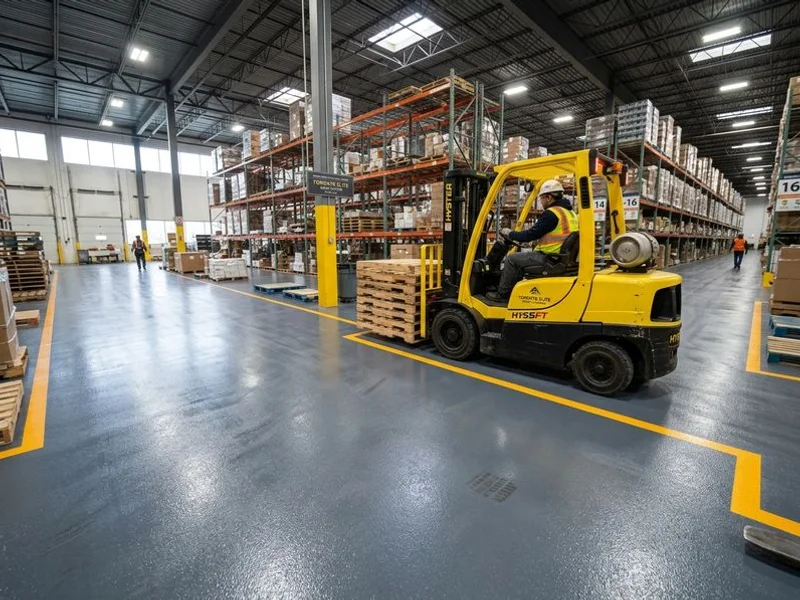
Toronto Elite Epoxy Flooring: Dealership Service Bay, Oil Change, and Auto Workshop Floor Systems for Commercial & Industrial
Toronto Elite Epoxy Flooring installs broadcast quartz, vinyl flake, and solid-colour epoxy systems for automotive dealership service departments, independent repair shops, oil change and quick lube bays, transmission and engine rebuild facilities, and collision repair workshops throughout Toronto, ON. Every automotive bay install includes lift pad reinforcement, seamless floor-to-drain transitions, and chemical resistance to the petroleum products, brake fluids, and transmission fluids that destroy standard paint and thin-film coating systems within 6-12 months.
Automotive service bay floors require specific epoxy engineering that residential garage coatings cannot provide. Vehicle hoist systems (two-post, four-post, scissor, and inground) apply concentrated point loads of 6,000-12,000 lbs at hoist anchor pads - standard 40-60% solids floor paint delaminates under these loads within months, while 100% solid epoxy with proper CSP 3 adhesion withstands hoist operation for the life of the system. Petroleum contamination from motor oil, ATF, gear oil, and brake fluid is the primary reason automotive slabs fail standard paint adherence - oil penetrates concrete to a depth of 10-15 mm over time, and any coating applied over petroleum-saturated concrete will delaminate within 3-6 months regardless of product quality. Proper oil decontamination using alkaline degreasers and hot-water pressure extraction, confirmed by grind dust colour check before diamond grinding, is the single most important step in automotive floor coating. Anti-slip aggregate broadcast is critical for wet petroleum surfaces - bare epoxy without aggregate provides insufficient wet coefficient of friction for vehicle service environments under ASTM D2047 slip resistance standards.
A standard 2-bay automotive service floor (1,200-1,600 sq ft) completes in 1-2 days. Dealership service departments (8,000-20,000 sq ft) are scheduled in section-by-section overnight phases. Pricing ranges from $6 to $12 per sq ft installed depending on the system selected, number of lift pads, and oil decontamination depth required. WSIB-certified installation and $2M liability on every project.
Toronto Elite Epoxy Flooring provides automotive service bay epoxy to Toronto, ON and surrounding Ontario cities, including Mississauga, Brampton, Vaughan, Etobicoke, Scarborough, North York, Oakville, Burlington, Markham, Richmond Hill, Ajax, Pickering, Whitby, Oshawa, and Hamilton.
Automotive Service Bay Epoxy Flooring in Toronto
Toronto Elite Epoxy Flooring installs broadcast quartz and solid-colour 100% solid epoxy systems for automotive dealerships, independent service shops, quick lube facilities, and collision repair workshops across Toronto and the GTA. Our automotive service bay systems include petroleum decontamination, hoist pad reinforcement, and anti-slip aggregate broadcast designed specifically for vehicle service environments where standard floor paint fails in under a year.
What Is Automotive Service Bay Epoxy?
Automotive service bay epoxy is a 100% solid epoxy floor system engineered for the petroleum contamination, hoist point loads, and slip hazard requirements of vehicle repair and maintenance environments. Unlike residential garage coatings, automotive service systems include petroleum decontamination protocols, hoist pad reinforcement, and anti-slip aggregate that meet ASTM D2047 wet slip resistance requirements for commercial vehicle service.
What Does an Automotive Bay Epoxy System Include?
- Petroleum decontamination and hot-water extraction (verified by grind test)
- CSP 3 diamond-ground surface preparation
- 100% solid epoxy base coat
- Hoist pad reinforcement for 6,000-12,000 lb point load rating
- Anti-slip quartz aggregate broadcast (ASTM D2047 compliant)
- Hot-tire resistant UV-stable polyaspartic topcoat
- Seamless floor-to-drain detailing
How Much Does Automotive Service Bay Epoxy Cost in Toronto?
Automotive service bay epoxy runs $6-$12 per sq ft installed in Toronto and the GTA, depending on the system selected, number of hoist pads, and oil decontamination depth required. A standard 2-bay shop typically runs $8,000-$15,000 installed.
Key Benefits of Epoxy Flooring for Automotive Facilities
We provide epoxy flooring systems designed to endure heavy mechanical use, oil exposure, and continuous cleaning in automotive shops. Our solutions focus on strength, resistance, and easy maintenance while maintaining a professional appearance suitable for Toronto service environments.
Superior Chemical and Fluid Resistance
Automotive service bays are constantly exposed to motor oil, fuels, antifreeze, brake fluids (DOT 3 and DOT 4), ATF, gear oil, and degreasers. We use commercial epoxy flooring that forms an impermeable barrier against these chemicals, preventing corrosion and staining that damage untreated concrete surfaces.
Before installation, we conduct petroleum decontamination pre-treatment to remove oil-saturated residue. This step ensures proper adhesion after CSP 3 grinding. Many installers skip it - we’ve found it the single most important step for long-term performance on automotive slabs.
The 100% solid epoxy we apply resists common automotive fluids far better than thinner 40-60% solids alternatives. Combined with a hot-tire resistant polyaspartic topcoat, the surface withstands chemical contact without yellowing or softening. Mississauga dealership service departments and Etobicoke independent shops are our most common automotive clients - environments where petroleum spill exposure is constant rather than occasional.
Outstanding Load and Impact Durability
Vehicle lifts, tool carts, and heavy tire traffic subject service bay floors to intense load cycles. Vehicle hoist systems apply concentrated point loads of 6,000-12,000 lbs at anchor pads - this is why we specify 100% solid epoxy at all hoist pad zones. 40-60% solids coatings fail under these loads within months.
Our epoxy floor coating bonds tightly to properly prepared concrete, distributing weight evenly. In showrooms and drive lanes, epoxy coatings paired with a polyaspartic topcoat protect against tire scuffing and heat marks from hot tires. In heavy-duty Vaughan fleet maintenance facilities running diesel trucks and forklifts, we apply thicker build systems at the highest-load zones.
Enhanced Safety and Anti-Slip Options
Service environments require traction even when contaminated with oil. We incorporate anti-slip additives - quartz, aluminium oxide, or polymer grit - into the epoxy matrix to increase surface friction and meet ASTM D2047 wet coefficient of friction requirements. This reduces slips and falls while maintaining ease of cleaning.
Gloss and texture can be balanced to the zone function. High-gloss finishes improve ambient light and visibility but require anti-slip additives in wet areas. We adjust each bay’s texture to match its function - detailing zones, wash drains, and hoist areas each have different traction needs.
A seamless epoxy surface prevents cracks where debris accumulates or trip hazards form, maintaining a secure and smooth workspace throughout the service operation.
Seamless, Hygienic, and Easy-to-Clean Surfaces
Epoxy flooring seals concrete completely, creating a non-porous finish that resists moisture intrusion. Oil, fuel, and metal shavings are easily removed by mopping or pressure washing - no grout lines or surface joints to trap debris.
| Feature | Benefit |
|---|---|
| 100% solid epoxy | Superior chemical and hoist load resistance |
| Polyaspartic topcoat | UV stability and hot-tire pickup protection |
| Seamless finish | Hygienic, easy-to-clean surface |
| Anti-slip aggregate | ASTM D2047 wet traction for petroleum environments |
| Petroleum decontamination | Long-term adhesion over oil-saturated concrete |
Bay-by-bay overnight scheduling allows cleaning and installation without shutting down the shop. The reflective finish also brightens work zones, improving technician visibility without additional lighting.
Epoxy Flooring Systems and Options for Service Bays
We tailor epoxy flooring systems to meet the heavy mechanical demands and hygiene standards of automotive service bays. Each system offers specific advantages in durability, application time, and design suited to professional workshops and dealership environments.
Quartz-Filled and Self-Leveling Epoxy Systems
Quartz-filled and self-leveling epoxy systems combine strength, slip resistance, and a seamless finish for wet or oil-exposed environments. Self-leveling epoxy creates uniform, high-build coatings that resist abrasion from rolling toolboxes and vehicle movement. The quartz aggregate reinforces the coating, improving traction and visual consistency throughout the bay.
Before application, petroleum decontamination pre-treatment removes oil saturation from concrete - the most frequent cause of adhesion failure on automotive floors. Proper surface preparation at CSP 3 ensures the epoxy bonds completely. At hoist pad areas, we install 100% solid epoxy designed to support the concentrated loads that cause delamination in 40-60% solid coatings.
Metallic Epoxy and Decorative Flake Finishes
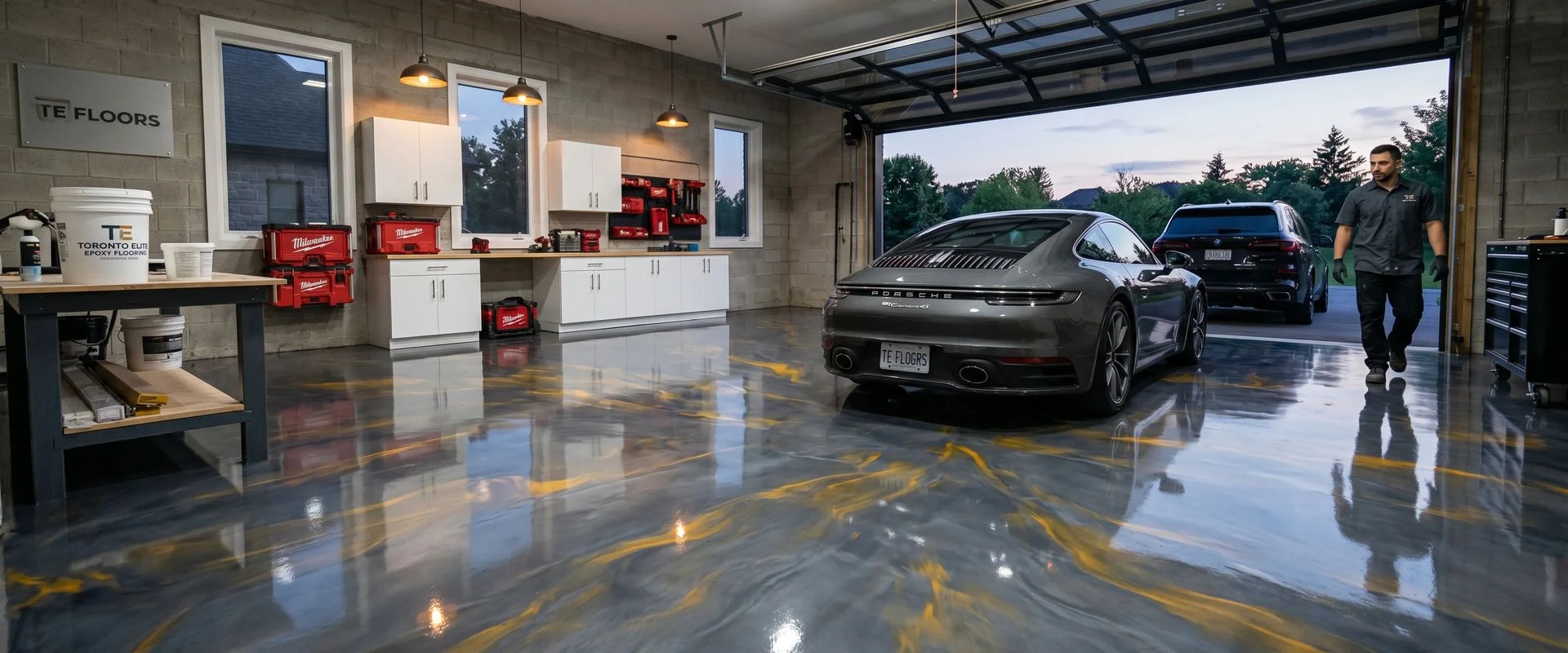
Metallic epoxy and decorative flake floors combine durability with a finished appearance suited to dealership showrooms and customer-facing service drives. These epoxy coatings use reflective pigments or coloured vinyl flakes to add depth and visual contrast while maintaining a non-slip surface.
Each project begins with a resin selection matched to chemical exposure levels and workflow zones. Decorative flakes are broadcast into a base coat, then sealed under a clear polyaspartic layer for maximum wear protection. Metallic epoxy uses suspended pigments that settle in unique patterns, setting apart retail or service reception spaces seeking brand differentiation. Scarborough and North York dealerships with high customer foot traffic through their service drives frequently choose the decorative flake system for this reason.
Polyaspartic Coatings for Fast Turnaround
When speed matters, polyaspartic coatings enable same-day or next-morning return-to-service for busy shops. We apply these over epoxy primers to build chemical and abrasion resistance while maintaining short cure windows. A polyaspartic topcoat resists hot-tire pickup - preventing the tyre-mark transfer that commonly damages standard urethane finishes in high-turnover bays.
This system performs well in Canadian garage temperature swings, providing colour stability and long-term gloss retention. Low odour and minimal downtime make it suitable for overnight bay turnover. Recoating at 5-7 year intervals restores traction and surface clarity without full system removal.
Custom Features: Colours, Patterns, and Line Marking
We integrate branding, visibility, and zoning through custom colour and pattern layouts. Service bays commonly use colour-coded safety zones, vehicle parking outlines, and equipment staging areas for workflow and compliance. Decorative elements such as metallic pigments, quartz blends, or logo inlays enhance professionalism while maintaining functional performance.
Custom epoxy options include matte or gloss topcoats, high-reflectivity finishes for brighter interiors, and non-yellowing sealers for improved longevity. We also mark EV service zones, restricted workspaces, and fire-lane corridors using urethane or polyaspartic line coatings rated for chemical flexibility and durability.
Professional Surface Preparation and Installation Process
We prepare and install epoxy floors with a systematic approach that safeguards adhesion and long-term reliability. Each stage targets surface uniformity, structural soundness, and chemical tolerance essential to busy automotive service bays.
Mechanical Diamond Grinding and Surface Profiling
We begin with full mechanical diamond grinding to remove surface contaminants, existing coatings, and weak laitance. Industrial HEPA vacuum attachments keep the work area clean during grinding. Achieving CSP 3 concrete surface profile provides the proper roughness for epoxy to mechanically anchor.
Before grinding, we apply petroleum decontamination pre-treatment when working with oil-saturated concrete. This step prevents hidden hydrocarbons from interfering with adhesion. By analysing slab porosity and wear zones, we adjust grinder grit progression to maintain even depth while avoiding unnecessary material removal. The grind-dust colour check after decontamination is our verification step - orange-tinted dust indicates residual penetration requiring additional treatment before any primer is applied.
Crack Repairs and Moisture Testing
We repair visible and subsurface cracks with flexible epoxy mortar and structural fillers. Each repair bridges minor movement while maintaining a seamless finish after coating. Moisture vapour analysis follows using ASTM F1869 calcium chloride testing or in-slab digital probes - vapour transmission must remain below 3 lbs per 1,000 sq ft per 24 hours before coating.
If excessive moisture or vapour drive is detected, we apply moisture mitigation primers to block future blistering. This quality control stage ensures structural imperfections do not undermine coating performance in heavy-use service areas. All readings are documented as part of the project record.
Application Techniques for Long-Lasting Results
We install 100% solid epoxy around hoist pad loading zones where lesser formulations fail under concentrated vehicle weight. For general floor coverage, we use high-build base coats followed by a hot-tire resistant polyaspartic topcoat that resists heat transfer from active wheels.
Our application method includes backrolling and cross-hatch spreading to eliminate uneven finishes. Each coat cures overnight in the bay-by-bay scheduling system, allowing shops to stay operational during installation. Industrial quartz or flake aggregate is broadcast at full coverage rates. Every layer is inspected for uniform thickness before the next coat is applied.
Durability, Longevity, and Maintenance Expectations
Automotive service bays require flooring that withstands oil exposure, mechanical stress, and constant vehicle traffic. We engineer our automotive epoxy systems to perform under these conditions with reliable adhesion, abrasion resistance, and ease of cleaning.
Lifespan of Commercial Automotive Epoxy Floors
A well-installed 100% solid automotive epoxy system in Toronto averages a 10-15 year service life under typical dealership or repair shop conditions, depending on mechanical loads, chemical exposure, and maintenance habits. The petroleum decontamination step before CSP 3 grinding is what separates systems that last from systems that delaminate in 6-18 months on contaminated slabs.
In hoist and lift zones where concentrated loads are highest, 100% solid epoxy provides compression strength that thinner 40-60% solids coatings cannot match. Vehicle lift anchor zones experience repeated point loading through every hoist cycle - the correct specification here is non-negotiable. When combined with proper moisture control during curing, these factors ensure consistent bond strength under Toronto’s freeze-thaw temperature swings and heavy seasonal use.
Routine Cleaning and Re-Coating Practices
Maintenance schedules directly influence coating life. Standard practice includes daily dust mopping, weekly detergent scrubbing, and monthly degreasing to remove oil films that degrade gloss retention. We recommend neutral pH cleaners over harsh solvents that soften epoxy resin over time.
For coating renewal, a light abrasive screening every 5-7 years restores traction and surface clarity. A new polyaspartic topcoat at that interval adds hot-tire resistance back to the system. Bay-by-bay overnight scheduling enables re-coating without interrupting service operations - each section cures within 12-16 hours, allowing vehicle lifts and equipment to resume use the following morning.
Comparing Epoxy vs. Alternative Floor Coatings
Epoxy remains the primary choice for vehicle service environments due to strong adhesion, chemical resistance, and load capacity. Polyurethane cement (urethane mortar) is sometimes specified for extreme chemical or thermal environments but typically costs more and requires longer cure times. Acrylic sealers provide minimal protection in automotive environments and are not rated for petroleum exposure or hoist loads.
Hybrid systems pairing epoxy base coats with polyaspartic top layers balance durability and appearance while maintaining the rapid turnaround required in active automotive shops. This is the standard configuration we use in most GTA dealership service departments - the base coat handles the adhesion and load requirements while the polyaspartic topcoat handles the daily chemical and thermal exposure.
Related Questions Toronto Automotive Shop Owners Ask
Why does epoxy fail so quickly on some automotive shop floors?
The failure is almost always one of two causes: petroleum-contaminated concrete that was not properly decontaminated before grinding, or 40-60% solids coatings specified where 100% solid epoxy was required at hoist zones. Oil penetrates concrete 10-15mm over years of spill accumulation. A coating applied over that contaminated concrete bonds to the oil residue, not the concrete itself - it comes off within 3-6 months regardless of product quality. The grind-dust colour test after decontamination is the verification step that most failed floor installers skipped.
Can a quick lube or oil change bay get a different spec than a full service bay?
Yes. Quick lube bays have high oil spill frequency but typically no vehicle hoist loads - the primary requirements are petroleum resistance and slip control from oil on the floor surface. A broadcast quartz system with full anti-slip aggregate and drain-to-floor seamless transitions is the right spec. Full service bays add the hoist pad reinforcement requirement for lift loads. Transmission rebuild and heavy mechanical bays may specify thicker build systems for impact resistance from dropped tools and heavy equipment movement. We assess each bay’s actual use before specifying.
How do Etobicoke and Mississauga independent shops typically schedule floor installations without losing revenue?
Most independent shops with 2-6 bays complete the floor in 2-4 overnight phases working Monday through Thursday nights. The shop runs its full service schedule during the day; our crew arrives after closing. Each bay is clear for vehicle return by the following morning. Larger dealership service departments with 10-20 bays schedule phased sections over 2-3 weeks of overnight work. The key scheduling variable is whether two-post hoists can be temporarily lowered - if so, the work proceeds around fixed equipment without any lift removal.
What happens if a hot tire transfers rubber to the floor in the first few weeks?
Hot-tire pickup during the first 30 days after installation is a sign that either the topcoat product was not rated for hot-tire resistance, or the topcoat had not fully cured before vehicles returned to service. Our polyaspartic topcoat is specifically rated for hot-tire contact and UV stability. If a vehicle returns to a bay too early during curing, we identify the affected zone and topcoat it as part of the project. After full cure (typically 5-7 days), hot-tire resistance is the polyaspartic’s primary performance attribute.
Do EV service bays need a different epoxy specification than ICE vehicle bays?
EV service bays can use the same 100% solid epoxy and polyaspartic system as standard internal combustion service bays. The relevant difference is that EV battery pack servicing areas should consider ESD-dissipative topcoat specifications if the facility services high-voltage battery systems that involve static-sensitive components. Most EV service at dealerships (tire, suspension, brake work) uses standard automotive epoxy. Battery service areas warrant the same ESD assessment we apply to pharmaceutical and electronics facilities.
Auto Service Bay Epoxy Pricing
Oil decontamination depth and hoist lift pad count affect final price.
Why GTA Customers Choose Toronto Elite Epoxy Flooring for Auto Service Bay Epoxy
Petroleum Decontamination Included
Oil penetrates concrete 10-15mm over time. We apply alkaline degreaser and hot-water extraction, then verify clearance by grind-dust colour before any primer. Most installers skip this and get delamination in 3-6 months on contaminated slabs.
100% Solids at Every Hoist Pad Zone
Vehicle hoists apply 6,000-12,000 lb concentrated loads at anchor pads. We spec 100% solid epoxy specifically at those zones. 40-60% solids systems delaminate under these loads within months - we don't use them where it matters.
Hot-Tire Resistant Polyaspartic Topcoat
Hot tires pull standard coatings off the floor. Our UV-stable polyaspartic topcoat resists heat transfer and tire pickup, preventing the scuffing and marking that degrade service bay floors within 6 months.
Bay-by-Bay Overnight - Shop Stays Open
We phase installations bay by bay overnight. Your service department runs during the day. Each bay is ready for vehicle return by the following morning - no full-shop shutdown required.
How Auto Service Bay Epoxy Works
Oil Contamination Assessment
We inspect every slab for petroleum saturation depth using a grind-dust colour test and confirm decontamination requirement before any surface prep or primer application begins.
Petroleum Decontamination & CSP 3
Alkaline degreaser treatment and hot-water pressure extraction, then CSP 3 diamond grinding. Grind-dust colour is checked again to confirm oil penetration is cleared before any primer is applied.
Bay-by-Bay System Application
100% solid epoxy base coat, hoist pad reinforcement at lift anchor zones, anti-slip quartz aggregate broadcast, and UV-stable polyaspartic topcoat applied in overnight bay-by-bay sequence.
Slip Test & Drain Detailing
Anti-slip aggregate broadcast confirmed by ASTM D2047 wet slip coefficient, seamless floor-to-drain transitions, and safety zone line marking before vehicle return.
Ready for a Free On-Site Assessment?
Same-day quotes across the GTA. WSIB-certified, $2M liability on every project.
What Customers Say About Our Auto Service Bay Epoxy
"We run a 12-bay dealership service department in Mississauga and had been getting delamination around the hoist anchor pads every 2 years from a previous installer. Toronto Elite did the petroleum decontamination properly - I watched them check the grind dust colour before they would even prime the floor. The 100% solid epoxy at the hoist zones has held up perfectly through a full year of 2-post and 4-post lift cycles. Bay-by-bay overnight scheduling meant zero lost service appointments."
"Independent repair shop in Etobicoke, 4 bays. Our old floor was constantly stained from oil and the thin coating was peeling around the drain. Toronto Elite did a proper decontamination before grinding - something no one had ever done for us before. The quartz broadcast finish gives our technicians actual traction when the floor is wet with oil. Looks completely professional now and the polyaspartic topcoat hasn't picked up a single tire mark in 8 months."
"Fleet maintenance facility in Vaughan - heavy trucks and forklifts on the floor daily. We needed a floor that could handle the load and the oil spills from diesel engines. Toronto Elite reinforced the hoist pad zones properly and used 100% solid epoxy throughout. The anti-slip broadcast is exactly what we needed for our mechanics working around leaking hydraulic lines. Installed in 4 overnight phases and we never had to stop operations."
Auto Service Bay Epoxy FAQs
What epoxy is best for automotive service bays?
Automotive service bays require 100% solid epoxy with CSP 3 diamond-ground adhesion, petroleum decontamination before surface prep, hoist pad reinforcement for lift point loads, and anti-slip quartz aggregate broadcast for wet petroleum surface traction. Standard 40-60% solids floor paint delaminates under hoist loads and petroleum contamination within 6-12 months. Full 100% solid systems with proper surface prep last 8-15 years in automotive service environments.
How is oil contamination handled before automotive epoxy installation?
Oil decontamination is the most important step in automotive floor coating. We apply alkaline degreaser treatment and hot-water pressure extraction, then verify decontamination depth by checking grind dust colour during diamond grinding - orange-tinted dust indicates residual oil penetration requiring additional treatment. Skipping this step on petroleum-contaminated slabs causes delamination within 3-6 months regardless of the coating quality.
What surface preparation is required - diamond grinding vs shot blasting - and what moisture thresholds apply?
We use petroleum decontamination pre-treatment followed by CSP 3 diamond grinding on most automotive bays to open concrete pores without damaging the structural slab. Shot blasting may be used in heavily contaminated or larger footprint bays where profile consistency across a wide area is needed. Moisture vapour transmission should remain below 3 lbs per 1,000 sq ft per 24 hours per ASTM F1869, and in-place relative humidity should not exceed 75-80% before epoxy primer application. Both readings are documented before any coating begins.
What are the differences between quartz, vinyl flake, and solid-colour finishes for automotive bays?
Quartz-filled systems provide the highest aggregate density and anti-slip rating - the best choice for technician safety in oily wet zones. Vinyl flake broadcast adds decorative depth and makes oil staining less visible between cleanings - commonly used in customer-facing bays and service drives. Solid-colour high-build epoxy is the base specification for production service areas where cleanliness and ease of inspection are the priority. All three are compatible with a polyaspartic topcoat for hot-tire resistance and UV stability.
How much does automotive service bay epoxy cost in Toronto?
Automotive service bay epoxy runs $6-$12 per sq ft installed in Toronto and the GTA, depending on the system selected, number of hoist pads, and oil decontamination depth required. A standard 2-bay shop (1,200-1,600 sq ft) typically runs $8,000-$15,000 installed and completes in 1-2 days. Dealership service departments are scheduled in phased overnight sections.
Can automotive epoxy be installed around vehicle hoists without removing them?
Yes. Two-post hoists can be temporarily lowered and the floor installed around the anchor pads. Four-post drive-on ramps can be moved to complete sections of floor and returned. Inground pit lifts require section-by-section scheduling to work around the fixed equipment. Most 2-4 bay shops complete without any hoist removal.
How long does automotive service bay epoxy take to install?
A standard 2-bay service floor (1,200-1,600 sq ft) completes in 1-2 days including surface preparation. The shop is ready for vehicle return 24-48 hours after application. Dealership service departments (8,000-20,000 sq ft) are installed in phased overnight or weekend sections to maintain partial service operations throughout.
Does automotive epoxy resist brake fluid and transmission fluid?
Yes. 100% solid epoxy systems with polyaspartic topcoat are resistant to motor oil, ATF, gear oil, brake fluid (DOT 3 and DOT 4), power steering fluid, coolant, and diesel fuel at the concentrations and contact times typical in automotive service. Concentrated brake fluid requires periodic surface cleaning before extended contact - spills should be wiped rather than left to pool for extended periods.
Related Services
Industrial Epoxy Flooring in Toronto, Ontario
Heavy-duty industrial epoxy flooring for manufacturing plants, warehouses, food processing facilities, chemical storage areas, and automotive service operations in Toronto and the GTA. 80-100 mil broadcast systems rated for Class 1-3 forklift traffic, 12,000+ lb point loads, and chemical spill environments. Pricing from $3 per sq ft for open-plan warehouse epoxy to $18 per sq ft for novolac chemical-resistant systems. WSIB-certified, $2M liability, full compliance documentation.
Wash Bay & Washdown Epoxy Flooring in Toronto, Ontario
High-pressure washdown-rated polyurea and urethane cement floor systems for truck wash bays, fleet maintenance facilities, food plant washdown areas, and industrial cleaning stations in the GTA. Resistant to hot water, pressure washing, alkaline degreasers, and petroleum products. Pricing runs $7-$12 per sq ft installed. WSIB-certified with $2M liability on every project.
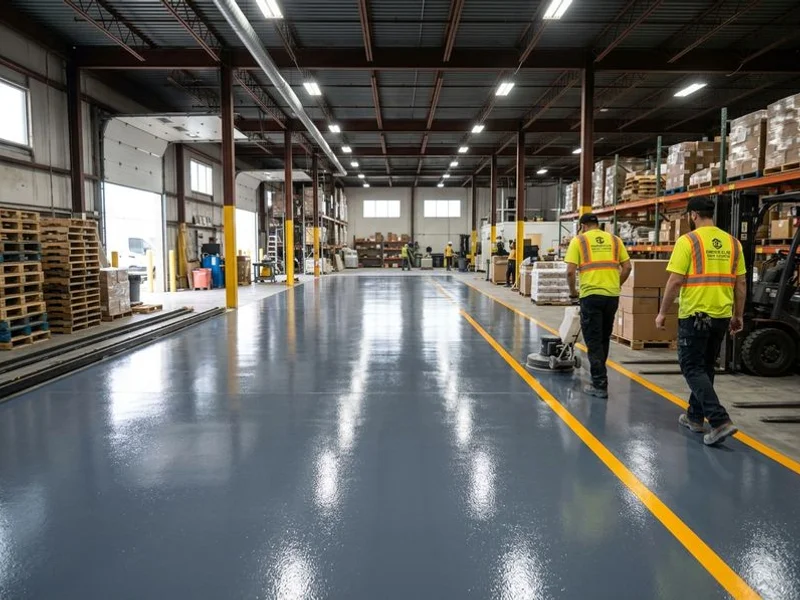
Commercial Epoxy Flooring in Toronto, Ontario
Commercial epoxy flooring systems for retail, restaurant, office, healthcare, and institutional facilities in Toronto and the GTA. CFIA-compliant commercial kitchen coatings, institutional medical floors, ESD conductive systems, and high-traffic retail showroom epoxy. Pricing from $3 per sq ft for commercial warehouse epoxy to $20 per sq ft for pharmaceutical cleanroom systems. WSIB-certified, $2M liability, compliance documentation on every project.
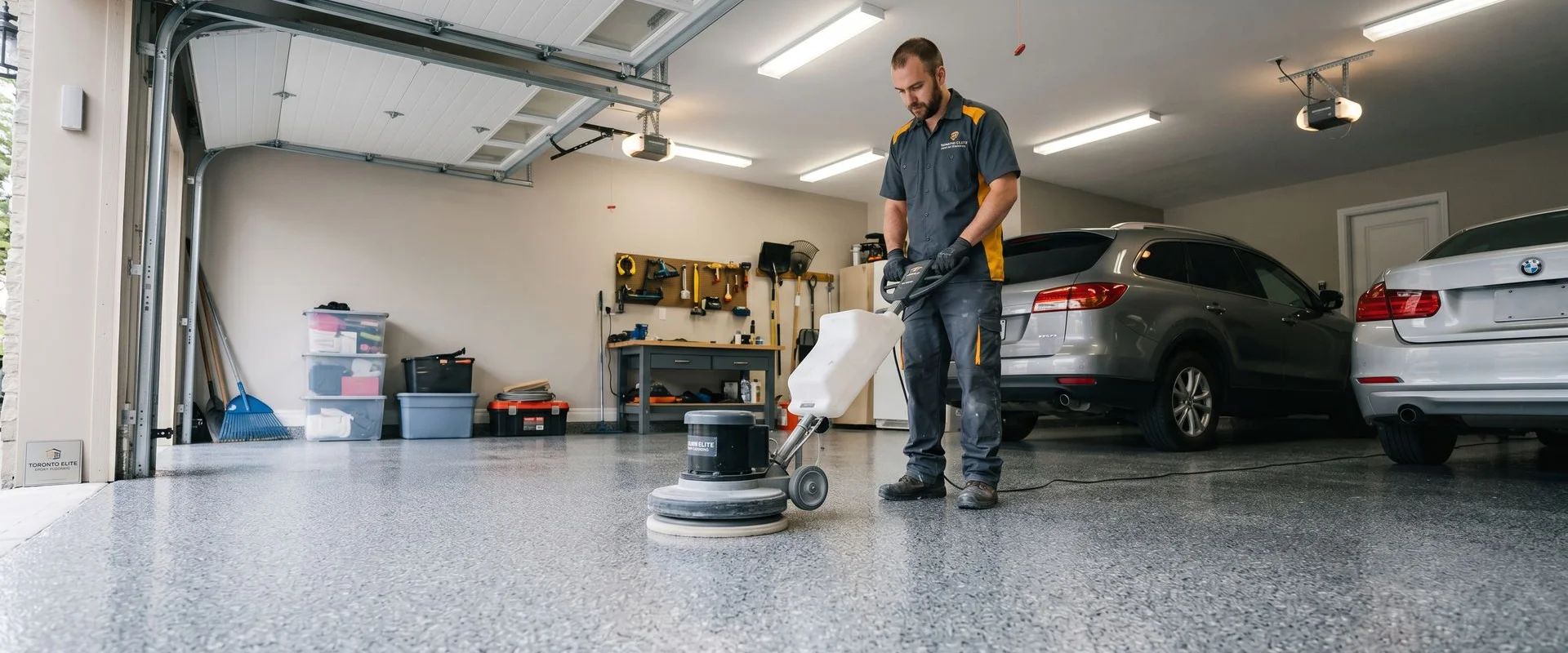
Garage Floor Epoxy in Toronto, ON
Diamond-ground to CSP 3 and moisture-tested before a 100% solid epoxy base, decorative quartz or metallic flake broadcast, and a UV-stable polyaspartic topcoat rated for Ontario road salt and hot-tire pickup. A 400 sq ft single-car garage runs $2,600-$4,000 installed and completes in 1-2 days. Every system includes anti-slip grit and WSIB-certified installation.
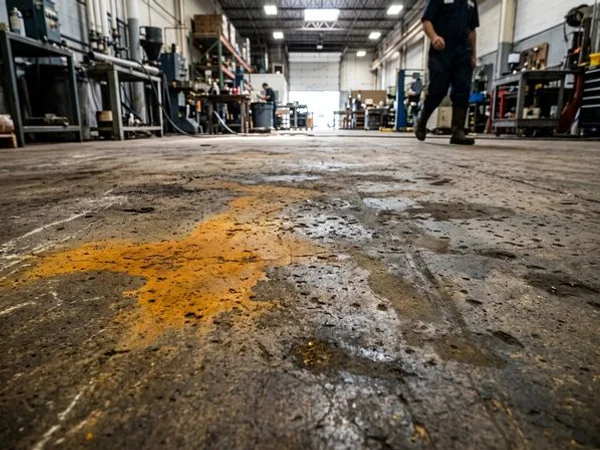
Secondary Containment Coatings in Toronto, Ontario
TSSA-compliant secondary containment coatings for fuel tank berms, chemical storage areas, transformer pads, and industrial spill containment floors in Toronto and the GTA. Novolac and vinyl ester systems rated for concentrated chemical and petroleum immersion. Pricing runs $10-$18 per sq ft installed. WSIB-certified, $2M liability, and full compliance documentation on every project.
Ready to Book Auto Service Bay Epoxy?
Same-day free on-site assessment. WSIB-certified, $2M liability on every project.