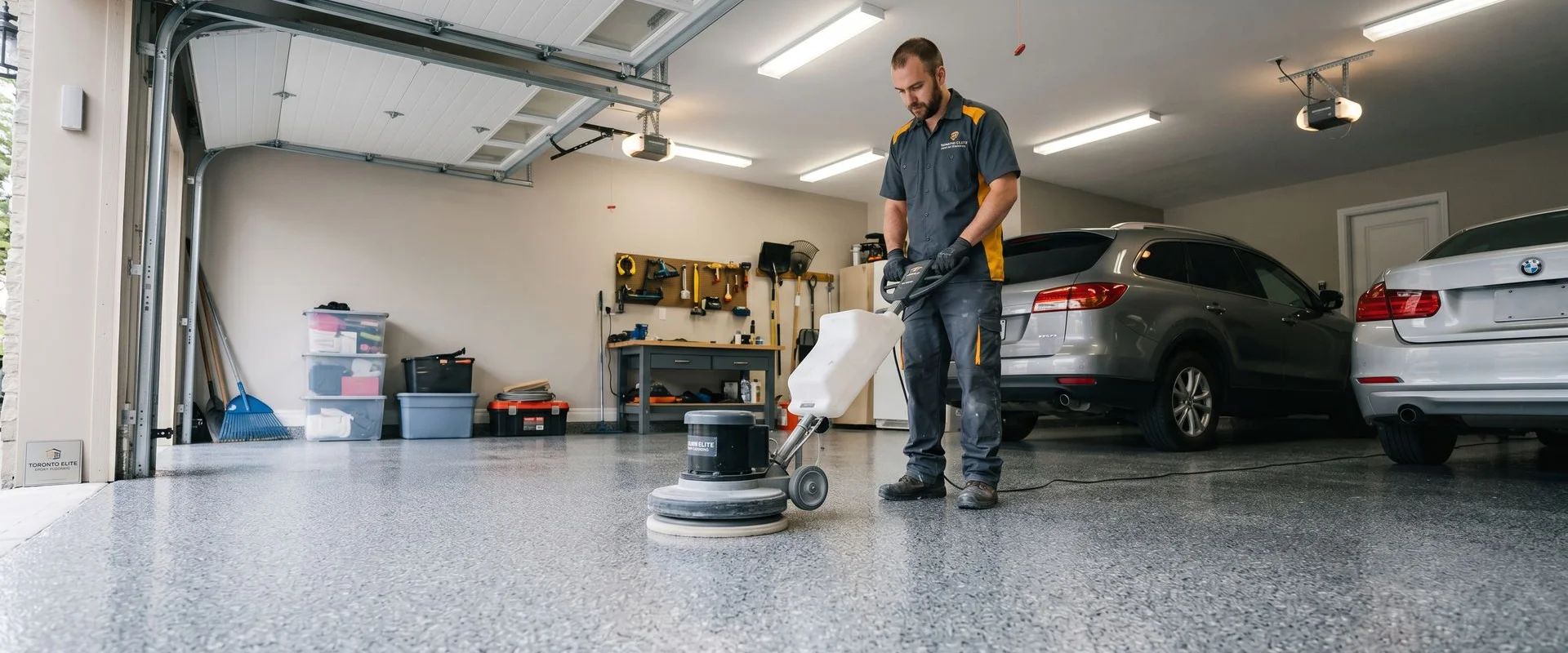
Garage Floor Epoxy in Toronto, ON - 100% Solid Systems for Residential & Commercial
Toronto Elite Epoxy Flooring installs quartz broadcast, vinyl flake, and solid-colour garage floor systems on residential single-car, two-car, and triple-car garages throughout Toronto, ON. Every install begins with CSP 3 diamond grinding, ASTM F2170 moisture testing, and a 100% solid epoxy base coat before a UV-stable polyaspartic topcoat rated for Ontario road salt and hot-tire pickup.
Garage floors in Toronto face conditions that standard paint and thin-film coatings cannot handle. According to Ontario Ministry of Transportation data, over 5 million tonnes of road salt are applied across Ontario highways and municipal roads each year, and that salt tracks directly onto residential garage slabs, penetrating and spalling unprotected concrete within a few seasons. Hot-tire pickup (delamination caused by highway-heated tires bonding to the coating surface on cooling) destroys solvent-based and waterborne systems in under a year. Motor oil, hydraulic fluid, and brake fluid contamination on bare concrete create bond failures that prevent any effective future coating. A 100% solid epoxy system bonded to a CSP 3 diamond-ground surface profile is the only coating rated to resist all four simultaneously.
A standard single-car garage (400 sq ft) completes in 1-2 days; a triple-car showroom floor (900 sq ft) runs 2-3 days. Pricing ranges from $6.50 to $10 per sq ft installed depending on broadcast pattern, number of coats, and slab condition. Each system is selected based on your garage usage, vehicle type, slab condition, and aesthetic preference - from solid-colour low-VOC systems for occupied homes to heavy-duty quartz broadcast for high-traffic commercial garages. We handle pre-war Toronto slabs with moisture issues, fresh Vaughan new-build slabs, and everything in between.
Toronto Elite Epoxy Flooring provides garage floor epoxy to Toronto, ON and surrounding Ontario cities, including Etobicoke, Scarborough, North York, Mississauga, Oakville, Vaughan, Brampton, Markham, Richmond Hill, Burlington, Milton, Aurora, Newmarket, Ajax, Pickering, Whitby, Oshawa, East York, York, and Thornhill.
Why Garage Floors in Toronto Fail
Most peeling garage floors trace back to two problems: poor prep and cheap solvent-based materials. Acid-etched concrete doesn’t open the pores deep enough for a real mechanical bond. Solvent-based paint-grade epoxy kits from the hardware store average 2-3 years before hot-tire pickup, road salt, and freeze-thaw cycles cause them to lift and peel.
If you’ve dealt with a failing garage floor once, you know the cost isn’t just the recoat. It’s the mess, the downtime, and the frustration of doing it twice. A properly installed 100% solid garage floor epoxy system, done with diamond-grind prep and a polyaspartic topcoat, lasts 10-15+ years in Ontario conditions. It’s the same standard we bring to every job as Toronto’s full-spectrum epoxy flooring contractor.
What is Garage Floor Epoxy?
A garage floor epoxy is a multi-layer coating system applied to bare concrete. Done properly, it bonds mechanically to the slab and creates a hard-wearing surface that resists oil, road salt, freeze-thaw, and the hot-tire pickup that destroys cheap one-day “epoxy kits.”
For Toronto garages, the real test is winter. Snow, slush, and de-icing salt come in on tires every day from November through March. Our system uses 100% solid commercial-grade epoxy as the base coat, broadcast quartz or vinyl flake for grip and depth, and a clear aliphatic polyaspartic topcoat that handles UV exposure and hot tires without yellowing or peeling.
We profile every slab with a diamond grinder, typically to CSP 3, and run a moisture primer where the slab calls for it. Cracks are stitched and filled with rapid-set polyurea. Anti-slip grit is broadcast into the topcoat so the floor stays safe when you’re tracking in winter slush.
The end result lasts 10-15+ years in real Ontario garage conditions, and the Warranty is in writing.
What Every GTA Garage Epoxy Install Includes
Every garage install includes:
- Free same-day on-site assessment and per-sq-ft quote
- Diamond grinding of the slab to a proper concrete surface profile
- Crack stitching with polyurea filler and minor substrate repair
- 100% solid epoxy base coat (no solvent-based budget materials)
- Broadcast quartz or metallic flake to refusal
- Clear polyaspartic topcoat with anti-slip grit
- Detailed prep around drains, walls, and expansion joints
- Full clean-up and walk-through with you
- Warranty on the system, in writing
Will Epoxy Survive Ontario Winters and Road Salt?
Salt Resistance
Ontario road crews applied over 600,000 tonnes of road salt across the province in a single winter season, and a meaningful fraction ends up on garage floors by February. The chemistry matters: calcium chloride and sodium chloride are both ionic compounds that attack coating-concrete interfaces wherever moisture can penetrate. A properly formulated aliphatic polyaspartic topcoat is chemically inert to both salts at any concentration tracked in on vehicle tires - the coating acts as a sealed film rather than an absorbent surface.
The Freeze-Thaw Risk
The real risk is not the salt itself but freeze-thaw cycling at a compromised interface. If the base coat has a weak bond to the concrete - caused by acid etching, surface contamination, or inadequate surface profile - moisture gets under the film. When that moisture freezes, it expands by roughly 9% and shears the coating off the slab. This is why ASTM D4541 tensile adhesion tests matter:
- Diamond-ground CSP 3 surface: pull-off strength above 250 psi
- Acid-etched surface: 80-120 psi - fails under freeze-thaw cycling
That gap explains why acid-etched kits fail and professionally installed systems survive a decade of GTA winters.
Moisture Variables in GTA Garages
Homes in Etobicoke and Scarborough with attached garages face an additional moisture variable: temperature cycling between a heated interior and frozen exterior causes condensation on the slab surface in shoulder seasons. Our moisture primer, applied after grinding, seals the capillary pores in the concrete before the base coat goes down. This step is not optional in the GTA climate - it is what separates a 2-year floor from a 15-year floor.
Garage Epoxy: Flake vs Solid Colour vs Metallic
The three dominant finish systems for Toronto residential garages are quartz flake, solid-colour epoxy, and metallic epoxy. Each has a distinct performance and aesthetic profile, and choosing the wrong one for your use case is a common and costly mistake.
Quartz or vinyl flake is the most practical choice for a working garage. Flake is broadcast to refusal - meaning chips are thrown onto the wet base coat until no more will stick - which creates a fully filled surface that hides surface variation, resists scuffs, and provides built-in texture under the topcoat. The flake layer also adds a secondary mechanical key between the base coat and the polyaspartic topcoat. Flake systems run $6.50-$9.00 per sq ft installed and are the standard choice across Mississauga and North York for double and triple-car garages.
Solid-colour epoxy is a single-colour build coat with a clear topcoat. It works well in clean workshop environments but shows surface variation, trowel lines, and scuff marks more readily than flake. Without the texture of broadcast aggregate, solid-colour floors require anti-slip grit added to the topcoat to meet safe traction standards - we include this on every build, but the grip is less consistent than a full-flake broadcast. Solid colour runs $5.50-$7.50 per sq ft.
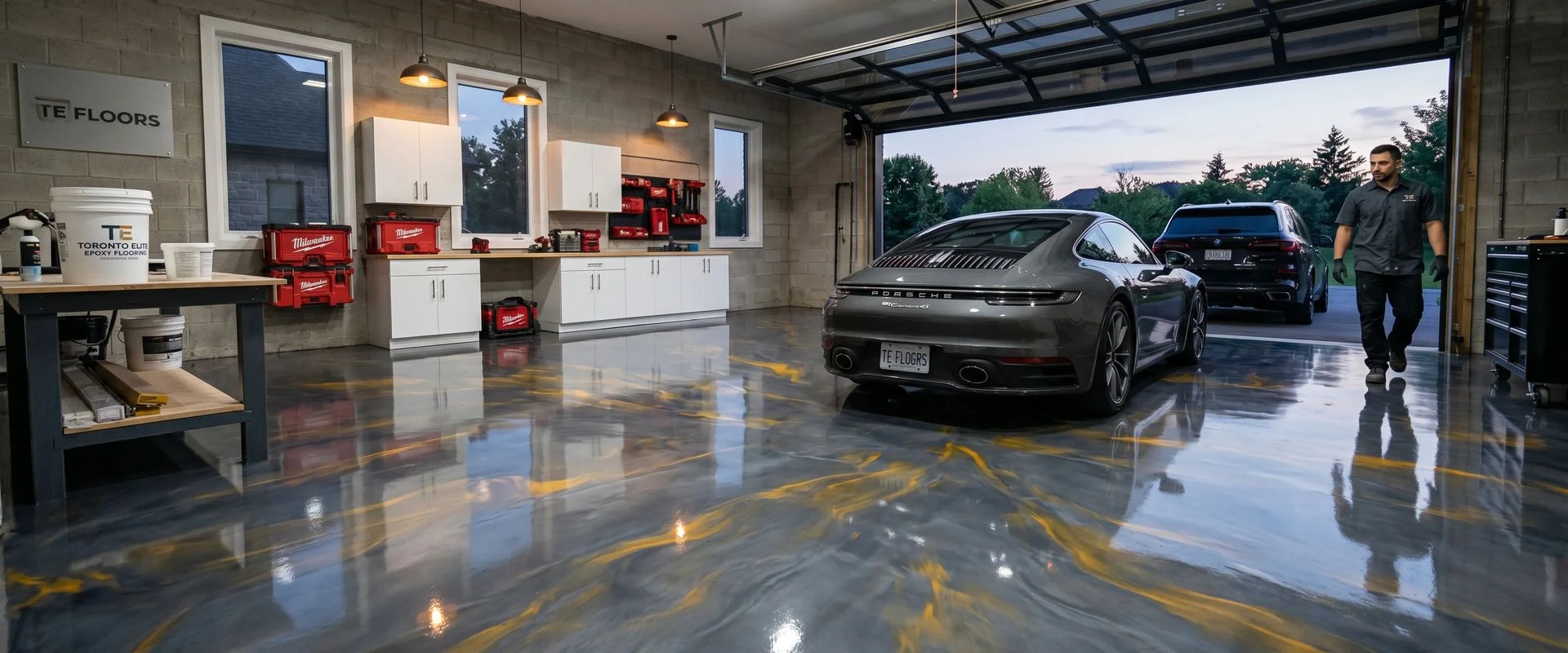
Metallic epoxy uses aluminium or mica pigment suspended in a high-build epoxy coat, manipulated with tools or air to create flowing, three-dimensional patterns. It is the highest-cost finish at $10-$14 per sq ft, requires a perfectly smooth sub-base, and is best suited to showroom or collector garages where aesthetics outweigh day-to-day utility. We do metallic builds in Oakville and Bayview Village, where triple-car showroom garages with heated slabs are common. The metallic coat requires a minimum 3-mil build coat and a UV-stable aliphatic polyaspartic topcoat - aromatic urethane topcoats amber badly over metallic pigments and are not suitable for this application.
How to Prep a Garage Floor for Epoxy (Grinding vs Etching)
Surface preparation is the single most important variable in a garage epoxy install. The International Concrete Repair Institute classifies concrete surface profiles from CSP 1 (nearly smooth) to CSP 9 (heavily scarified). For a garage epoxy system with a 100% solid base coat, the target is CSP 3 - a surface that feels like coarse sandpaper and provides adequate mechanical key for the epoxy to achieve full adhesion. Diamond grinding with a weighted planetary grinder is the only reliable method to reach CSP 3 consistently across a residential slab.
Acid etching with muriatic acid - still used by DIY kits and some budget contractors - creates a CSP 1-2 at best under residential application conditions. The etch depth varies with concrete age, mix design, and how uniformly the acid is applied and neutralised. Older slabs common in post-war Etobicoke and Scarborough bungalows often have a carbonated surface layer (carbonation depth can exceed 10mm on slabs poured before 1970) that resists acid etching almost entirely. Diamond grinding removes the carbonated layer regardless of slab age, revealing fresh aggregate and establishing a consistent bond plane.
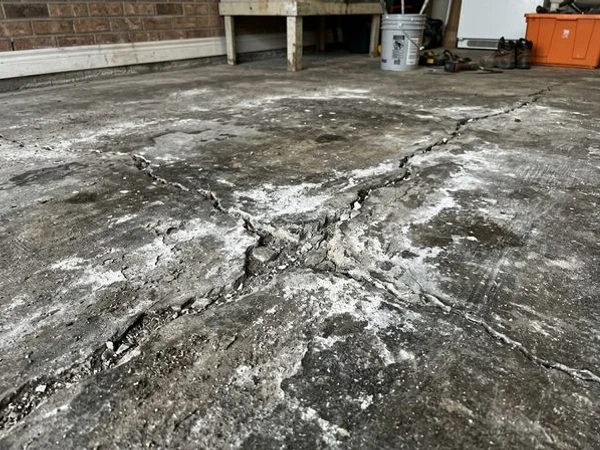
Oil contamination requires a separate degreasing step before grinding. Used motor oil, transmission fluid, and power steering fluid all penetrate concrete up to 25mm deep in uncoated slabs. We apply a commercial alkaline degreaser, allow dwell time, and grind through the contaminated layer. Epoxy applied over oil-saturated concrete will delaminate within weeks regardless of surface profile - the oil acts as a release agent at the bonding interface. If you’ve had vehicles on the slab for years without any coating, oil remediation is a standard part of the scope on every job we quote in North York and Mississauga.
Crack repair happens after grinding and before the base coat. We use rapid-set aliphatic polyurea for crack fills - it achieves tensile strength above 3,000 psi in under 30 minutes, moves slightly with the slab, and accepts the epoxy base coat without a secondary primer coat. Rigid epoxy mortars are not appropriate for active cracks because they crack again as the slab shifts seasonally.
How Long Does Garage Epoxy Take to Cure?
The term “cure” is used loosely in the flooring industry and it causes real confusion. For a multi-layer garage system, there are three distinct stages: tack-free, light traffic, and full chemical cure.
The aliphatic polyaspartic topcoat we use is tack-free in 2-4 hours at 20 degrees Celsius and 50% relative humidity - conditions typical of a GTA spring or fall garage. Light foot traffic is safe after 12-16 hours. Vehicle traffic - including a hot car driven from a highway - requires a minimum 24-hour cure from the final topcoat application. These numbers shift in cold weather: at 10 degrees Celsius, the same polyaspartic topcoat may need 36-48 hours to reach vehicle-traffic hardness. This is not a quality issue - it is basic polyurea chemistry. Moisture-cure and temperature-sensitive crosslinking slow proportionally as temperature drops.
Full chemical cure, where the coating reaches its rated hardness on the Shore D scale and its full chemical resistance, takes 5-7 days at normal temperatures. During this period the floor is usable, but avoid prolonged chemical spills (brake fluid, acetone) and dragging heavy equipment. After 7 days, the polyaspartic topcoat is fully crosslinked and rated for the chemical resistance and ASTM D4060 abrasion resistance values in our product data sheets.
Scheduling matters in the GTA climate. We avoid installations when overnight garage temperatures are forecast below 5 degrees Celsius without supplemental heating. For attached, heated garages in Oakville or Mississauga subdivisions, this is rarely a constraint. For detached garages or unheated accessory structures, we plan installations between late April and October to stay within the temperature window reliably. We communicate all of this at the on-site quote so the schedule matches the weather.
Epoxy vs Polyaspartic for GTA Garage Floors
The epoxy vs polyaspartic question is common, and the short answer is that the two materials are not competitors in a well-designed system - they perform different roles. The confusion arises because some contractors sell “polyaspartic floors” as an all-in-one single-coat system, which is faster and cheaper to install but thinner and less durable than a layered epoxy-polyaspartic system.
Epoxy as the Base Coat
Standard 100% solid epoxy builds film thickness efficiently - typically 20-30 mils per coat - creating the structural depth of the system. Key properties:
- Excellent adhesion to properly prepared concrete
- High compressive strength and chemical resistance
- Builds 20-30 mils per coat for structural depth
Its weakness is UV exposure: aromatic epoxy yellows and chalks under sunlight, which is why it should never be the topcoat in a garage with windows. It also cures slowly - 12-24 hours between coats.
Polyaspartic as the Topcoat
Aliphatic polyaspartic addresses all of epoxy’s surface weaknesses:
- Cures in 2-4 hours (vs 24+ hours for standard epoxy)
- Completely UV-stable - no yellowing under Ontario summers
- Shore D hardness 75-85 - significantly harder than standard epoxy topcoats
- Rated -30°C to +100°C - the full Ontario temperature range
Its weakness is that thin applications over bare concrete do not build sufficient film thickness for long-term impact resistance. Applied over an epoxy build coat, the two materials work together: epoxy provides depth and adhesion, polyaspartic provides hardness and UV resistance.
One-Day Systems vs Full Layered Systems
Single-coat polyaspartic systems sold as “one-day floors” typically apply at 10-15 mils total, versus 40-60 mils for a full epoxy-polyaspartic layered system. Thinner films wear through faster under vehicle traffic and show scratch patterns within 3-5 years. For a working GTA garage that sees multiple vehicles and winter slush, the layered system is the correct specification.
Garage Floor Epoxy Cost in Toronto: What to Budget
Garage epoxy pricing in the GTA varies based on system type, slab condition, and square footage. Here is what a realistic budget looks like in 2026 for a properly installed system - not a DIY kit or a one-coat spray job.
Cost by System Type
| System | Price per sq ft | Best For |
|---|---|---|
| Quartz flake + polyaspartic | $6.50-$9.00 | Working garages, double/triple-car |
| Solid colour + polyaspartic | $5.50-$7.50 | Clean workshop spaces |
| Metallic + polyaspartic | $10-$14 | Showroom and collector garages |
Typical Project Totals
- 400 sq ft single-car: $2,600-$3,600 installed
- 600-800 sq ft double-car: $3,900-$7,200 installed
- 600 sq ft double-car metallic: $6,000-$8,400 installed
All prices include diamond grinding, crack repair, all materials, and the Warranty - average slab condition assumed.
Slab Condition Add-Ons
- Severe crack networks (polyurea injection + bridging): +$300-$800
- Heavy oil contamination (degreasing + grinding passes): +$200-$500
- Moisture barrier for hydrostatic pressure (older Scarborough/Etobicoke slabs): +$1.50-$2.50/sq ft
We scope all of this at the on-site quote with no surprises at invoice. Avoid comparing these prices to DIY kits or budget one-day coating services. A $600 hardware store kit applied to an acid-etched slab will fail in 2-4 years and require full removal before any professional coating can be applied. The removal and recoat typically costs more than a professional install would have in the first place. As a Toronto epoxy flooring contractor we price for 15-year outcomes, not 3-year outcomes.
Related Questions Toronto Homeowners Ask
How much does it cost to epoxy a two-car garage in the GTA?
A 600 sq ft double-car garage with a quartz-flake system and polyaspartic topcoat typically costs $3,900-$5,400 installed in 2026. The range reflects slab condition - a clean, crack-free slab from a newer North York or Mississauga build comes in at the lower end, while an older slab needing crack repair and oil remediation lands at the higher end. Metallic finishes for the same footprint run $6,000-$8,400.
Can garage epoxy be applied in cold weather in Ontario?
Yes, with constraints. The polyaspartic topcoat requires a minimum ambient and slab temperature of 10 degrees Celsius to cure properly. For attached heated garages, this is rarely a limitation. For detached or unheated structures, installation is practical from late April through October. We use propane heaters and heated enclosures for shoulder-season jobs, which adds a modest mobilisation cost but allows year-round scheduling for attached garages across the GTA.
How do I know if my garage slab needs crack repair before epoxy?
Any crack wider than a hairline (roughly 0.3mm) should be filled with polyurea before the base coat is applied. Cracks at control joints, around drain frames, and along the perimeter wall are the most common locations on GTA residential slabs. Structural cracks that move seasonally - you can tell because they have a slight lip on one side - should be injected with flexible polyurea rather than rigid epoxy mortar. We assess all cracks at the on-site quote and include repair in the scope.
What is the difference between vinyl flake and quartz aggregate in garage epoxy?
Vinyl flake chips are thin acrylic wafers broadcast onto the wet base coat to create a multi-colour, terrazzo-like appearance. They are purely decorative - the flake itself does not significantly change the mechanical properties of the system. Quartz aggregate is a harder, denser material that adds abrasion resistance when broadcast into the base coat. Many systems use both: quartz aggregate in the base coat for durability, vinyl flake broadcast over top for the visual effect. Our standard GTA garage system uses a quartz-and-flake blend for both grip and aesthetics.
How long does the epoxy smell last after a garage installation?
100% solid epoxy has very low VOC content compared to solvent-based products - typically under 50 g/L versus 250-400 g/L for solvent-borne systems. You may notice a mild resin odour for 6-12 hours after application with the garage door closed. With normal ventilation - door open or a fan - the odour dissipates in 2-4 hours. The polyaspartic topcoat has similarly low VOC levels. If a contractor’s product produces a strong solvent smell during application, it is a solvent-borne product and not the commercial-grade system we use.
Our Garage Epoxy Results in Toronto
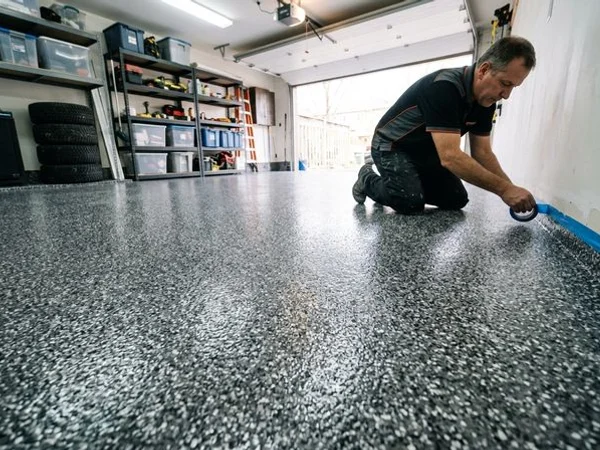
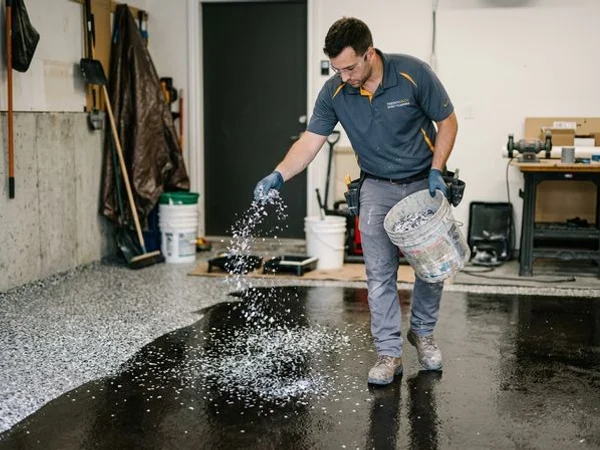
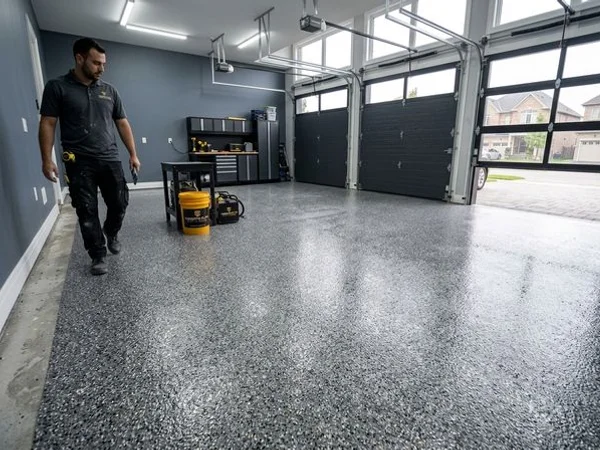
Garage Epoxy Pricing
Quartz flake + polyaspartic topcoat. Final price depends on slab condition.
Why GTA Customers Choose Toronto Elite Epoxy Flooring for Garage Epoxy
Built for Ontario Winters
Polyaspartic topcoats resist road salt, freeze-thaw cycles, and hot tires straight from the driveway.
100% Solid Materials
Commercial-grade zero-VOC epoxy on every job. We never use solvent-based budget products.
Warranty
Backed in writing. If the floor fails from a prep or product issue, we fix it.
Same-Day Free Quotes
On-site assessment of your slab with a transparent per-sq-ft quote, no obligation.
How Garage Epoxy Works
Free On-Site Assessment
We inspect your slab, measure square footage, and quote on the spot - same-day in most of the GTA.
Diamond Grinding Prep
We grind the concrete to a proper surface profile (CSP 3) and fill cracks. No acid etching shortcuts.
Base + Broadcast Flake
100% solid epoxy base coat, broadcast quartz or metallic flake to refusal for grip and depth.
Polyaspartic Topcoat
UV-stable polyaspartic topcoat with anti-slip grit. Ready for use in about 24 hours.
Ready for a Free On-Site Assessment?
Same-day quotes across the GTA. WSIB-certified, $2M liability on every project.
What Customers Say About Our Garage Epoxy
"Had them coat our double-car garage in Leaside - CSP 3 grind, moisture test on the old slab, full vinyl flake broadcast and polyaspartic topcoat. Six months of winter slush and the floor hasn't shown a single mark."
"Triple-car garage with metallic flake - looks like a showroom. Crew was tidy, on time, and the warranty is in writing."
"Old post-war garage with cracks everywhere. They stitched the cracks, prepped properly, and the new flake floor is flawless after two winters."
Garage Epoxy FAQs
How long does garage epoxy last in Toronto?
A properly prepped quartz-flake garage system with a polyaspartic topcoat lasts 10-15+ years in GTA conditions, including winter salt and hot tires. Lifespan depends almost entirely on prep - diamond grinding gives the coating a mechanical bond, while acid etching often leads to peeling within a few years.
Will the floor handle hot tires from my car?
Yes. Hot-tire pickup is one of the most common failure modes for cheap garage coatings. Our polyaspartic topcoat is aliphatic polyurea-based and stays stable under hot tires, road salt, and chemical splashes.
How long does a garage install take?
Most single and double-car garages are done in 1-2 days. Day 1 is diamond grinding, crack repair, and base coat with broadcast flake. Day 2 is the polyaspartic topcoat. You can usually drive on it within 24 hours of the final coat.
Do I need to move everything out of the garage?
Yes, the garage must be fully empty during install so we can grind and coat the entire slab. We'll let you know exactly what's needed during the on-site quote.
What about cracks and oil stains in my existing slab?
Cracks are stitched and filled with polyurea crack filler as part of prep. Oil stains are degreased and ground out. If your slab is severely damaged, we'll cover the substrate repair in the quote so there are no surprises.
What does garage epoxy cost in Toronto?
Quartz-flake garage systems with a polyaspartic topcoat run $6.50-$10 per sq ft, including all prep, materials, and Warranty. A typical 400 sq ft single-car garage is $2,600-$4,000.
Is polyaspartic better than standard epoxy for a Toronto garage?
For a topcoat, yes. Aliphatic polyaspartic cures in 2-4 hours versus 24+ hours for epoxy, handles UV without yellowing, and has a higher Shore D hardness that resists road-salt abrasion through freeze-thaw cycling. We use 100% solid epoxy as the build coat and polyaspartic as the wear layer - the two systems work together rather than competing.
Will calcium chloride road salt damage the coating?
A properly formulated aliphatic polyaspartic topcoat is chemically inert to calcium chloride and sodium chloride at the concentrations used for road de-icing in Ontario. The risk comes from prep failures - if the base coat delaminates at the concrete interface, salt and moisture will migrate under the film and accelerate peeling. Diamond grinding to CSP 3 eliminates that risk.
What warranty do you provide on garage epoxy?
We back every system with a Warranty in writing. The warranty covers delamination, hot-tire pickup failure, and coating defects. It does not cover mechanical damage from impacts or slab heave from pre-existing drainage issues. All warranty terms are reviewed at walk-through before we leave.
Can epoxy be applied over an existing painted or coated garage floor?
No. Any previous coating must be fully ground off before we apply a new system. Applying epoxy over existing paint or a failed coating is the single most common cause of early delamination. Our diamond grinding step removes all prior coatings down to bare concrete.
How soon can I park my car on the new epoxy floor?
Light foot traffic is typically safe after 12-16 hours. Vehicle traffic requires a full 24-hour cure of the polyaspartic topcoat. In cooler weather - below 10 degrees Celsius - we may recommend waiting up to 48 hours before parking a hot vehicle on the surface.
Do you work in the winter months?
Yes, though installation requires a minimum slab and ambient temperature of 10 degrees Celsius. We use heated enclosures for early spring and late fall jobs when needed. If your garage is attached and heated, winter installs are straightforward. We schedule year-round across the GTA.
Related Services
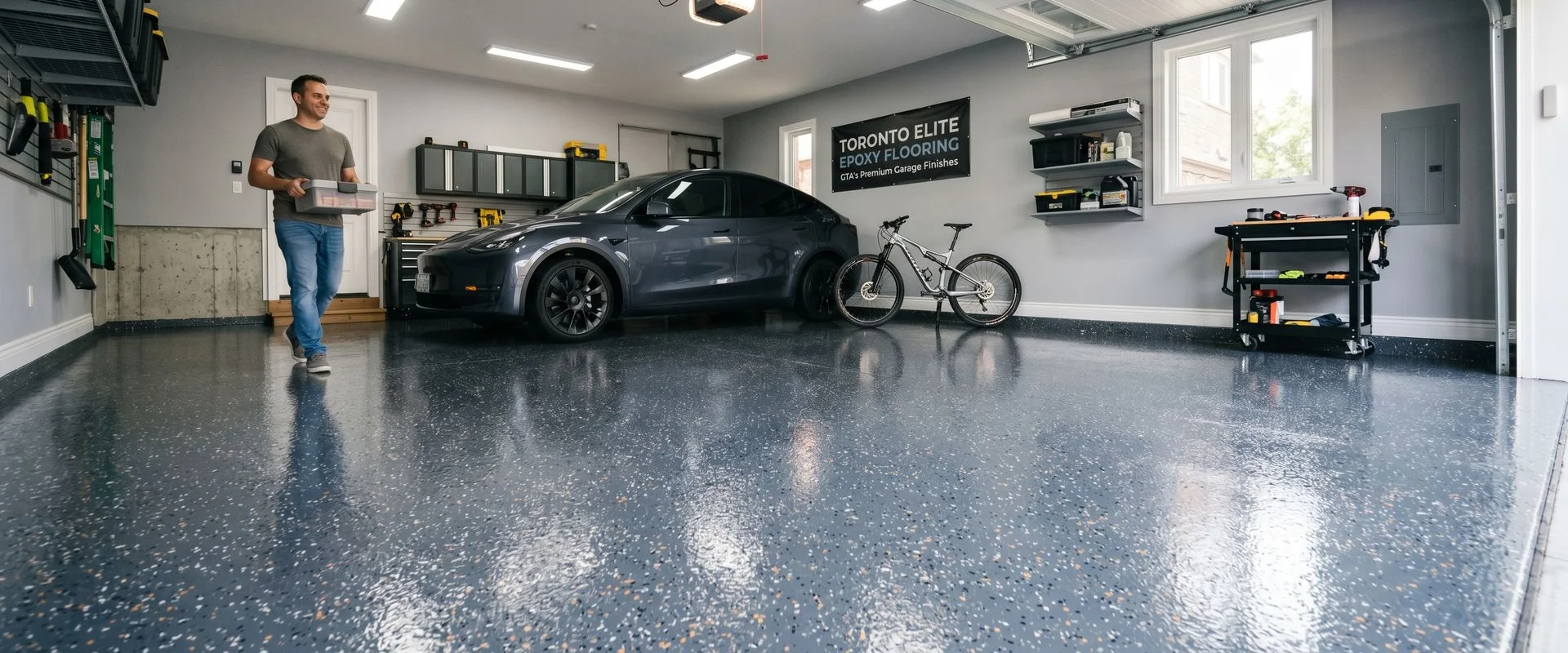
Polyaspartic Floor Coating in Toronto, ON
Fast-cure aliphatic polyaspartic floor coating returns most GTA garages to vehicle traffic within 24 hours - 4x harder than standard epoxy topcoats with full UV stability and cold-weather application down to -20°C. Pricing runs $3.50-$7 per sq ft installed; a standard 2-car garage completes in 1 day. WSIB-certified crews and liability coverage on every GTA install.
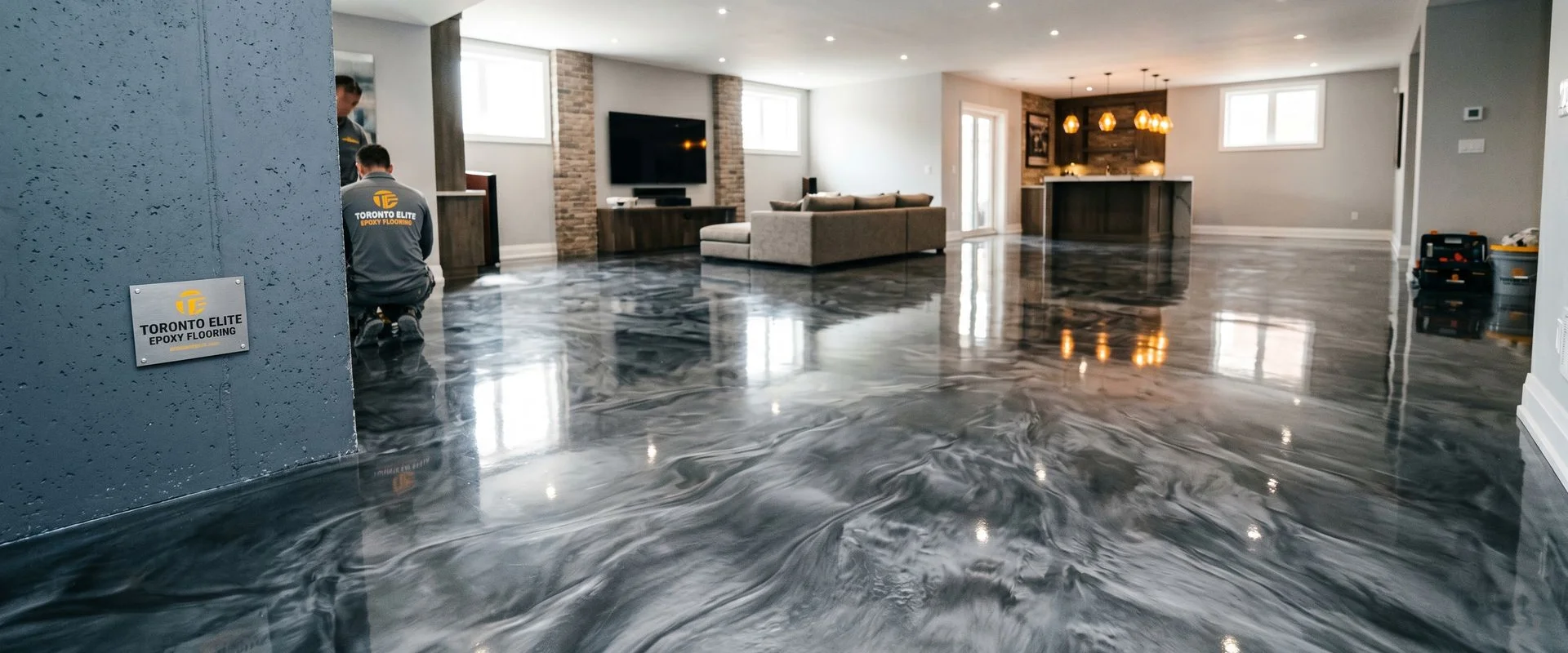
Decorative Metallic Epoxy Flooring in Toronto, ON
Hand-manipulated metallic pigment systems that create a unique 3D liquid-art effect - no two floors identical. Pricing runs $9-$16 per sq ft installed; a 500 sq ft basement or showroom completes in 2-3 days. UV-stable aliphatic polyaspartic topcoat keeps colours vivid under Ontario sun and retail LED lighting for 15+ years.
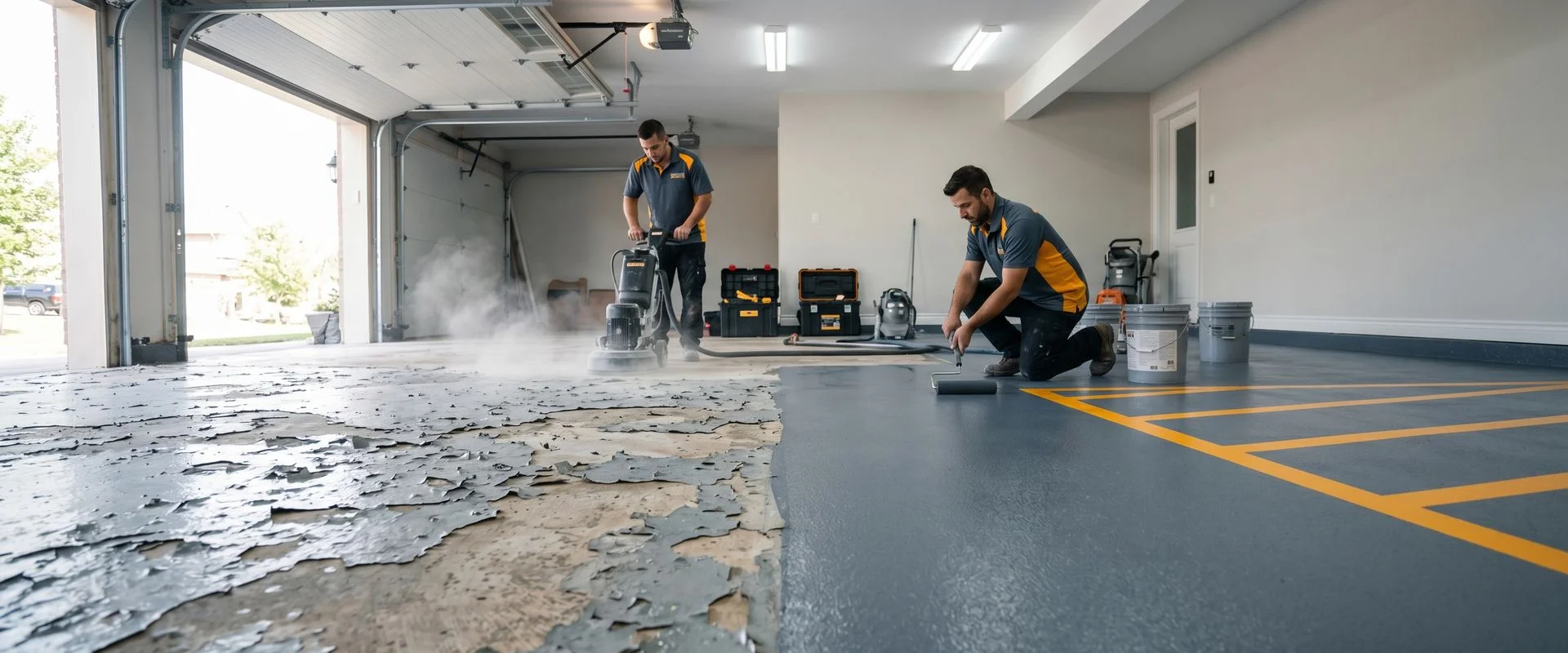
Epoxy Floor Repair & Recoat in Toronto, ON
Full mechanical removal of failed or peeling epoxy back to bare concrete, ASTM F2170 moisture re-testing, and a fresh 100% solid system rated for 10-15+ years on a correctly profiled CSP 3 slab. Full recoat runs $3-$7 per sq ft installed; most GTA garage repairs complete in a 2-day window. We diagnose the root cause first so the new floor doesn't fail the same way.
Ready to Book Garage Epoxy?
Same-day free on-site assessment. WSIB-certified, $2M liability on every project.