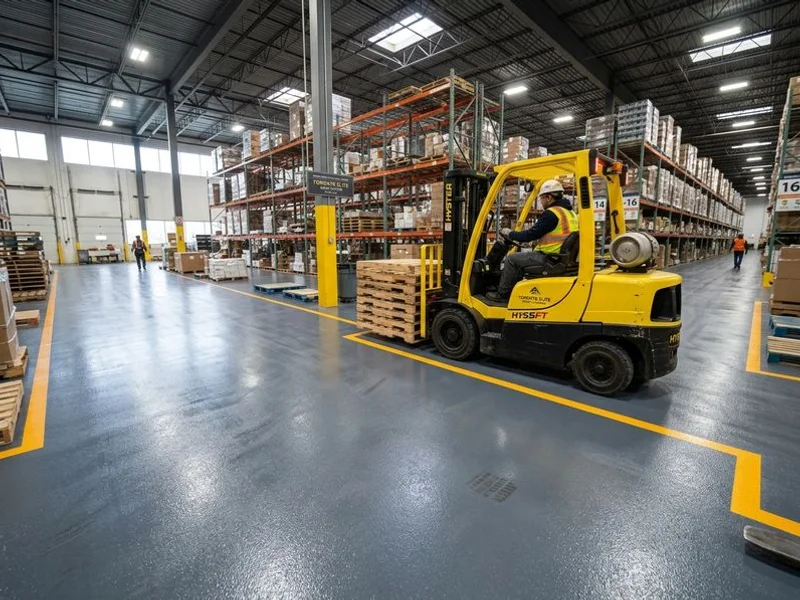
Toronto Elite Epoxy Flooring: Warehouse, Manufacturing, and Chemical-Resistant Floor Systems for Commercial & Industrial
Toronto Elite Epoxy Flooring installs high-build broadcast epoxy, urethane cement, novolac chemical-resistant systems, polyurea floor coatings, secondary containment coatings, and ESD conductive floors for manufacturing plants, distribution warehouses, food processing facilities, automotive service operations, and chemical storage environments throughout Toronto, ON. Every industrial project is specified for the actual loading, chemical exposure, and compliance requirements of the facility - Class 1-3 forklift traffic rating, CFIA food plant seamless surface requirements, TSSA secondary containment compliance, or ANSI/ESD S20.20 for electrostatic discharge control.
Industrial floors carry point loads, chemical exposures, and traffic demands that commercial and residential epoxy systems are not engineered to withstand. Class 3 forklifts operating at 6,000-10,000 kg capacity apply contact pressures of 300+ PSI at the drive-wheel contact patch - a 40-60% solids epoxy with 30-50% volumetric shrinkage during cure cannot maintain adhesion under this shear force at the CSP 2 surface profile typical of inadequately prepared industrial slabs. Industrial floor failure is almost always a surface preparation failure, not a coating failure: the coating peels cleanly off the slab because the laitance layer was never removed. CSP 3 diamond grinding or 1-3 mm shot blasting is the minimum surface preparation for any industrial floor expected to carry forklift and heavy equipment traffic. High-build 80-100 mil total systems (4-6 layers) bridge hairline slab cracking and provide the build depth required for industrial traffic durability - thin 25-30 mil systems appropriate for office and retail cannot tolerate forklift wheel shear.
Industrial epoxy pricing in Toronto ranges from $3 per sq ft for open-plan warehouse systems with shot-blast prep up to $18 per sq ft for novolac chemical-resistant systems with full compliance documentation. Heavy-duty manufacturing floor systems run $5-$10 per sq ft. Urethane cement and wash bay systems run $7-$12 per sq ft. Secondary containment and chemical storage coatings run $10-$18 per sq ft. Projects range from 1,000 sq ft equipment pad installations to 200,000+ sq ft distribution centre floors.
Toronto Elite Epoxy Flooring provides industrial epoxy flooring to Toronto, ON and surrounding Ontario cities, including Mississauga, Brampton, Etobicoke, Scarborough, North York, Vaughan, Oakville, Burlington, Markham, Richmond Hill, Hamilton, Ajax, Pickering, Whitby, and Oshawa.
Industrial Epoxy Flooring in Toronto
Toronto Elite Epoxy Flooring is Toronto’s industrial epoxy flooring contractor, installing high-build broadcast systems, urethane cement, novolac chemical-resistant floors, and secondary containment coatings for manufacturing plants, distribution warehouses, food processing facilities, and chemical storage environments across the GTA. Every industrial project starts with CSP 3 surface preparation - the single step that determines whether your floor holds up under forklift traffic for 15 years or fails in 12 months.
Industrial Epoxy Services We Install
- Commercial & Industrial Epoxy - 80-100 mil high-build broadcast, Class 1-3 forklift rated
- Warehouse Epoxy Flooring - distribution centres, logistics hubs, pallet racking areas
- Secondary Containment Coatings - TSSA, Ontario Reg 675/98, CCME compliant
- ESD Conductive Epoxy - ANSI/ESD S20.20 electronics manufacturing
- Wash Bay & Washdown Epoxy - urethane cement, 82°C hot pressure wash rated
- Automotive Service Bay Epoxy - oil-decontaminated, hoist-pad reinforced
- Cold Storage & Freezer Epoxy - polyurea -40°C cryogenic service
- Commercial Kitchen Epoxy - CFIA food plant seamless surface
- Parking Garage & Hangar Epoxy - ASTM C672, polyurea traffic membrane
How Much Does Industrial Epoxy Cost in Toronto?
Industrial epoxy flooring in Toronto ranges from $3 per sq ft for open-plan warehouse systems to $18 per sq ft for novolac chemical-resistant systems with full compliance documentation. Heavy-duty manufacturing floor systems run $5-$10 per sq ft. Projects range from 1,000 sq ft equipment pad installations to 200,000+ sq ft distribution centre floors.
Key Benefits of Industrial Epoxy Flooring
We install industrial epoxy flooring systems that strengthen, protect, and extend the lifespan of concrete surfaces while keeping workspaces clean and safe. Our coatings meet Ontario’s industrial standards, supporting heavy machinery, chemical exposure, and continuous traffic common in Toronto facilities.
Durability and Longevity
We engineer our epoxy floor coating systems to deliver long-term strength under extreme industrial use. Each installation uses forklift-rated 100% solid epoxy with compressive strength between 3,000 and 6,000 psi. This supports material handling equipment, pallet racking, and constant movement without chipping or delamination.
Our preparation includes CSP 3-5 shot blasting for proper surface profiling, ensuring deep mechanical adhesion and longer performance life. We also use ASTM F2170 moisture testing to verify substrate conditions before coating - reducing premature failure risks caused by trapped moisture that delaminates coatings from below.
Facilities such as warehouses and manufacturing plants in Mississauga and Brampton benefit from this durability. With a typical lifespan exceeding 15 years under Class 2-3 forklift traffic when properly prepared and installed, these floors minimise replacement cycles and reduce overall maintenance budgets.
Chemical and Abrasion Resistance
Many industrial environments in Toronto face chemical exposure from oils, hydraulic fluids, and cleaning agents. Our epoxy coatings and optional urethane topcoats form a seamless barrier that resists corrosive substances and stains, rated under ASTM D1308 for chemical immersion resistance.
We combine epoxy with polyurethane topcoats for superior scratch and abrasion resistance. In automotive, electronics manufacturing, and food processing environments, this hybrid system retains surface integrity after extended exposure to the specific chemicals present in each facility. Where concentrated acids or solvents are involved, novolac epoxy provides the chemical crosslink density that standard bisphenol-A epoxy cannot maintain under long-term immersion.
Easy Maintenance and Hygiene
Our seamless floors simplify daily cleaning and improve hygiene standards. The non-porous epoxy surface prevents absorption of liquids, reducing bacterial growth and surface contamination. Floors can be scrubbed or pressure-washed without damaging the coating.
We design section-by-section installations so operations continue while new areas cure. Compared to tile or bare concrete, epoxy floors eliminate grout lines and concrete dusting. This makes them ideal for distribution centres and logistics facilities in Toronto and Vaughan where uptime and cleanliness are key performance indicators. Regular sweeping and an occasional neutral cleaner retain long-lasting appearance and function.
Enhanced Appearance and Safety
Industrial epoxy flooring improves both safety and presentation. We integrate safety lines, colour-coded zones, and slip-resistant textures to guide vehicle and pedestrian movement in warehouses. Epoxy’s reflective finish increases ambient light distribution and enhances visibility, reducing accident risk during shift operations in large facilities.
For sensitive environments or MHE traffic zones, we add anti-static and chemical-resistant formulations. These reduce hazards linked to electrical discharge near production equipment or spilled lubricants in vehicle aisles. Safety line colours are selected for compliance with Ontario occupational health and safety visibility standards for industrial floor markings.
Advanced Industrial Flooring Solutions in Toronto
We deliver industrial flooring built to perform under heavy machinery, high traffic, and strict safety regulations. Our epoxy and concrete systems combine strength, durability, and compliance with Ontario Building Code standards for industrial occupancy. Every installation follows professional testing and preparation procedures to ensure longevity and efficiency.
Specialised Systems for Heavy-Duty Environments
We apply forklift-rated, 100% solid epoxy coatings with compressive strengths between 3,000 and 6,000 psi. This specification supports continuous MHE traffic common in warehouses and manufacturing plants. Before coating, we conduct ASTM F2170 moisture testing and perform CSP 3-5 shot blasting to manage surface contamination and adhesion challenges.
Each project receives tailored scheduling, including off-hours and section-by-section installations that minimise production downtime. We use chemical-resistant resins that tolerate oils, hydraulic fluids, and industrial cleaners, conforming to the demands of automotive and electronic manufacturing across Etobicoke and Vaughan industrial zones.
Our industrial floor coating cost ranges from $3 to $7 per sq ft installed for standard warehouse systems, up to $18 per sq ft for novolac chemical-resistant systems with compliance documentation. All installations are WSIB-certified with $2M liability coverage.
Polished Concrete for Industrial Facilities
We provide mechanical polished concrete systems that improve both appearance and strength without adding a surface coating layer. Our approach refines the concrete surface through multiple stages of concrete polishing and densification with lithium silicate hardener to achieve a dense, abrasion-resistant finish.
Clients often choose polished floors for low maintenance and reflectivity benefits in low-chemical exposure areas. Polished surfaces resist tire marking and light chemical staining, and the reflectivity improves light distribution in large facilities. In mixed facilities, polished concrete suits low-traffic office and corridor areas while epoxy broadcast systems handle forklift aisles and loading zones in the same project.
Slip Resistance and Safety Features
Maintaining traction and workplace safety is a core requirement in every industrial epoxy installation. We embed silica aggregates or textured topcoats tailored to each workspace, enhancing slip resistance in wet or oil-prone areas. Surface profiles can be adjusted from light texture for pedestrian areas to coarse finishes for vehicle aisles, rated to ASTM D2047 for coefficient of friction compliance.
In addition, we install safety lines, zone markings, and high-visibility borders embedded under the final topcoat - protecting them from forklift wear and chemical cleaning that destroys surface-applied paint within months in active industrial environments.
Commercial Applications and Customisation Options
Our industrial epoxy flooring systems support high-traffic environments while meeting strict safety and performance standards. We build each installation to fit the functional and operational needs of industrial facilities across Toronto, ensuring long wear life and simple maintenance.
Warehouses and Manufacturing Facilities
We install industrial-grade epoxy floor coatings that serve distribution centres, production lines, and automotive facilities with heavy-duty performance. In warehouses, our forklift-rated 100% solid epoxy handles up to 6,000 psi compressive strength and meets Ontario Building Code industrial occupancy requirements. We prepare each floor using CSP 3-5 shot blasting, including areas with heavy contamination from oil or solvents.
In manufacturing plants, chemical-resistant epoxy withstands oils, hydraulic fluids, and strong cleaning agents used in regular maintenance. Facilities using material handling equipment (MHE) benefit from seamless, non-slip surfaces that reduce tire wear and minimise vibration under load. For electronics or automotive industries, we offer anti-static epoxy rated to ANSI/ESD S20.20 and conduct ASTM F2170 moisture testing to ensure long-term adhesion and safety.
Our crews schedule off-hours or section-by-section epoxy floor installation so operations remain active. Pricing typically ranges between $3-$7 per sq ft installed for standard systems, up to $18 per sq ft for specialised chemical-resistant and compliance-documented installations. We maintain full WSIB coverage and $2 million liability insurance for every project.
Customisation: Colours, Finishes, and Safety Markings
We tailor each industrial epoxy project to match operational requirements and facility safety standards. Clients can choose from solid colour, metallic, or decorative flake systems that enhance lighting reflectivity while staying easy to clean. A high-gloss epoxy floor coating improves light distribution in warehouse picking aisles, while a satin or matte finish suits production zones where reduced glare improves operator visibility.
Our team incorporates custom colour zones, line markings, and wayfinding borders to support traffic management and safety compliance. Loading zones, pedestrian lanes, and work cells are colour-coded under the final topcoat for permanent marking that withstands forklift wheel traffic and chemical cleaning.
We use high-performance flooring systems with UV-stable topcoats and slip-resistant aggregates matched to client specifications. Every surface we install combines function, appearance, and regulatory compliance to create a lasting investment for Toronto’s industrial sector.
Professional Installation Process and Quality Standards
We follow a standards-based workflow to ensure each industrial epoxy floor installation in Toronto meets longevity, appearance, and safety expectations. Our focus on preparation, precise application, and efficient scheduling allows us to maintain consistent quality while minimising disruption to client operations.
Surface Preparation and Moisture Mitigation
Proper surface preparation forms the foundation of durable epoxy coatings. We begin every project with a detailed concrete assessment, using diamond grinding or CSP 3-5 shot blasting to remove contaminants and ensure strong adhesion. For heavy-contaminant substrates - oil-soaked machine shop floors, fuel storage areas, automotive facilities - we apply petroleum decontamination pre-treatment before shot blasting to reach uncontaminated concrete.
Moisture testing is critical. Following ASTM F2170 procedures, we measure relative humidity in the concrete slab to prevent delamination and blistering. When readings exceed threshold, we apply moisture mitigation primers before any industrial floor coating. Concrete compressive strength must also meet a minimum of 3,500 psi - we assess this at the site visit and flag any areas requiring repair before coating proceeds.
Epoxy Floor Installation Best Practices
Once surfaces are prepared, we install high-performance flooring systems engineered for durability and safety. Each epoxy coating layer is applied at controlled thickness, with environmental conditions (temperature, humidity) monitored to ensure proper cure. We select from epoxy resin systems, urethane topcoats, and anti-static formulations based on facility requirements, ensuring compliance with Ontario Building Code industrial occupancy standards.
Temperature and humidity control maintain bonding strength, while consistent application techniques minimise variance across large floor areas. We document each installation stage for quality assurance - coating thickness per layer, substrate moisture readings, cure timestamps, and topcoat coefficient of friction test results.
Project Scheduling and Minimal Downtime
Uptime matters for manufacturing and distribution clients. We schedule section-by-section installations or off-hours work to fit production timetables. By segmenting work zones, we reduce interference with active machinery and foot traffic. Coordinated sequencing allows rapid cure times and controlled access for each completed section as the next section begins.
For large facilities (50,000-200,000 sq ft), we produce a written installation schedule mapping each work section, installation date, cure timeline, and traffic access date before the project begins. Clients receive this schedule at project kickoff so production planning can account for each zone’s availability.
Related Questions Toronto Industrial Facility Managers Ask
Why does industrial epoxy fail in some Toronto warehouses and not others?
The most common cause is surface preparation - specifically, applying industrial epoxy over CSP 1-2 surface profiles that do not provide adequate mechanical adhesion for forklift traffic loads. A CSP 2 surface (achievable with light grinding or acid etching) provides adequate bond strength for pedestrian traffic but not for the 300+ PSI contact pressures at Class 3 forklift drive wheels. The second most common cause is moisture - ASTM F2170 testing above 75% RH indicates a substrate that will delaminate standard epoxy through vapour pressure. The third cause is oil contamination that was not removed below the grinding depth, leaving a contaminated layer between the concrete and the primer. All three are preparation failures, not product failures.
What is the difference between shot blasting and diamond grinding for industrial floor preparation, and when is each required?
Diamond grinding is the standard preparation method for clean concrete - new construction, light-duty commercial floors, and concrete without petroleum contamination. It achieves CSP 2-4 depending on tool selection and is appropriate for most warehouse and manufacturing floor projects. Shot blasting is required when the concrete surface has oil, chemical, or mechanical contamination bonded into the pore structure - automotive facilities, machine shops, fuel storage areas, and heavily contaminated food plant floors. Shot blasting removes contaminated surface concrete mechanically without water or chemicals, exposing uncontaminated concrete for epoxy adhesion. For industrial projects with confirmed oil contamination, we apply petroleum decontamination pre-treatment before shot blasting to pull contamination out of the pore structure before mechanical removal.
Can a 200,000 sq ft Mississauga or Brampton distribution centre get an epoxy floor without halting operations?
Yes - this is exactly the application that section-by-section scheduling is designed for. We map the facility’s forklift traffic patterns, picking routes, and dock door usage, then divide the floor into sections that can be isolated from active operations during overnight and weekend shifts. A 200,000 sq ft facility typically installs in 5,000-10,000 sq ft sections over 20-40 overnight shifts, with each section available for forklift traffic 48-72 hours after installation. The written installation schedule mapping each section’s installation date and forklift access date is provided at project kickoff. No shutdown of operations is required for a properly scheduled industrial floor project.
What ASTM standards govern the performance of industrial epoxy flooring in Ontario facilities?
The key ASTM standards for industrial epoxy specification in Ontario facilities are: ASTM F2170 (in-situ concrete RH testing before installation), ASTM D1308 (chemical resistance of organic coatings by immersion), ASTM D4060 (abrasion resistance by Taber abraser), ASTM D2047 (slip resistance of floor surfaces), and ASTM D4259 (surface preparation of concrete). For ESD applications, ANSI/ESD S20.20 governs the system specification and test protocol. For food processing facilities, CFIA RCP 2019 governs seamless surface and coving requirements. We reference the applicable standards in the compliance documentation package provided at project handover.
How do anti-static and ESD conductive epoxy floors differ, and which does a Toronto electronics manufacturing or automotive plant need?
ESD dissipative epoxy (10^6-10^9 ohm surface resistance) provides a controlled slow path to ground that bleeds off electrostatic charges without creating a sudden discharge event - the correct specification for electronics manufacturing, PCB assembly, and server room environments where components are sensitive to static but not at explosive risk. ESD conductive epoxy (under 10^6 ohm) provides faster discharge and is required in environments where static could ignite flammable vapours or detonate explosive materials. For automotive assembly and electronics manufacturing in Markham, Vaughan, and North York, dissipative systems meeting ANSI/ESD S20.20 are the standard. We test installed ESD systems with a calibrated surface resistance meter and provide ANSI/ESD S20.20 compliance documentation at handover.
Industrial Epoxy Pricing
Loading specification, chemical resistance rating, and compliance documentation affect final price.
Why GTA Customers Choose Toronto Elite Epoxy Flooring for Industrial Epoxy
80-100 Mil Build - Not 25-30 Mil
Thin 25-30 mil systems cannot withstand forklift wheel shear. We install 80-100 mil total system builds (4-6 layers) that bridge hairline slab cracking and handle Class 1-3 forklift contact pressures exceeding 300 PSI at the drive-wheel contact patch - the specification industrial facilities actually need.
CSP 3-5 Confirmed Before Any Coat
Most industrial floor failures are surface preparation failures, not coating failures. CSP 2 (from acid etching or inadequate grinding) provides insufficient mechanical adhesion under heavy equipment. We confirm CSP 3 or higher with a profile gauge before any primer goes down. No exceptions.
Shot Blasting for Oil-Contaminated Slabs
Diamond grinding alone cannot remove petroleum contamination bonded into concrete pore structure. Oil-contaminated automotive facilities, machine shops, and fuel storage areas require petroleum decontamination pre-treatment followed by 1-3 mm shot blasting to reach uncontaminated concrete before any epoxy application.
Section-by-Section Off-Hours Scheduling
200,000 sq ft distribution centres cannot close for a week. We map production zones and forklift traffic patterns before scheduling, then install in 5,000-10,000 sq ft sections during overnight and weekend shifts. One section opens as the next begins - operations continue throughout.
How Industrial Epoxy Works
Loading & Chemical Exposure Assessment
Forklift class and axle weight, chemical exposure profile, ASTM F2170 moisture testing, slab condition and compressive strength, and section-by-section scheduling plan mapped to your production timetable.
CSP 3-5 Shot Blasting & Contamination Removal
1-3 mm shot blasting for oil-contaminated substrates, petroleum decontamination pre-treatment where required, HEPA dust collection, surface profile confirmation with CSP gauge before any primer application.
High-Build System Application
Moisture-tolerant primer, 100% solid epoxy base coat, broadcast aggregate or flake, 80-100 mil total build for forklift-rated applications, urethane or polyaspartic topcoat matched to chemical exposure profile.
Safety Marking & Compliance Documentation
Safety line and zone marking installation, adhesion and thickness testing, compliance documentation package (CFIA, TSSA, ANSI/ESD S20.20 as applicable), forklift access timeline confirmed at handover.
Ready for a Free On-Site Assessment?
Same-day quotes across the GTA. WSIB-certified, $2M liability on every project.
What Customers Say About Our Industrial Epoxy
"80,000 sq ft distribution centre in Mississauga - we had forklifts running 24 hours a day and couldn't take any downtime. Toronto Elite mapped our entire production zone and forklift traffic pattern before scheduling started, then installed section-by-section over three weeks of overnight shifts. Every section was handed back on time with the correct cure documentation so our operators knew exactly when each zone was available for traffic. The floor has now been under Class 3 forklift traffic for two years without a single delamination or crack."
"Manufacturing plant in Brampton with hydraulic fluid and industrial cleaner exposure - we had two previous epoxy jobs fail within 18 months from chemical delamination. Toronto Elite pulled out the existing failed coating, ran ASTM F2170 moisture testing, and specified a urethane topcoat over the 100% solid epoxy base for the chemical resistance profile our facility requires. They also documented the ASTM D1308 chemical resistance rating for our insurance file. The system has been in service through our full production cycle with no chemical damage."
"Automotive parts facility in Vaughan - 30 years of oil contamination in the slab. Two previous contractors tried to grind and coat without decontamination and both jobs failed within a year. Toronto Elite ran petroleum decontamination pre-treatment and then shot blasted to CSP 4 to get below the contaminated layer. The moisture test came back above threshold so they applied a moisture-tolerant primer before the base coat. That was three winters ago and the floor still shows zero delamination at any of the drive-wheel zones."
Industrial Epoxy FAQs
What industrial epoxy systems does Toronto Elite Epoxy install?
We install high-build broadcast epoxy (80-100 mil for Class 1-3 forklift traffic), urethane cement (hot washdown, alkaline cleaning environments), novolac chemical-resistant systems, polyurea coatings, secondary containment (TSSA compliant), ESD conductive floors (ANSI/ESD S20.20), and cold storage polyurea systems for manufacturing, warehouse, food processing, and chemical storage facilities throughout Toronto and the GTA.
How much does industrial epoxy flooring cost in Toronto?
Industrial epoxy flooring in Toronto ranges from $3 per sq ft for open-plan warehouse systems to $18 per sq ft for novolac chemical-resistant systems with compliance documentation. Heavy-duty manufacturing floor systems run $5-$10 per sq ft. Urethane cement and washdown-rated systems run $7-$12 per sq ft. Pricing depends on loading specification, chemical resistance rating, surface preparation required, and compliance documentation package.
How thick does industrial epoxy need to be for forklift traffic?
Industrial floors subject to Class 1-3 forklift traffic require 80-100 mil total system build depth (4-6 layers). Thin 25-30 mil systems appropriate for retail and office cannot withstand forklift wheel shear forces. The surface preparation is as critical as the thickness - CSP 3 diamond grinding or shot blasting removes the laitance layer and creates the mechanical bond profile required for adhesion under heavy equipment loading.
What surface preparation is required for industrial epoxy floors?
Industrial epoxy requires CSP 3 diamond grinding or 1-3 mm shot blasting at minimum. CSP 2 surface profiles (typical of acid etching or inadequate grinding) provide insufficient mechanical adhesion for forklift and heavy equipment traffic. The majority of industrial floor failures we see are adhesion failures due to inadequate surface preparation, not coating failures. We confirm surface profile with a CSP gauge before any primer or base coat application. Concrete compressive strength must meet a minimum of 3,500 psi before coating - lower-strength concrete requires repair or reinforcement before the industrial system can be applied.
Can industrial epoxy be installed without shutting down the facility?
Yes. Industrial floor projects are scheduled in section-by-section phases during off-hours, nights, and weekends to keep operations running. Large distribution and manufacturing facilities (20,000-200,000 sq ft) are installed in 5,000-10,000 sq ft sections, typically completing one section per overnight shift. Production schedules and forklift traffic patterns are mapped before scheduling to minimise operational disruption.
How long does industrial epoxy flooring last in Toronto?
High-build industrial epoxy systems with CSP 3 surface preparation last 10-20 years under forklift and heavy equipment traffic. Urethane cement systems in hot washdown and food processing environments last 8-15 years. Chemical-resistant novolac systems in acid and solvent environments last 10-20 years depending on exposure frequency and chemical concentrations. Surface maintenance recoats at 7-10 years on high-traffic areas extend base coat life considerably.
What is the difference between industrial epoxy, polyurethane cement, and polyaspartic for industrial applications?
Industrial epoxy (100% solids, 80-100 mil build) is the standard system for forklift-rated warehouse and manufacturing floors - high compressive strength, chemical resistance, and long-term adhesion under mechanical traffic. Polyurethane cement is the correct system for hot washdown environments (food processing, breweries, chemical plants) where thermal shock from steam cleaning or boiling washdown would crack a rigid epoxy coating - urethane cement flexes with the thermal cycle. Polyaspartic is used as a fast-cure topcoat over epoxy base coats where UV stability and rapid return-to-service are required - it is typically thinner than an industrial epoxy base and should not be used as the primary structural layer in high-traffic applications.
How long does industrial epoxy installation take and when can forklifts return to the floor?
Industrial epoxy floors typically allow light foot traffic within 12-18 hours of the final topcoat. Forklift and heavy equipment traffic can resume after 48-72 hours depending on ambient temperature and product formulation. In temperature-controlled facilities, cure timelines are consistent. In unheated warehouses during Ontario winters, cure time extends - we use heated enclosures when necessary to maintain minimum 10°C slab temperature through the cure cycle. Section-by-section scheduling allows partial reopening as each zone cures while adjacent sections are still being installed.
Which epoxy systems are rated for chemical resistance against oils, solvents, and acids?
Chemical exposure drives system selection. For oils, hydraulic fluids, and industrial cleaners: 100% solid epoxy with urethane topcoat, rated under ASTM D1308 chemical resistance testing. For concentrated acids and strong solvents: novolac epoxy or vinyl ester, with ASTM D1308 immersion test results confirming resistance to the specific chemicals present. Abrasion resistance is rated separately under ASTM D4060 (Taber abraser test). Silica or aluminium oxide aggregate embedded in the topcoat provides slip resistance rated to ASTM D2047. We specify all three ratings at the site assessment based on the actual chemical exposure profile of the facility.
How do finish options affect safety line marking and visibility in industrial facilities?
High-gloss epoxy improves light reflectivity in warehouse and manufacturing spaces, supporting energy efficiency and reducing lighting requirements per unit area. Satin or textured finishes are used in production zones where glare creates visibility problems for operators. Safety lines and pedestrian/vehicle zone markings are embedded under the final topcoat layer - this protects the markings from forklift wear and chemical cleaning that would destroy surface-applied paint within months. Quartz or flake broadcast systems provide abrasion durability and colour variety while concealing wear patterns. Bright contrasting safety line colours are selected for compliance with Ontario occupational health and safety visibility standards for industrial floor markings.
Related Services
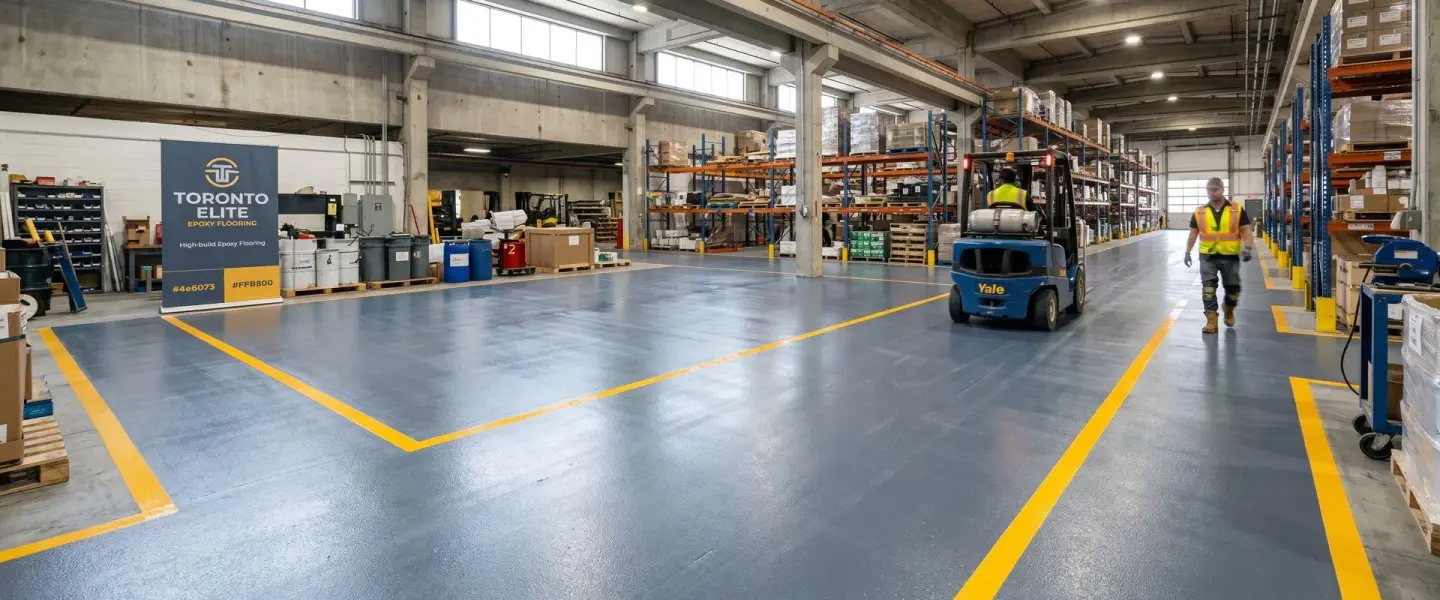
Warehouse Epoxy Flooring in Toronto, ON
Forklift-rated 100% solid epoxy systems with shot-blast prep, chemical-resistant topcoat, and integrated line marking for GTA distribution centres and logistics hubs. Pricing runs $3-$7 per sq ft installed; large warehouse floors complete in off-hours weekend windows with WSIB-certified crews. WSIB-certified crews, liability, and full compliance documentation on every commercial project.
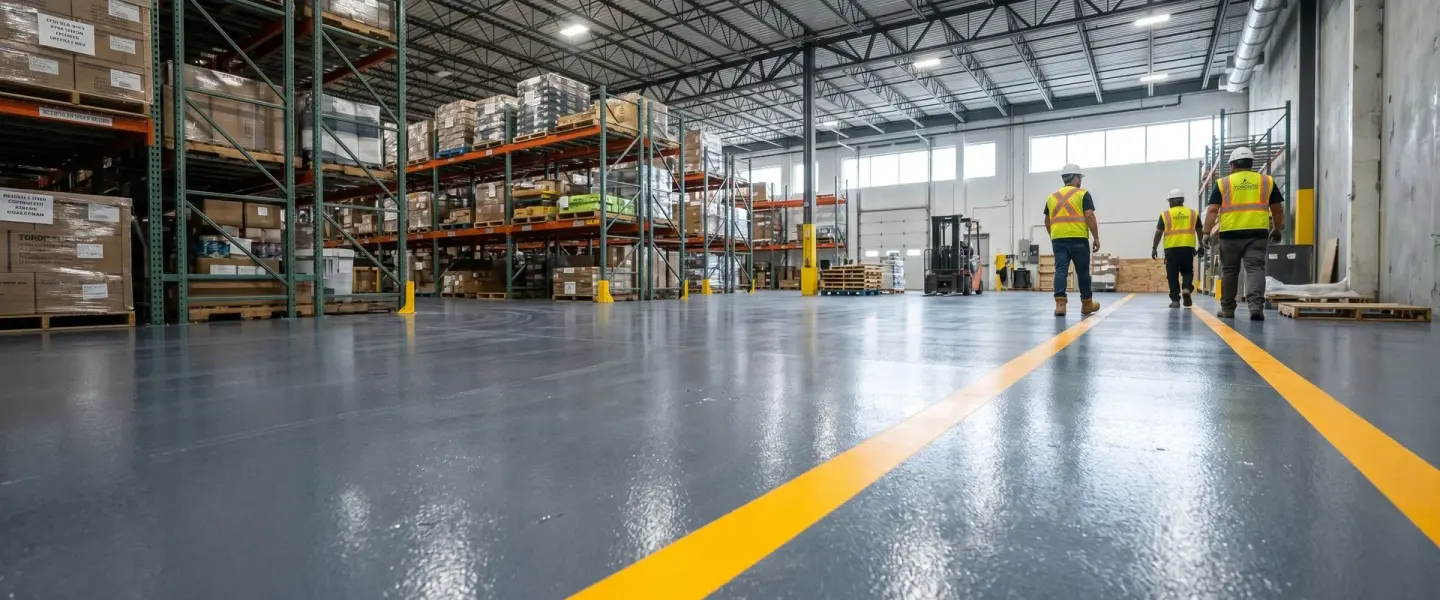
Commercial & Industrial Epoxy Flooring in Toronto, ON
100% solid commercial-grade epoxy systems shot-blast to CSP 3-4 for facilities running forklifts, food production, or 24-hour operations in the GTA. Pricing runs $3.50-$8 per sq ft installed; off-hours scheduling returns your floor before the next shift. WSIB-certified crews, $2M liability, and full compliance documentation on every project.
Automotive Service Bay Epoxy Flooring in Toronto, Ontario
Heavy-duty broadcast epoxy floor systems for automotive service bays, dealership showrooms, oil change facilities, and vehicle repair workshops in the GTA. Oil, fuel, and brake fluid resistant with anti-slip surface texture and lift pad reinforcement. Pricing runs $6-$12 per sq ft installed. Completes in 1-2 days per bay. WSIB-certified, $2M liability coverage.
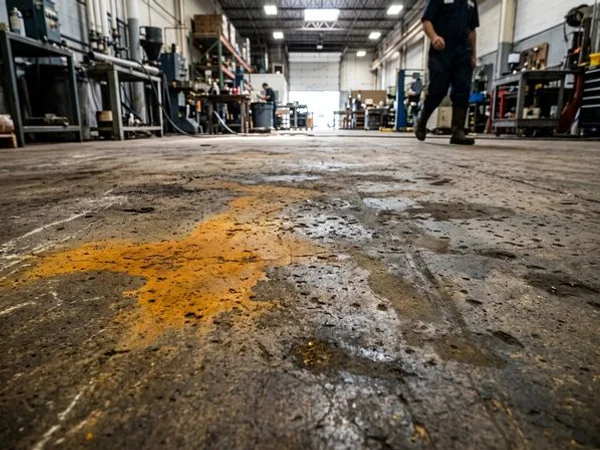
Secondary Containment Coatings in Toronto, Ontario
TSSA-compliant secondary containment coatings for fuel tank berms, chemical storage areas, transformer pads, and industrial spill containment floors in Toronto and the GTA. Novolac and vinyl ester systems rated for concentrated chemical and petroleum immersion. Pricing runs $10-$18 per sq ft installed. WSIB-certified, $2M liability, and full compliance documentation on every project.
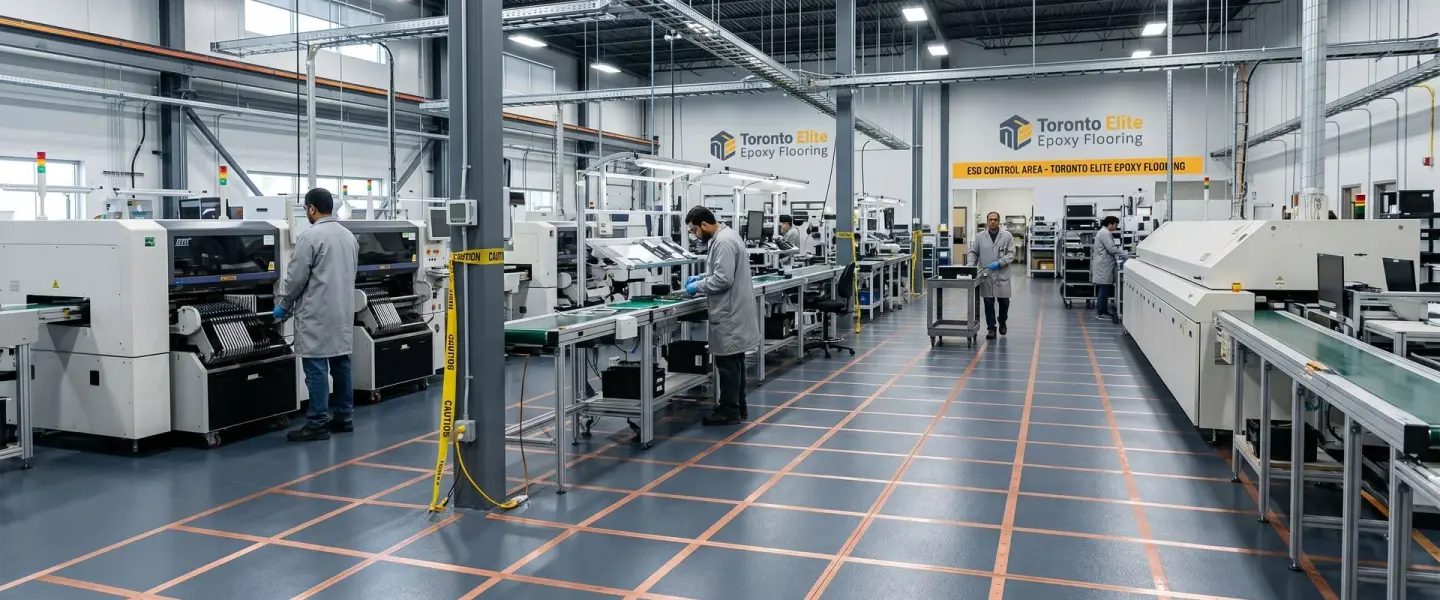
ESD Conductive Epoxy Flooring in Toronto, ON
ANSI/ESD S20.20 certified conductive epoxy with copper grounding grid, verified by megohmmeter to NFPA 99 and EOS/ESD Association STM7.1 standards. Pricing runs $7-$14 per sq ft installed; resistance testing and a full compliance report are included on every GTA install. Used in electronics manufacturing, data centres, and cleanroom environments across Mississauga and Markham.
Ready to Book Industrial Epoxy?
Same-day free on-site assessment. WSIB-certified, $2M liability on every project.