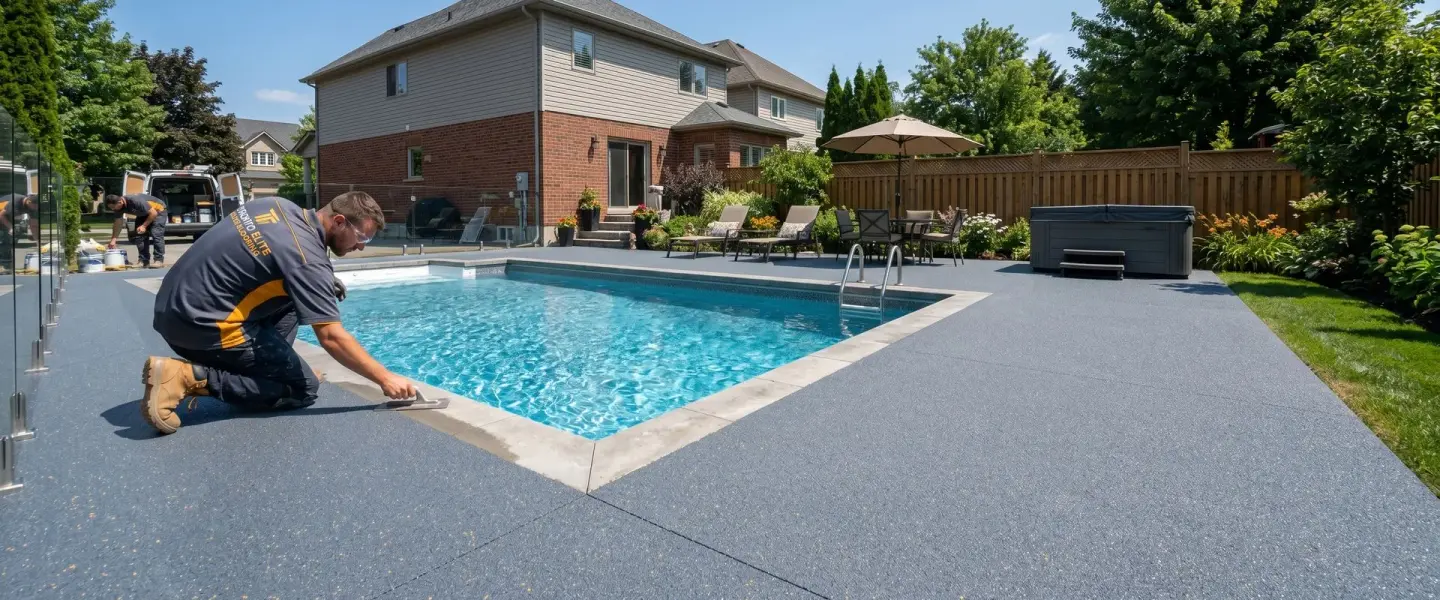
Outdoor Patio Epoxy Coating in Toronto, ON - UV-Stable Exterior Floor Professionals
Toronto Elite Epoxy Flooring installs textured quartz broadcast, pea gravel aggregate, and non-slip polyaspartic systems for residential patios, pool surrounds, walkways, and commercial terraces throughout Toronto, ON. Every outdoor coating uses freeze-thaw rated polyaspartic topcoat chemistry tested to Ontario's -30°C winters, expansion joint sealing to prevent substrate movement cracking, and waterproof base coat application to block moisture intrusion from below.
Outdoor concrete in Ontario faces ASTM C666 freeze-thaw exposure that interior slabs never see. Toronto patios and pool decks experience 50-80 freeze-thaw cycles per winter - standard epoxy becomes brittle below -10°C, developing microcracking that allows moisture intrusion, and once moisture is trapped under the film, the next freeze cycle expands it and delaminates entire sections. Expansion joints must be placed at a maximum 10-foot spacing to manage thermal movement across a 65°C seasonal temperature swing (-30°C winter to +35°C summer), and only aliphatic polyaspartic chemistry rated to -30°C maintains flexibility and adhesion across that full range without cracking.
A standard residential patio or pool deck (200-600 sq ft) completes in 1-2 days. Pricing ranges from $6 to $12 per sq ft installed depending on aggregate broadcast depth, slip-resistance grade, and expansion joint count. Chlorine-resistant and UV-stable chemistry options are available for pool deck applications adjacent to saltwater and standard chlorine systems.
Toronto Elite Epoxy Flooring provides outdoor patio epoxy coatings to Toronto, ON and surrounding Ontario cities, including Etobicoke, Scarborough, North York, Mississauga, Oakville, Vaughan, Brampton, Markham, Richmond Hill, Leaside, and the Beaches.
What is Outdoor & Patio Epoxy?
Outdoor concrete in Ontario goes through more abuse than any other surface - UV in summer, road salt in winter, and the freeze-thaw cycle that opens up cracks and lifts coatings. A standard indoor epoxy will yellow, chalk, and peel in one winter outside.
Our outdoor systems use UV-stable polyaspartic floor coatings over a textured non-slip base. The grit broadcast keeps the surface safe in rain and around pool water, and the sealed topcoat protects against salt and freeze-thaw damage - the same UV-stable chemistry we trust as Toronto’s full-spectrum epoxy flooring contractor.
Pool decks, patios, and walkways across the GTA - sealed properly so spring still looks like fall.
What’s Included
- Diamond-grind surface prep and crack repair
- UV-stable base coat in your chosen colour
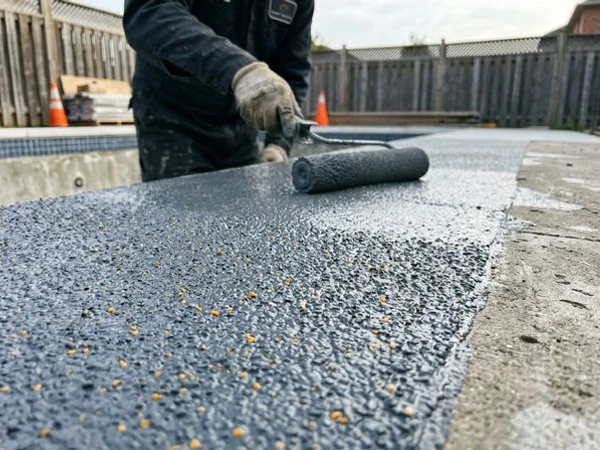
- Non-slip grit broadcast for wet-area safety
- Polyaspartic or urethane weatherproof topcoat
- Cool-surface technology for pool decks
- Sealed perimeter and expansion joint detailing
- Warranty in writing
Will Outdoor Epoxy Survive GTA Freeze-Thaw Winters?
The short answer is yes - but only if the system is specified correctly for Canadian outdoor exposure. Ontario’s climate puts outdoor coatings through roughly 60 to 80 freeze-thaw cycles per year in the GTA, with ground temperatures swinging from -20 C in January to +35 C in July. Standard aromatic epoxy, which is what most big-box DIY kits contain, cannot tolerate that thermal cycling. It chalks in UV and loses adhesion as the concrete substrate contracts and expands beneath it. The result is the peeling, bubbling surface you see on many residential driveways and patios by their second spring.
The materials that actually survive a Toronto winter are aliphatic polyurea and polyaspartic coatings. Both are aliphatic rather than aromatic, meaning the molecular backbone is not degraded by UV radiation. Polyaspartic specifically was developed as a cold-weather coating - it remains pliable at low temperatures rather than becoming brittle, which is critical for adhesion through freeze-thaw cycling. We use polyaspartic as the topcoat on every outdoor system we install, from pool decks in Oakville to patio walkways in Markham.
Prep work is the variable that separates a 10-year coating from one that fails in two seasons. We diamond-grind every outdoor slab to a CSP 3 concrete surface profile (the profile scale is defined by the International Concrete Repair Institute) before any coating is applied. CSP 3 creates the mechanical tooth that allows polyaspartic binders to grip the concrete rather than simply sitting on top of it. Crack and spall repairs are filled with a semi-rigid polyurea filler rather than rigid cementitious patch - rigid patches fail at the patch boundary in freeze-thaw conditions because they expand and contract at a different rate than the surrounding slab. Semi-rigid polyurea moves with the concrete, so the repair stays flush season after season. We also seal all perimeter joints and expansion joints with a flexible joint sealant rated for outdoor exposure, which stops water from migrating under the coating through the edges.
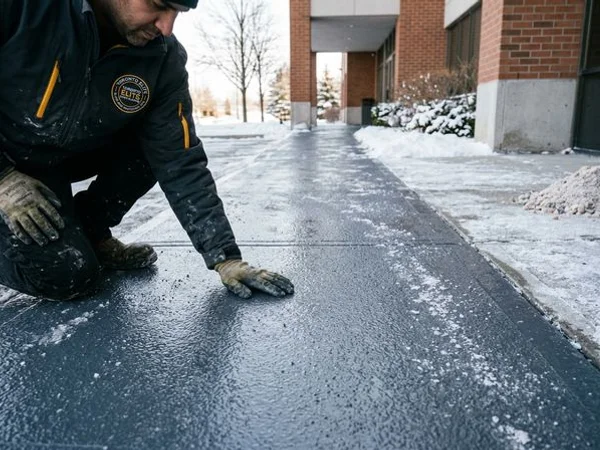
Road salt is the other major threat specific to the GTA. Sodium chloride and calcium chloride applied to driveways and walkways in Etobicoke and Mississauga are highly aggressive to unprotected concrete, accelerating surface spalling by drawing moisture in and out of the slab. Our polyaspartic topcoats are salt-impermeable once cured, forming a physical barrier between the slab and the brine that forms when deicers contact snow. Clients who sealed their pool deck walkways with us three or four years ago are reporting zero spall damage on surfaces that had active scaling before we coated them.
Pool Deck and Patio Coatings: Slip-Resistant Options
Slip resistance on a pool deck is not optional - it is a safety requirement and, in the GTA, a liability issue for any property with a backyard pool. The ASTM D2047 standard defines a minimum static coefficient of friction of 0.5 for a surface to be considered slip-resistant. A smooth, unbroadcast epoxy coating on a wet pool deck typically measures between 0.3 and 0.4, which is below that threshold. Our pool deck systems broadcast a silica or aluminium oxide grit into the topcoat while it is still wet, which raises the measured coefficient of friction to between 0.6 and 0.8 depending on grit size and broadcast density. For families with young children or elderly users, we can specify a coarser grit profile that pushes the reading higher still.
Slip-resistance options are not one-size-fits-all. For residential pool decks in Richmond Hill and Oakville, we most commonly specify a medium broadcast of 60-grit aluminium oxide - aggressive enough to grip a wet foot but fine enough not to abrade bare feet uncomfortably. For commercial pool surround applications, we move to a heavier broadcast or a quartz aggregate system that meets NFPA 101 life safety criteria for wet walking surfaces. In either case, the grit is broadcast into the polyaspartic topcoat, not a separate added layer, so the texture profile is chemically bonded to the surface and cannot be scraped off or worn away the way an applied traction strip would be.
Colour selection for pool decks has a thermal component that most contractors do not address. A dark-coloured pool deck in full summer sun in Mississauga can reach surface temperatures of 55 C to 65 C - hot enough to be painful on bare feet and to accelerate UV degradation of the coating itself. We offer cool-surface colour technology in lighter base tones that reflect infrared radiation rather than absorbing it, keeping surface temperatures 10 C to 15 C lower than a comparable dark deck under identical sun exposure. This is not a special coating product - it is a function of pigment selection. We use infrared-reflective pigments in our light and mid-tone colour mixes so the aesthetic reads as a warm, neutral grey or sandstone rather than a flat white, while still staying significantly cooler underfoot than a charcoal or slate finish.
Budgeting for a pool deck or patio coating in the GTA runs $8 to $14 per sq ft installed for a standard two-coat polyaspartic system with grit broadcast. A 400 sq ft pool deck typically lands between $3,200 and $4,800 depending on the existing slab condition, the number of repairs required, and the colour system chosen. Slabs with significant spalling or previous failed coatings that need full removal are at the upper end of that range because prep labour increases substantially. We quote after a physical site assessment, not over the phone, because outdoor slab condition varies too widely to give a reliable number without seeing the surface.
Driveway Aprons, Walkways, and Entryways: Expanding Beyond the Patio
Pool decks and backyard patios are the most common outdoor coating requests in the GTA, but the same polyaspartic system performs equally well on driveway aprons, front walkways, and covered entryways where foot traffic and weather exposure combine in a concentrated area. Driveway aprons - the concrete pad between the garage door and the public sidewalk - are among the hardest-worn surfaces on a residential property. In Etobicoke and Scarborough, where city road crews apply calcium chloride liberally through January and February, unprotected driveway aprons routinely scale and spall within 10 to 15 years of pouring. A sealed polyaspartic surface stops chloride ion penetration at the film layer and eliminates the freeze-thaw moisture cycling that causes surface scaling.
Front walkways in older Leaside and Rosedale properties present a different set of conditions. The concrete is often post-war construction, narrow, and bordered by mature tree roots that have heaved sections by 10 to 30 mm over several decades. We assess these slabs for grinding tolerances and expansion joint condition before quoting - heaved sections beyond 20 mm typically require self-levelling underlayment or saw-cutting before a flat, continuous coating surface can be achieved. A level, non-slip coated entry walkway also reduces slip-and-fall liability for homeowners, particularly in the November-to-March window when wet leaves and overnight ice make uncoated concrete dangerous.
Covered entryways and porches present a slightly different UV exposure profile than open patios. Under a covered entry, UV exposure is reduced but condensation from temperature differences between the heated interior and the cold exterior can saturate an uncoated slab seasonally. A polyaspartic system with a penetrating epoxy primer seals the slab against condensation-driven moisture cycling and provides a clean, maintainable surface that matches the interior flooring aesthetic at the threshold.
Related Questions Toronto Homeowners Ask
How long does outdoor patio epoxy last on a Toronto-area slab?
A properly installed polyaspartic system on a prepared slab in the GTA should last 10 to 15 years under normal residential foot traffic before the topcoat shows visible wear. The limiting factor is not the coating itself but UV exposure - even aliphatic polyaspartic will show minor gloss reduction after 8 to 10 years of direct southern exposure. When that happens, a single topcoat refresh at roughly $2 to $3 per sq ft restores the finish without stripping the existing system.
What is the difference between polyaspartic and polyurea for outdoor use in Ontario?
Both are aliphatic binders that resist UV and freeze-thaw cycling. Polyurea cures faster - often in 30 to 60 seconds after mixing - which makes it ideal for cold-weather application and for moisture-tolerant primers over damp slabs. Polyaspartic has a longer working time of 20 to 45 minutes depending on temperature, which allows for a more controlled colour coat and grit broadcast on larger surfaces. In practice, we often use a polyurea primer followed by a polyaspartic colour coat and topcoat, using each chemistry where it performs best.
Can outdoor epoxy be applied to a pool deck that slopes for drainage?
Yes - and a proper drainage slope is actually required for a coating to perform well long-term. Standing water on a pool deck that cannot drain will eventually work under any coating at the low point. ICRI guidelines recommend a minimum 1.5 percent slope (roughly 3/16 inch per foot) for outdoor slabs. We assess slope during the site visit and, if drainage is inadequate, flag the issue before coating. In some cases we can build slope into the repair layer using a fast-set cementitious underlayment before grinding and coating.
When is the right time of year to coat an outdoor patio in the GTA?
The ideal installation window is May through September, when ambient temperatures stay consistently above 10 C. Polyaspartic topcoats can technically be applied at temperatures as low as -20 C with the right formulation, which means we can extend the season into early spring and late fall for urgent projects in Etobicoke or Richmond Hill. What we cannot work around is rain or dew on the slab surface at time of application - moisture on the substrate causes adhesion failure regardless of temperature. We monitor the forecast window and book accordingly.
Does outdoor epoxy require a building permit in Toronto or the GTA?
Applying a coating to an existing concrete slab does not require a building permit in Toronto or in the surrounding GTA municipalities including Mississauga and Markham, because it does not alter the structure or footprint of the slab. Permits are only triggered when the slab itself is being poured, replaced, or extended. If you are adding a new pool deck slab as part of a landscaping project, your contractor for that scope will handle the permit; we coat after the slab is cured and passed inspection.
Our Outdoor Epoxy Results in Toronto
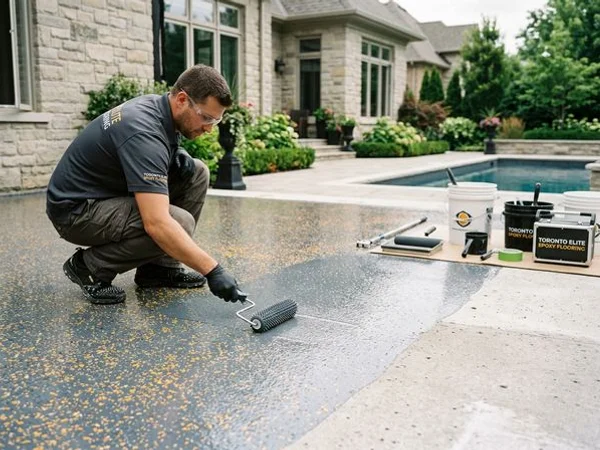
Why GTA Customers Choose Toronto Elite Epoxy Flooring for Outdoor Epoxy
Made for Ontario Winters
Salt-, freeze-thaw-, and UV-resistant. Spring still looks like fall.
Non-Slip for Wet Areas
Broadcast grit makes pool decks and patios safe in rain and around water.
Cool-Surface Options
Light colours and cool-surface tech to keep pool deck temps down in summer.
Warranty
Backed in writing - even outdoor systems.
How Outdoor Epoxy Works
Site Assessment
We check slab condition, exposure, and the sheen and colour you want.
Diamond-Grind Prep
Full prep plus crack and spall repair before the coating system goes down.
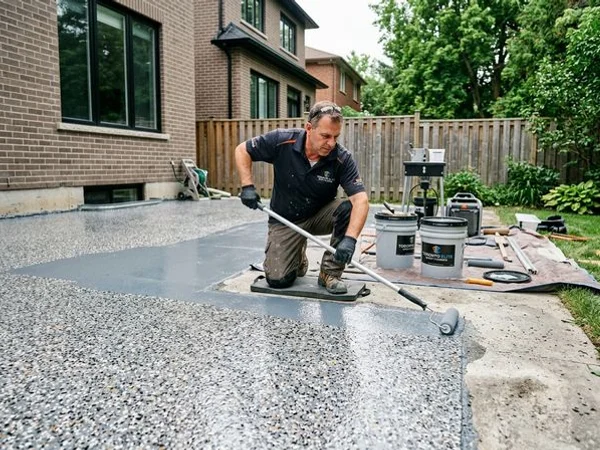
Base + Texture Coat
UV-stable base coat with broadcast grit for non-slip surface.
Weatherproof Sealer
Sealed against freeze-thaw, road salt, and UV. Cool-surface options available.
Ready for a Free On-Site Assessment?
Same-day quotes across the GTA. WSIB-certified, $2M liability on every project.
What Customers Say About Our Outdoor Epoxy
"Had Toronto Elite coat our pool deck in Oakville - diamond grind to CSP 3, 60-grit aluminium oxide broadcast into the polyaspartic topcoat. Three summers in and the surface is still slip-free and hasn't yellowed."
"Our Leaside patio had serious spalling from years of road salt - they filled every spot with semi-rigid polyurea filler before the aliphatic topcoat went down. The Warranty in writing sealed the deal."
"Covered walkway around our pool in Richmond Hill needed a non-slip surface fast - moisture test passed, cool-surface colour coat applied, and foot traffic was safe the same afternoon the polyaspartic topcoat cured."
Outdoor Epoxy FAQs
Will outdoor epoxy survive Ontario winters?
Yes - our outdoor systems are UV-stable and sealed against freeze-thaw cycles and road salt. We seal pool decks before winter every fall for clients across the GTA.
Is it slippery when wet?
No. We broadcast a non-slip grit into the topcoat so the surface stays grippy in rain and around pool water.
Can I get a custom colour?
Yes. We mix solid colours, flake broadcast, and cool-surface options for pool decks. Sample boards during the quote.
What does outdoor epoxy cost?
Custom-quoted after a site visit because slab condition and exposure vary widely outdoors. We'll quote on the spot during the assessment.
Best time of year to install outdoor epoxy in Toronto?
Late spring through early fall, when ambient temps are consistently above 10 degrees C. We can schedule earlier or later with polyaspartic topcoats.
How does outdoor epoxy differ from indoor epoxy systems?
Outdoor systems use aliphatic polyurea or polyaspartic chemistry rather than standard aromatic epoxy. Aromatic epoxy will yellow and chalk within a single Toronto summer from UV exposure. Aliphatic binders are UV-stable by molecular design, which is why every outdoor system we specify uses them as the topcoat.
What concrete surface profile is required before applying outdoor coatings?
We target a CSP 3 profile (concrete surface profile per ICRI guidelines), achieved by diamond grinding rather than acid etching. CSP 3 gives the mechanical tooth needed for polyaspartic topcoats to bond reliably through Ontario freeze-thaw cycling. Acid etching alone only reaches CSP 1 to 2, which is insufficient for outdoor exposure.
Does outdoor epoxy need a vapour barrier on a pool deck slab?
Pool deck slabs are typically above-grade and drain freely, so vapour barrier membranes are less critical than in basement applications. However, we always test moisture content with a calcium chloride test (ASTM F1869) before coating. If readings exceed 5 lbs per 1,000 sq ft per 24 hours, we apply a moisture-tolerant polyurea primer before the colour coat.
How long does an outdoor patio epoxy installation take?
A standard patio or pool deck up to 600 sq ft takes two days - day one for grinding, crack repair, and primer, day two for colour coat and polyaspartic topcoat. The polyaspartic topcoat reaches foot traffic in 4 to 6 hours, so you can use the space the same day the final coat goes down.
What warranty comes with outdoor epoxy and what does it exclude?
Our outdoor systems carry a Warranty on adhesion failure and delamination. The warranty excludes damage from standing water that is not drained within 72 hours, physical impact from sharp objects, and coating applied over slabs with active structural movement. We inspect the slab before quoting and flag any conditions that could void coverage.
Can outdoor epoxy be applied over existing pavers or interlock?
No - we coat concrete slabs only. Pavers and interlock move independently at each joint, and a coating bridging those joints will crack within one freeze-thaw season. If you have a paver patio and want a seamless coated surface, the pavers need to come up and a concrete slab needs to be poured first.
How does the cost of outdoor epoxy compare to concrete resurfacing or stamped concrete?
A polyaspartic outdoor system typically runs $8 to $14 per sq ft installed, depending on slab condition and colour complexity. Stamped concrete overlays are similar in price but require resealing every 2 to 3 years and are more susceptible to freeze-thaw delamination. A polyaspartic coating, properly installed on a prepared slab, needs no resealing for 10 or more years under normal residential use.
Ready to Book Outdoor Epoxy?
Same-day free on-site assessment. WSIB-certified, $2M liability on every project.