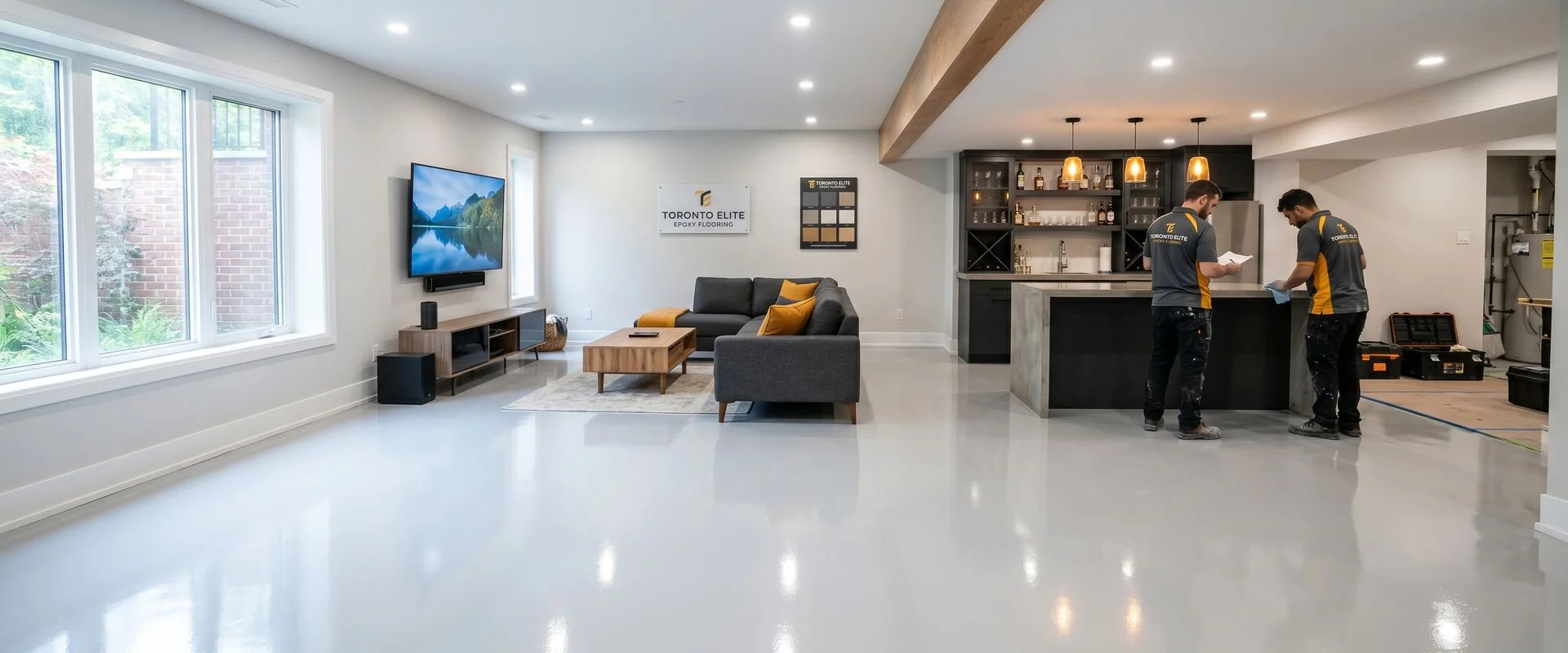
Basement Epoxy Flooring in Toronto, ON - Moisture-Proof Systems for Below-Grade Slabs
Toronto Elite Epoxy Flooring installs moisture-tested, vapour-barrier-primed epoxy systems for residential basements, home gyms, rec rooms, laundry rooms, and below-grade commercial spaces throughout Toronto, ON. Every basement install starts with ASTM F2170 concrete moisture testing, a penetrating epoxy primer sealed against hydrostatic vapour, and a decorative broadcast or solid-colour topcoat rated for below-grade humidity.
Basement slabs in Toronto present a vapour challenge that above-grade floors do not. ASTM F2170 in-situ RH testing consistently shows below-grade slabs at 75-95% relative humidity in older Toronto neighbourhoods like the Annex, Riverdale, and East York - above the 75% threshold where standard epoxy adhesion fails. Hydrostatic pressure from clay-heavy Ontario soil forces moisture vapour through the slab at rates exceeding 10 lbs per 1,000 sq ft per 24 hours on pre-war concrete. A penetrating moisture-tolerant epoxy primer, not a standard DPM paint-on coating, is the only product rated to bond permanently at those vapour emission levels.
A standard 600-900 sq ft basement completes in 1-2 days; full-home basement systems run 2-3 days. Pricing ranges from $4.50 to $10 per sq ft installed depending on moisture mitigation requirements, broadcast pattern, and wall coving depth. Pre-war Toronto homes with original concrete slabs receive a dedicated moisture assessment before any pricing is confirmed.
Toronto Elite Epoxy Flooring provides basement epoxy flooring to Toronto, ON and surrounding Ontario cities, including Etobicoke, Scarborough, North York, Mississauga, Oakville, Vaughan, Brampton, Markham, Richmond Hill, Leaside, East York, and the Annex.
Why Basement Floors in Toronto Are Tricky
Toronto basements have a moisture problem most homeowners don’t see until a floor fails. Vapour drive pushes water vapour up through the concrete slab constantly, and if a coating is installed without testing for it, that moisture pressure lifts the floor from below. The result is bubbling, delamination, and a floor that looks worse than bare concrete within a few years.
Standard tile, laminate, and vinyl plank have the same problem. Grout lines trap moisture and mould. Floating floors swell and buckle when humidity rises. A properly installed basement epoxy, with ASTM F2170 testing and a built-in vapour barrier, solves the moisture issue at the source. As Toronto’s full-spectrum epoxy flooring contractor, we moisture-test every basement slab before a single coat goes down, and finish many of them with a decorative metallic finish for a high-end rec-room look.
What is Basement Epoxy Flooring?
Basement epoxy is a seamless coating system designed for below-grade concrete, where vapour drive, the process of moisture pushing up through the slab, is the main reason cheap floors fail. Our system starts with ASTM F2170 relative-humidity testing, then installs a moisture mitigation primer or a full vapour barrier based on those readings.
Once the substrate is sealed, we apply a 100% solid zero-VOC epoxy base coat in your chosen colour, seamlessly to the slab edges and around any plumbing or columns. A clear protective topcoat seals the floor against everyday wear, pet claws, and rec-room traffic.
The result is a single continuous surface with no tile grout lines to harbour mould and no carpet to hold dampness. It’s pet-friendly, easy to clean, and built to last in Toronto basements where the alternative is constant moisture issues.
What Every Basement Epoxy Install Includes
Every basement install includes:
- Free same-day on-site assessment with sample boards
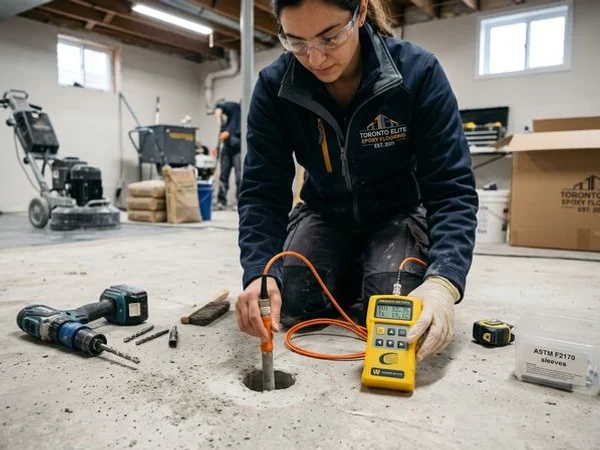
- 72-hour ASTM F2170 moisture vapour testing
- Diamond grinding and crack repair as needed
- Moisture mitigation primer or vapour barrier when readings require it
- 100% solid zero-VOC epoxy base coat in your chosen colour
- Optional flake broadcast or 3D metallic layering
- Clear protective topcoat for cleaning and traffic durability
- Detailed work around plumbing, columns, and stair edges
- Warranty in writing
Is Epoxy Good for Damp Toronto Basements? Moisture and Vapour
Toronto’s below-grade environment is more aggressive than most homeowners expect. The city sits on a mix of clay-heavy glacial till and sedimentary bedrock, and that soil holds water through the spring thaw cycle from roughly March through May. Ground moisture migrates laterally and upward through older poured-concrete slabs, particularly in pre-1980 homes in neighbourhoods like Riverdale and Leslieville where the slabs were not poured over a polyethylene vapour barrier. The result is persistent, invisible vapour pressure that can exceed 15 lbs per 1,000 sq ft per 24 hours on a bad day - well above the 3 lb threshold at which most standard epoxies begin to fail.
A properly specified basement epoxy system addresses vapour drive at two points. First, a moisture mitigation primer - typically a two-component polyurea or epoxy-moisture-tolerant formulation - bonds to damp concrete at the chemical level and creates a low-permeance layer between slab and finish coat. Second, a 100% solids epoxy base coat, applied at a minimum 8 mils dry film thickness, adds a physical vapour retarder on top of that primer. Together, these layers reduce vapour transmission to levels below what causes delamination or blistering.
Homes in East York and Etobicoke with 1960s-era slabs routinely show ASTM F2170 relative-humidity readings between 80% and 95% RH during spring. Above 75% RH, standard epoxy without mitigation will fail within two to three years. Above 90% RH, even a standard mitigation primer may not be enough, and a full reactive polyurea vapour barrier becomes necessary before any decorative coating goes down. This is why the 72-hour probe test is not optional - it determines which system the slab actually needs.
Why Moisture Vapour Testing (ASTM F2170) Matters Before Install
ASTM F2170 is the current standard for measuring in-situ relative humidity inside a concrete slab. Unlike older calcium chloride (ASTM F1869) tests, which only measure surface emission rates, F2170 probes are inserted into holes drilled 40% of the way through the slab depth and sealed for a minimum of 72 hours. This captures the actual humidity condition inside the concrete mass - the number that predicts long-term vapour drive under a sealed coating.
The practical implication for Toronto basement flooring is significant. A slab that passes a calcium chloride test in January may register 88% RH on an F2170 probe in April after snowmelt has saturated the surrounding soil. Contractors who skip the 72-hour wait or use the older surface-only test will often pass a slab that is genuinely too wet to coat. The delamination typically appears 12 to 24 months later, after the first summer heating cycle drives vapour pressure to its seasonal peak. Many Leaside and Etobicoke homeowners who have called us to re-coat a failed floor have noted the previous contractor never drilled a hole in their slab.
Beyond the diagnostic value, the written F2170 test record also matters for warranty purposes. A documented pre-installation reading gives both the homeowner and the installer a baseline against which any future performance question can be evaluated. Our test results are included with every project file so the data is available if the floor is ever re-sold or refinished.
Is Basement Epoxy Pet-Friendly and Safe to Walk On?
The short answer is yes, once cured. The longer answer depends on which system is installed and when re-entry happens. A 100% solids epoxy base coat reaches functional cure - the point at which it is safe for foot traffic and pet contact - within 12 to 18 hours at 20 degrees Celsius. A polyaspartic or aliphatic polyurea topcoat, which is what we use as the final layer on basement systems, reaches full hardness in 4 to 6 hours at room temperature. The combination means a basement floor coated on a Tuesday morning is typically walkable by Tuesday evening.
The zero-VOC specification matters in a below-grade environment. Standard solvent-based epoxies off-gas volatile organic compounds during the curing phase, and basements have less natural air exchange than above-grade floors. A 100% solids system has no solvent carrier to off-gas, which is why it is appropriate for occupied homes with kids and pets. Once fully cured, the surface is chemically inert and non-porous - there is nothing for pet dander, bacteria, or allergens to bind to.
For homes with large dogs, the topcoat selection matters for scratch resistance. Aliphatic polyurea topcoats are significantly harder than standard clear epoxy topcoats, rating above 80 on the Shore D scale. This matters for high-traffic rec rooms in busy Leslieville and Riverdale households where the floor sees daily use from dogs, kids’ toys, and rolling furniture. We specify aliphatic polyurea as our standard topcoat on all basement systems rather than treating it as an upgrade.
Best Basement Floor Finishes Compared: Epoxy vs Vinyl vs Tile
Luxury vinyl plank (LVP) is the most common alternative Toronto homeowners consider for basements. It is a floating floor, meaning it is not bonded to the concrete substrate. This creates an air gap where vapour drive continues to act on the underside of the planks. In a below-grade space with measured RH above 60% at the slab surface, LVP will swell at the joints over time, particularly along north-facing walls in homes in East York where seasonal soil moisture is highest. Many LVP manufacturers void their warranty if the slab exceeds a certain moisture emission rate, and those rates are routinely exceeded in Toronto’s older housing stock without any intervention.
Ceramic and porcelain tile bonded with a polymer-modified thin-set creates a more rigid assembly than LVP, but grout lines remain the weak point. Grout is porous and will absorb vapour and harbour mould colonies over time in a consistently damp environment. Epoxy grout reduces this risk but adds installation complexity and cost, bringing the total installed price for tile to $12 to $18 per sq ft in Toronto - well above the $4.50 to $10 per sq ft range for a full basement epoxy system.
Polished concrete is an alternative worth noting. A Class B grind and polish (Concrete Polishing Association of America level 3) produces a low-maintenance surface, but polishing does not add any vapour barrier. Polished concrete over a high-RH slab will eventually show efflorescence - white salt deposits - as vapour carries dissolved minerals to the surface. Epoxy with moisture mitigation is the only common basement flooring option that actively addresses vapour drive rather than ignoring it.
Basement Epoxy Flooring Cost in Toronto per Sq Ft
Toronto basement epoxy pricing varies primarily by system complexity and slab condition. A standard two-coat system - moisture mitigation primer plus a solid-colour 100% solids epoxy base with a clear polyaspartic topcoat - runs $4.50 to $6.00 per sq ft installed. This covers slabs with ASTM F2170 readings under 75% RH that need only the primer for mitigation.
Slabs above 75% RH require a reactive polyurea vapour barrier coat as an additional layer before the decorative system. This adds $0.75 to $1.25 per sq ft depending on the specific product used and the measured vapour emission rate. For most Etobicoke and East York basements tested in spring, this brings the working total to $5.25 to $7.25 per sq ft.
Decorative upgrades move pricing into the $7 to $10 per sq ft range. Full-flake broadcast systems, where vinyl colour chips are broadcast to full coverage before the topcoat is applied, add texture and visual depth and are the most popular choice for basement gyms. Metallic pigment systems using a two-part aliphatic polyurea pigmented topcoat - often specified as Gunmetal, Copper, or Pearl White in Leaside and Riverdale renovations - run $8.50 to $10 per sq ft installed. Substrate repairs, including crack routing and filling with polyurea crack filler and grinding down high spots, are quoted on assessment but typically add $0.50 to $2.00 per sq ft for slabs in poor condition.
Epoxy vs Waterproofing: What a Wet Basement Actually Needs
Basement epoxy and basement waterproofing solve different problems, and conflating them is one of the most common mistakes in Toronto renovation planning. Epoxy addresses vapour drive - the diffusion of moisture vapour up through an otherwise structurally sound slab. Interior waterproofing systems, such as a French drain with a sump pump, address hydrostatic pressure - the physical force of groundwater accumulating against the foundation wall or under the slab.
If a Toronto basement has active water intrusion through wall cracks, window wells, or floor-wall joints, that water source needs to be addressed before any floor coating is installed. Applying epoxy over active water infiltration will result in delamination within months, not years. A reputable contractor will identify active infiltration during the on-site assessment and recommend the appropriate remediation - typically an interior drainage system or exterior membrane repair - before proceeding with flooring.
For basements with no active water entry but consistently high vapour readings - which describes the majority of older homes in Etobicoke and East York - epoxy with a reactive polyurea vapour barrier is the correct intervention. The polyurea layer bonds to the concrete and creates a low-permeance membrane that holds back vapour pressure without needing to drain or redirect water. This is a different mechanism than a sump pump, and it is what most Toronto basements actually need. A Toronto epoxy flooring contractor’s first job is to diagnose which condition is present before recommending a product.
Related Questions Toronto Homeowners Ask
How much does basement epoxy cost for a 1,000 sq ft basement in Toronto?
A 1,000 sq ft basement with a standard moisture mitigation primer and solid-colour epoxy system runs approximately $4,500 to $6,000 installed in the Toronto area. If the slab tests above 75% RH on the ASTM F2170 probe - common in East York and Etobicoke in spring - add $750 to $1,250 for the reactive polyurea vapour barrier layer. Decorative flake or metallic finishes bring the total to $7,000 to $10,000 for the same footprint.
How long does basement epoxy take from start to finish?
Elapsed time is typically 5 to 7 days. The 72-hour ASTM F2170 moisture test accounts for the majority of that window. Active prep and coating work takes 1 to 2 days for a standard basement. The floor is walkable within 12 to 18 hours of the final coat and ready for furniture and heavy use within 48 to 72 hours.
Will basement epoxy crack if the slab moves?
Concrete slabs settle and experience minor thermal movement year-round, particularly in Toronto’s freeze-thaw climate. A 100% solids epoxy system has very low flexibility and will telegraph a crack that opens after installation. For basements with existing crack movement, we route and fill cracks with a semi-rigid polyurea crack filler before coating, which bridges minor future movement. Cracks wider than 3 mm or showing differential settlement on either side indicate a structural issue that needs assessment before flooring is installed.
Can basement epoxy be installed in winter in Toronto?
Yes, with conditions. Concrete and epoxy chemistry both require a minimum substrate temperature of 10 degrees Celsius for proper adhesion and cure. An unheated Toronto basement in January may fall below this threshold. We require the space to be heated to at least 15 degrees Celsius for 48 hours before prep begins, and maintained at that temperature through cure. Most occupied homes already meet this requirement. Unfinished basements in vacant properties may need temporary heating, which adds to project logistics but does not change the system specification.
What is the lifespan of a basement epoxy floor in a Toronto home?
A correctly installed basement epoxy system - meaning one installed over an F2170-tested slab with appropriate vapour mitigation - should remain in good condition for 15 to 20 years or more under normal residential use. The topcoat may show wear in high-traffic zones before the base coat does. Re-topcoating, typically at $1.50 to $2.50 per sq ft, can refresh the surface without replacing the full system. The longest-lived failures we have seen are floors installed without moisture testing that delaminate within 3 years - the system lifespan is almost entirely a function of prep quality, not the coating brand.
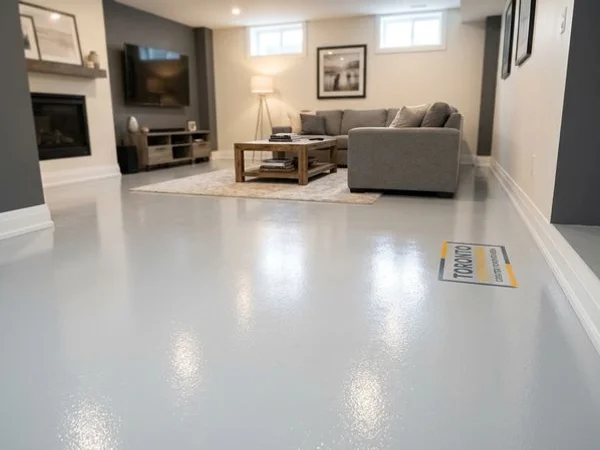
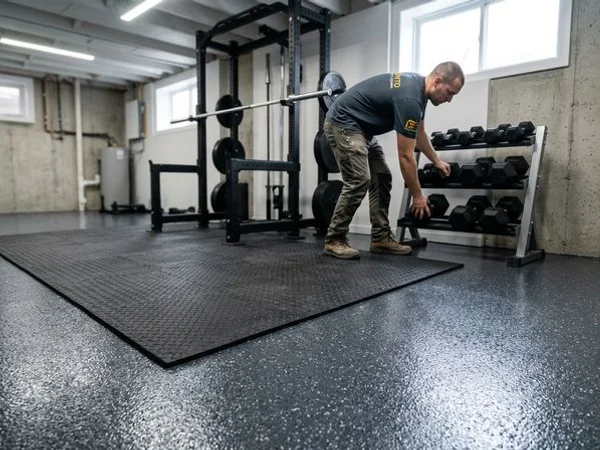
Our Basement Epoxy Results in Toronto
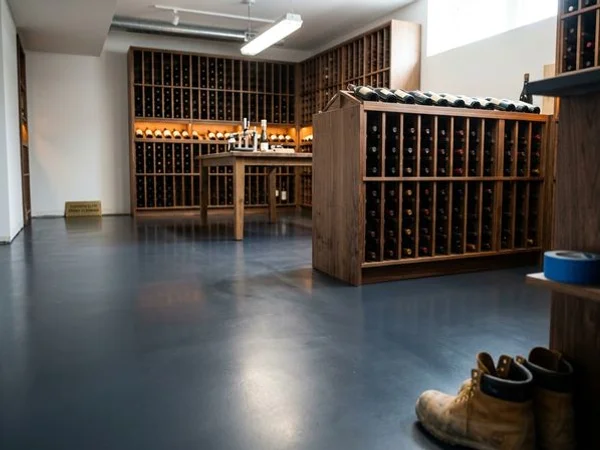
Basement Epoxy Pricing
Includes ASTM F2170 moisture testing, vapour barrier where needed, and seamless finish.
Why GTA Customers Choose Toronto Elite Epoxy Flooring for Basement Epoxy
Moisture-Tested First
Concrete vapour drive is the #1 cause of failed basement floors. We test before we coat, every time.
Zero-VOC, Pet-Safe
Living-space safe materials with no harsh fumes. Safe for kids and pets once cured.
Seamless Finish
No tile joints to harbour mould or hold water. Easier to clean and visually open.
Warranty
Backed in writing because we control the prep and the material.
How Basement Epoxy Works
Moisture Vapour Testing
ASTM F2170 relative-humidity probes go in your slab for 72 hours so we know exactly what mitigation is required.
Prep & Vapour Barrier
Diamond grind, crack repair, and a moisture mitigation primer or vapour barrier where the test results call for it.
Seamless Base Coat
100% solid zero-VOC epoxy base in your chosen colour, applied seamlessly to the slab edges and around obstructions.
Clear Protective Topcoat
Clear topcoat sealed for easy cleaning, pet claws, and rec-room traffic. Ready for furniture in 24-48 hours.
Ready for a Free On-Site Assessment?
Same-day quotes across the GTA. WSIB-certified, $2M liability on every project.
What Customers Say About Our Basement Epoxy
"Slab in our Etobicoke bungalow tested at 88% RH - they installed a full reactive polyurea vapour barrier before the zero-VOC epoxy base coat. Floor has been bone dry through two spring thaws."
"Basement gym floor turned out incredible. Seamless, easy to clean, and the kids and dog love it."
"Had the rec room in our Joshua Creek home done with a Gunmetal metallic finish - ASTM F2170 tested first, Warranty backed in writing. Looks like something out of a magazine."
Basement Epoxy FAQs
Why do you moisture-test before installing basement epoxy?
Concrete vapour drive is the leading cause of bubbling and delamination in basement epoxy floors. We run ASTM F2170 relative-humidity testing on every slab and apply a moisture mitigation primer or vapour barrier when the readings call for it. Skipping this step is why other contractors' floors fail in 2-3 years.
Is basement epoxy safe for kids and pets?
Yes. We use 100% solid, zero-VOC materials safe for living spaces once cured. Seamless surfaces are easier to clean than tile (no grout lines for bacteria) and don't catch pet claws.
Can epoxy fix a damp basement?
Epoxy with a proper vapour barrier prevents moisture from coming up through the slab and damaging the floor finish. It is not a foundation waterproofing solution. If you have wall leaks or hydrostatic issues, those need separate remediation.
What does basement epoxy cost in Toronto?
Standard basement epoxy runs $4.50-$7 per sq ft. Decorative flake or metallic finishes are higher, typically $7-$10 per sq ft. Pricing includes moisture testing and vapour mitigation where required.
How long does the install take?
Including the 72-hour moisture-test wait, most basements are done in about a week of elapsed time. Active work is usually 2-3 days. We schedule around your household's routine.
Can I have a custom colour?
Yes. We mix solid colours, add flake broadcast for texture, or do 3D metallic patterns. We bring sample boards to the on-site quote so you can pick on real materials.
What is the warranty on a basement epoxy floor?
We provide a Warranty in writing. The warranty covers delamination, peeling, and bubbling - the failure modes that result from poor prep or skipped moisture testing. Because we control both the prep and the materials, we can stand behind it fully.
How does basement epoxy compare to luxury vinyl plank (LVP) for Toronto basements?
LVP is a floating floor, which means it sits on top of the slab rather than bonding to it. Vapour drive can still push moisture up under the planks, causing swelling and buckling over time. Epoxy bonds directly to the concrete and seals vapour at the slab level, making it the more durable long-term solution for below-grade spaces.
Do I need to move out of my home during the install?
No. The 72-hour moisture test period requires no work in the space. Active coating days typically take 1-2 days of light disruption per floor area. Zero-VOC materials mean no need to vacate the house - normal ventilation is sufficient.
How soon after a spring thaw can I install basement epoxy?
The 72-hour ASTM F2170 test will tell us. Toronto slabs absorb ground moisture from snowmelt through April and into May. We see elevated RH readings frequently in Etobicoke and East York during this window. If readings exceed the 75% RH threshold, we install a vapour barrier coat before proceeding - this is standard practice, not an upsell.
Can basement epoxy be applied over existing floor paint?
No. Any existing paint or coating must be completely removed by diamond grinding before epoxy can bond to the concrete. Applying over paint is one of the most common causes of delamination. Our prep process always starts from bare concrete.
What decorative options are available for a basement epoxy floor?
Options include solid colour, full flake broadcast (which provides texture and hides minor surface variation), partial flake for a terrazzo look, and 3D metallic systems using pigmented aliphatic polyurea topcoats. Metallic systems are popular for home theatres and wine cellars where a high-end visual finish is the goal.
Related Services
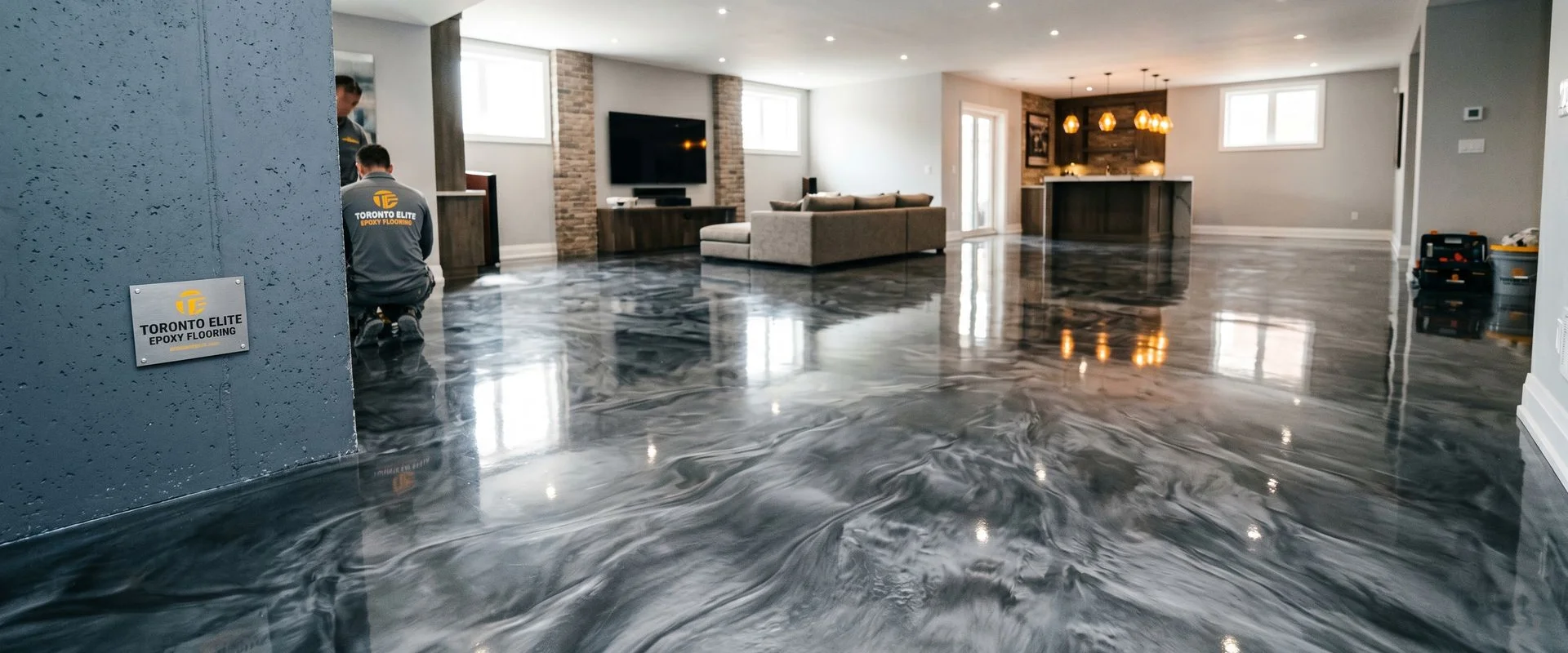
Decorative Metallic Epoxy Flooring in Toronto, ON
Hand-manipulated metallic pigment systems that create a unique 3D liquid-art effect - no two floors identical. Pricing runs $9-$16 per sq ft installed; a 500 sq ft basement or showroom completes in 2-3 days. UV-stable aliphatic polyaspartic topcoat keeps colours vivid under Ontario sun and retail LED lighting for 15+ years.
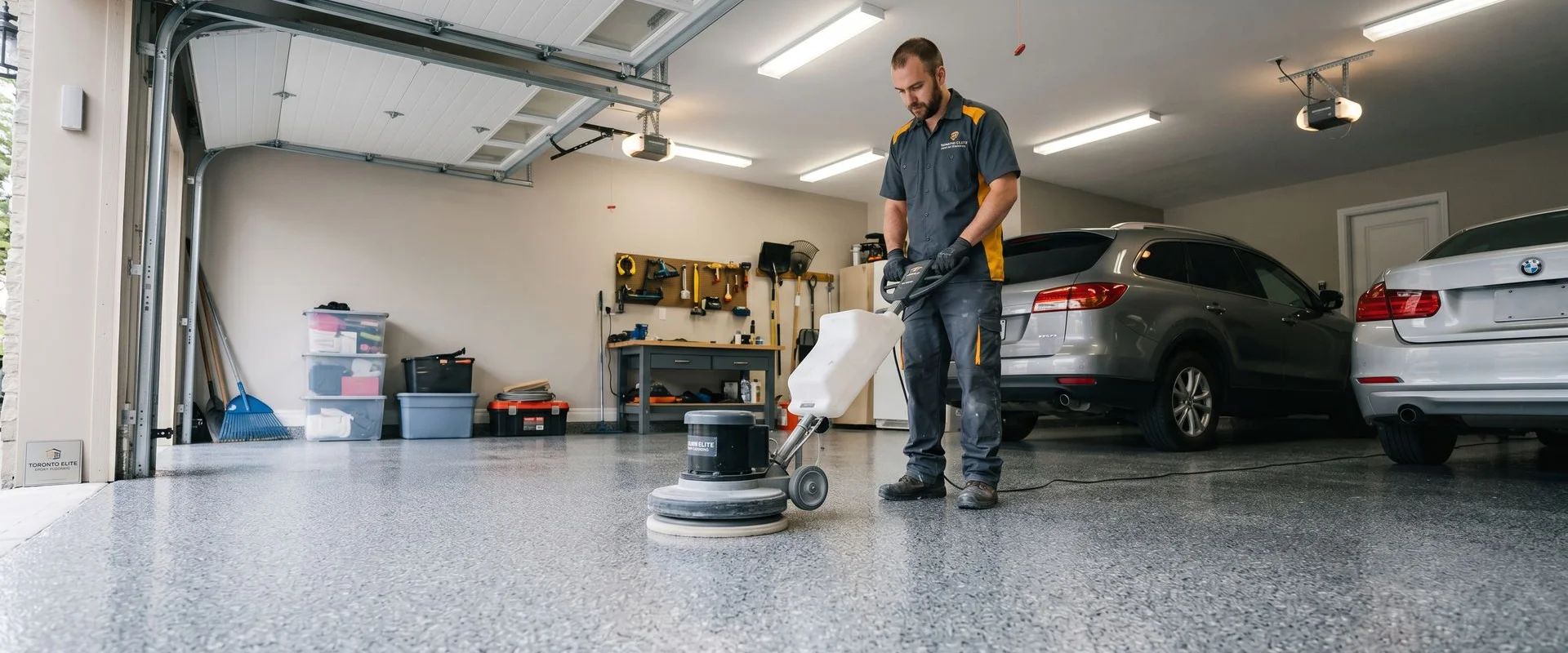
Garage Floor Epoxy in Toronto, ON
Diamond-ground to CSP 3 and moisture-tested before a 100% solid epoxy base, decorative quartz or metallic flake broadcast, and a UV-stable polyaspartic topcoat rated for Ontario road salt and hot-tire pickup. A 400 sq ft single-car garage runs $2,600-$4,000 installed and completes in 1-2 days. Every system includes anti-slip grit and WSIB-certified installation.
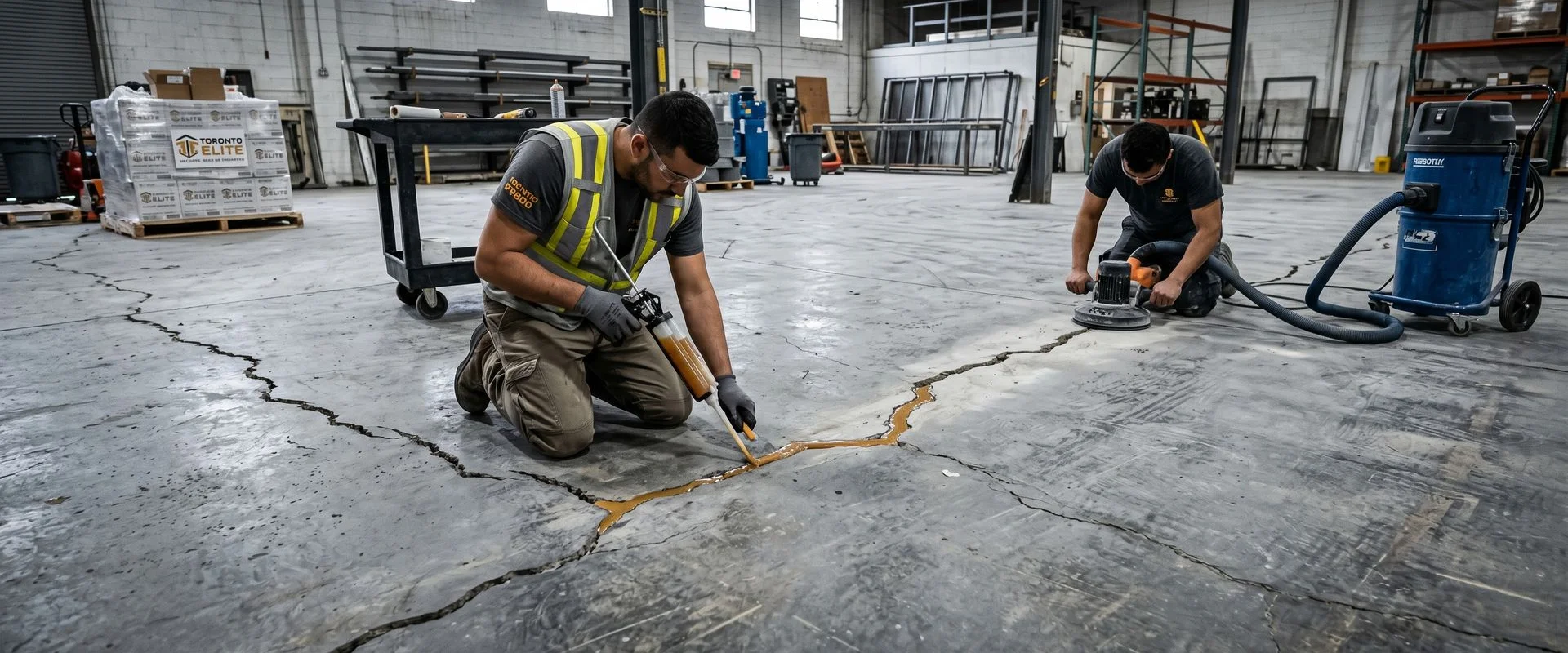
Concrete Repair & Restoration in Toronto, ON
Structural crack stitching, polyurea injection, spall patching, and self-levelling underlayment to restore any GTA concrete slab to a CSP 3 bondable surface before coating. Crack repair starts at $8-$18 per linear foot; slab resurfacing from $3 per sq ft. CSP 3 surface profile confirmed by grind gauge before any coating is applied.
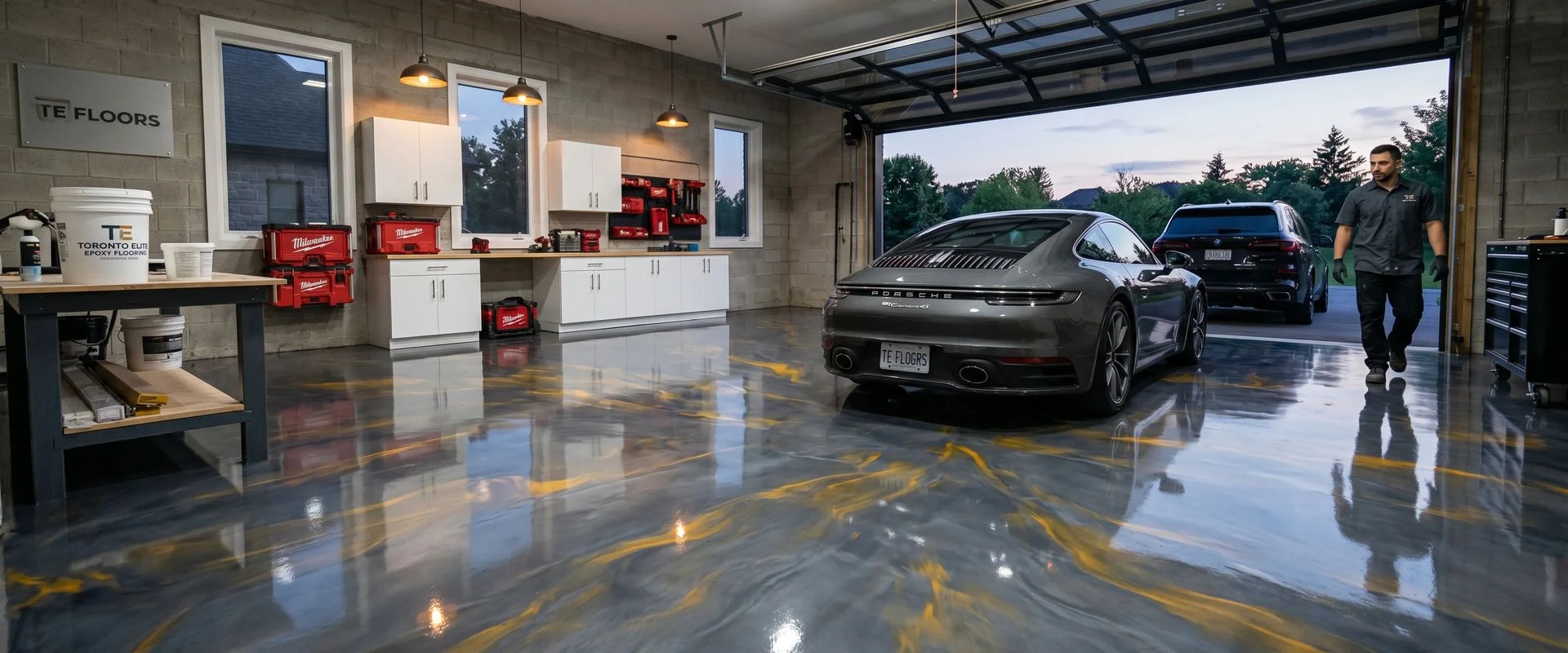
Ready to Book Basement Epoxy?
Same-day free on-site assessment. WSIB-certified, $2M liability on every project.