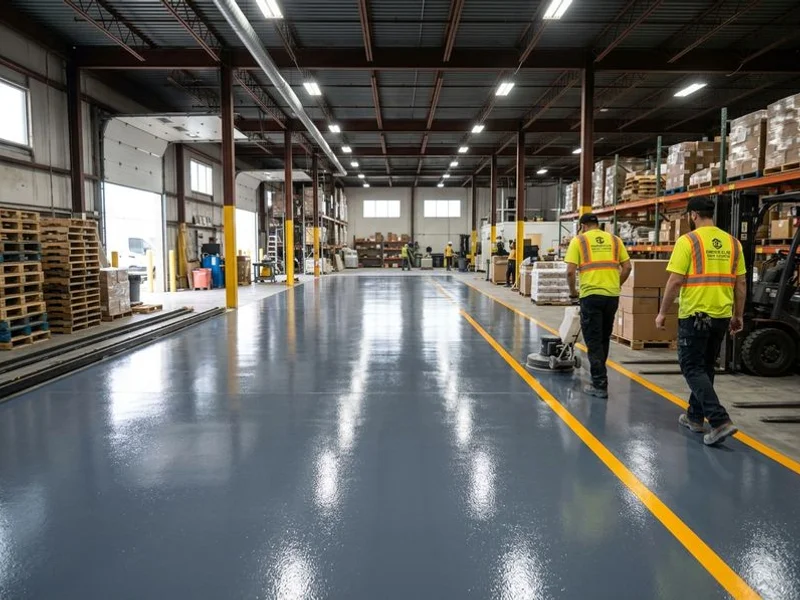
Toronto Elite Epoxy Flooring: Restaurant, Retail, Healthcare, and Specialty Floor Systems for Commercial & Industrial
Toronto Elite Epoxy Flooring installs commercial epoxy floor systems for retail showrooms, restaurants and commercial kitchens, office and institutional buildings, healthcare clinics and medical facilities, pharmaceutical and laboratory environments, and all commercial property types throughout Toronto, ON. Every commercial project is specified to the compliance requirements of the facility type - CFIA for food establishment floors, Toronto Public Health critical violation standards for restaurant coatings, IPAC Canada coving requirements for medical facilities, and ISO 14644-1 for cleanroom environments.
Commercial floors carry compliance and liability obligations that residential floors do not. A restaurant floor that fails a Toronto Public Health inspection for porous or cracked surfaces under Ontario Regulation 562 results in a critical violation and mandatory closure - the cost of lost revenue for even one closure day far exceeds the cost of a properly installed seamless epoxy system. Commercial kitchens require CFIA-compliant seamless coving at floor-to-wall junctions to eliminate bacterial harbourage points that health inspectors cite as critical violations. Healthcare floors installed without IPAC Canada-compliant 4-inch coving create infection control non-compliance in any Ontario Health inspection cycle. The difference between a compliant commercial floor and a non-compliant one is not the epoxy product - it is the application detail, coving specification, and compliance documentation that most general contractors and residential epoxy installers cannot provide.
Commercial epoxy pricing in Toronto ranges from $3 per sq ft for open-plan warehouse epoxy up to $20 per sq ft for ISO-classified pharmaceutical cleanroom systems. Restaurant and commercial kitchen floors run $8-$14 per sq ft. Healthcare and medical facility floors run $9-$16 per sq ft. Retail showroom systems run $5-$9 per sq ft. All commercial projects include compliance documentation appropriate to the facility type and regulatory environment.
Toronto Elite Epoxy Flooring provides commercial epoxy flooring to Toronto, ON and surrounding Ontario cities, including Mississauga, Brampton, Vaughan, Etobicoke, Scarborough, North York, Markham, Richmond Hill, Oakville, Burlington, Hamilton, Ajax, Pickering, Whitby, and Oshawa.
Commercial Epoxy Flooring in Toronto
Toronto Elite Epoxy Flooring is Toronto’s commercial epoxy flooring contractor, installing CFIA-compliant kitchen systems, healthcare floors with IPAC Canada-required coving, ESD conductive pharmaceutical environments, and high-traffic retail showroom epoxy for commercial properties throughout the GTA. Every commercial project comes with the compliance documentation, off-hours scheduling, and regulatory-standard installation details that commercial property owners and facility managers require.
Commercial Epoxy Services We Install
- Commercial & Industrial Epoxy - broadcast systems for high-traffic commercial facilities
- Commercial Kitchen Epoxy - CFIA and Ontario Regulation 562 compliant
- Retail & Showroom Epoxy - 1,000-5,000 daily crossing rated systems
- Institutional & Medical Epoxy - IPAC Canada coving, QAC resistant
- ESD Conductive Epoxy - ANSI/ESD S20.20 compliant, 10^6-10^9 ohm
- Pharmaceutical Cleanroom Epoxy - ISO 14644-1, GMP documentation
- Laboratory Epoxy Flooring - novolac, anti-static, chemical resistant
- Secondary Containment Coatings - TSSA compliant, CCME RCP
- Warehouse Epoxy Flooring - forklift-rated, 80-100 mil total build
- Parking Garage & Hangar Epoxy - ASTM C672 rated, polyurea membrane
How Much Does Commercial Epoxy Cost in Toronto?
Commercial epoxy flooring in Toronto ranges from $3 per sq ft for open-plan warehouse systems to $20 per sq ft for pharmaceutical cleanroom installations. Restaurant and kitchen floors run $8-$14 per sq ft; healthcare floors run $9-$16 per sq ft; retail showroom systems run $5-$9 per sq ft.
Benefits of Commercial Epoxy Flooring
We use commercial-grade epoxy systems in Toronto that perform reliably under constant wear in offices, schools, medical clinics, and retail environments. Our floors combine durability, hygiene, and safety compliance, creating a long-term surface solution that meets both performance and building code standards.
Long-Term Durability and Lifespan
Our commercial epoxy flooring withstands continuous impact, high foot traffic, and equipment movement without cracking or peeling. By using 100% solid epoxy coatings and preparing each surface with CSP 3 diamond grinding, we create a mechanical bond that extends the floor’s service life far beyond conventional tile or vinyl systems.
Industrial epoxy flooring resists abrasions from forklifts, carts, and heavy tools. In multi-use facilities across Toronto, we design each installation for specific wear zones - reception areas, corridors, and storage rooms - so every section maintains its finish according to the performance demands of that zone.
Compared with standard floor coatings, epoxy provides exceptional compressive strength, often exceeding 10,000 psi. This performance reduces repair cycles and keeps operations running without costly downtime - a major advantage for businesses that operate continuously or on tight maintenance schedules.
Low Maintenance and Easy Cleaning
We design our commercial epoxy solutions for minimal maintenance. The seamless, non-porous surface resists stains from oils, chemicals, and cleaning agents, making daily upkeep straightforward. Routine sweeping and mopping remove most debris without the need for wax or polish.
In healthcare and education settings, a low-maintenance surface helps reduce operational disruptions. The smooth finish allows automatic scrubbers to perform effectively, lowering janitorial time and labour costs.
Commercial owners benefit from long-term cost efficiency. Because the surface does not absorb liquids or harbour dirt, it keeps its appearance for years even in retail spaces and restaurant environments with heavy customer traffic.
Enhanced Safety and Compliance
Safety compliance is built into every commercial installation. Our epoxy floors meet ASTM D2047 slip resistance and Ontario Building Code requirements for public-access spaces, reducing liability and accident risk.
We offer multi-texture finishes for wet or high-motion zones, following the same slip-rated standards used in hospitals and production environments. These systems maintain traction while allowing easy cleaning with standard commercial sanitation protocols.
Each project includes documented inspection for adhesion, gloss level, and coefficient of friction. Our WSIB-certified crews and $2M liability coverage ensure full compliance with provincial safety regulations throughout preparation and installation.
Hygienic and Allergen-Resistant Surfaces
Epoxy’s seamless design prevents bacteria, mould, and dust accumulation in joints or grout lines. This hygienic surface suits clinics, laboratories, and food preparation areas that must meet strict cleanliness standards under Ontario Regulation 562 and CFIA RCP 2019.
We use low-VOC epoxy formulations approved for LEED tenant fit-outs, minimising odours and chemical emissions during and after installation. By integrating vapour barriers and moisture-control primers, we also limit microbial growth caused by trapped humidity beneath the coating.
Commercial clients benefit from a cleaner indoor environment and improved air quality. The absence of allergens and dust harbourage supports healthier workplaces, aligning with national health and facility safety standards for commercial flooring across Toronto and the GTA.
Professional Installation Process in Toronto
We complete each epoxy floor installation through a methodical process designed to ensure consistent results, minimal downtime, and compliance with local building codes. Every commercial project - whether a retail floor, medical clinic, or school corridor - receives precise technical attention to achieve strong adhesion, a smooth finish, and slip-resistant performance.
Site Evaluation and Multi-Zone Assessment
We start each project with a comprehensive site evaluation that assesses substrate conditions, layout challenges, occupancy classification, and usage requirements. Our estimators measure floor area, inspect humidity levels, evaluate existing coatings or deterioration, and map zone-specific requirements (reception, back-of-house, washroom, server room) before issuing a scope.
For sensitive facilities such as clinics and schools, we plan off-hours and weekend-only installation to avoid business disruption. The evaluation phase identifies which Ontario Building Code, CFIA, IPAC Canada, or TSSA regulatory framework applies to each area so we specify the correct system for each zone rather than a single specification applied across the whole facility.
Surface Preparation Techniques
Durable floors depend on high-quality surface preparation. Our installers mechanically abrade the concrete using CSP 3 diamond grinding or shot blasting to open pores and remove contaminants. This creates the mechanical profile required for proper epoxy adhesion under ASTM and industry standards.
We vacuum and clean all surfaces to achieve dust-free conditions before applying any coating. When preparing occupied sites, we use low-dust machines and sealed HEPA vacuums to prevent airborne debris from affecting adjacent occupied areas. Our crews follow strict safety guidelines and use equipment compliant with current Ontario Building Code requirements for public-access spaces.
| Preparation Step | Purpose | Equipment Used |
|---|---|---|
| Diamond Grinding | Achieve proper surface profile (CSP 3) | Planetary grinder |
| Crack Cleaning | Remove debris and weak edges | Angle grinder and wire brush |
| Vacuuming | Eliminate dust particles | HEPA vacuum system |
Crack Repair and Moisture Barriers
Before coating, we address all visible substrate flaws through crack repair and patching methods. We inject epoxy filler or flexible joint sealant depending on the type of movement expected in the substrate. Large gaps or spalled areas are resin-patched and sanded flush to create a uniform surface. These repairs prevent future coating failures caused by uneven adhesion.
Moisture control plays a critical role. Elevated vapour emissions lead to bubbles or delamination - the most common failure mode in commercial epoxy applied without proper substrate verification. We measure concrete RH levels and apply a moisture barrier primer when readings exceed acceptable limits. This step stabilises the foundation and prolongs coating life across Etobicoke and Vaughan facilities where older concrete slabs frequently test above threshold.
Epoxy Application and Curing
Once preparation is complete, our team begins the epoxy application sequence. We use 100% solid epoxy systems that meet ASTM D2047 slip-resistance criteria, making them suitable for walkable public spaces throughout Ontario. Multiple coats are rolled or squeegee-applied, with each layer inspected for thickness consistency and surface uniformity.
We install colour flakes, quartz broadcast systems, or urethane topcoats for additional wear protection and design flexibility. During curing, we monitor ambient temperature and humidity to ensure proper hardening and gloss development. Depending on product type, curing ranges from 16 to 24 hours before light foot traffic resumes.
For LEED-certified tenant improvements, we use low-VOC systems and maintain air quality controls during work. Our WSIB-certified technicians follow a strict schedule to deliver projects on time, ensuring each commercial floor meets performance, safety, and aesthetic standards specific to Toronto’s high-traffic commercial environments.
Comparing Flooring Solutions for Businesses
We assess flooring systems for performance, code compliance, and long-term durability in commercial and industrial environments. Each option provides distinct benefits tied to installation requirements, lifecycle cost, and resistance to wear in demanding Toronto facilities.
Epoxy Flooring vs Polished Concrete
Epoxy flooring creates a seamless, non-porous surface that resists chemicals, stains, and moisture infiltration. Polished concrete, achieved through mechanical grinding and densification, offers an exposed aggregate finish with natural reflectivity. Both appeal to facility managers seeking easy-to-clean and low-maintenance floor systems.
For high-traffic environments like hospital corridors, retail areas, or school gyms, our commercial epoxy flooring systems exceed durability standards by using industrial-grade materials formulated for mechanical wear. Polished concrete, while durable, requires periodic resealing to maintain gloss and resistance to chemical penetration.
| Feature | Epoxy Flooring | Polished Concrete |
|---|---|---|
| Surface Type | Seamless coating | Exposed aggregate |
| Maintenance | Minimal, easy to clean | Needs resealing |
| Chemical Resistance | Excellent | Moderate |
| Lifespan | 15-25 years | 10-20 years |
| Compliance | ASTM D2047 slip-rated | Depends on finish |
Advantages Over Painted Concrete
Standard painted concrete floors typically fail under frequent mechanical or chemical exposure. In comparison, an epoxy floor coating forms a thicker protective layer engineered to handle forklifts, rolling carts, and sanitation chemicals common in manufacturing and food facilities.
We use systems that cure without emitting strong odours or VOCs, ideal for LEED tenant fit-outs and occupied spaces. The seamless surface also limits dust accumulation and bacterial growth, addressing hygiene concerns in clinics and laboratories that painted concrete cannot meet.
Painted finishes show wear after a year or two, while properly installed polymer coatings maintain gloss and integrity for more than a decade with basic maintenance. The slip-resistant texture meets Ontario Building Code public-access safety levels, verified through ASTM D2047 testing.
Selecting the Right System for Your Facility
Choosing the correct system depends on load requirements, chemical exposure, regulatory framework, and operational schedule. Many Toronto commercial facilities operate around the clock, making our off-hours and weekend-only installation model essential to reduce downtime.
We divide projects into multi-zone specifications - reception, washroom, server room, and kitchen applications within one facility each meeting different traction or hygiene standards. Textured finishes improve safety in wet zones; high-gloss coatings enhance lighting efficiency in production and retail areas.
Our WSIB-certified crews and $2M liability coverage ensure compliance with workplace safety and insurance requirements in Ontario. We guide clients through system selection that balances appearance, maintainability, and longevity for each specific use zone in the facility.
Customisation and Design Options
We create epoxy flooring systems that align with clients’ operational, aesthetic, and safety goals by controlling material formulation, surface texture, and layout detailing. Each project combines design flexibility with precise technical performance suited for Toronto’s commercial environments.
Colour, Texture, and Finish Selections
We offer a large palette of solid colours, metallic blends, and flake systems for our commercial epoxy installations. Clients in retail, offices, and schools often select neutral tones for clean aesthetics, while branding areas may call for vibrant accents or metallic pigments that mimic polished stone. Our epoxy floor coating options include matte, satin, and high-gloss finishes, each influencing light reflectivity and maintenance frequency.
Surface texture varies by zone and usage. We prepare substrates using CSP 3 diamond grinding, ensuring proper profile and adhesion. This allows consistent finish quality across mixed environments - reception areas, washrooms, and back-of-house zones within one building all receiving coordinated finishes appropriate to their specific use.
Logos, Safety Lines, and Branding
Adding logos, wayfinding symbols, or safety lines enhances both functionality and visual identity. We integrate painting services for traffic markings and interior guide routes directly onto cured epoxy surfaces, ensuring secure adhesion and longevity. Logos and demarcations can be embedded under a clear topcoat to prevent wear and peeling.
Our team uses high-contrast colour combinations that comply with Ontario visibility standards. Branded elements can extend corporate colours or highlight specific operational zones - production, visitor, or server spaces. This approach helps facilities maintain compliance while projecting professionalism.
Anti-Slip and Specialised Coatings
To meet Ontario Building Code requirements for public-access flooring, we apply slip-resistant finishes tested to ASTM D2047. Our coatings incorporate fine aggregate or micronised grip agents to improve traction without roughening the surface excessively. These systems ensure safe footing in wet areas such as entry vestibules and washrooms.
We use 100% solid epoxy and low-VOC formulations suitable for LEED-certified tenant fit-outs. These coatings maintain indoor air quality and can be installed during off-hours or weekends to limit business downtime. For critical zones like medical clinics, server rooms, or ESD-sensitive electronics areas, our anti-static and chemical-resistant systems protect equipment and withstand routine cleaning protocols.
Industries and Applications in Toronto
We deliver epoxy flooring systems designed to meet functional, safety, and operational needs across Toronto’s industrial, commercial, and institutional sectors. Our methods align with commercial-grade standards while complying with Ontario Building Code and LEED low-emission requirements.
Warehouses and Industrial Facilities
In warehouses, factories, and logistics hubs across the GTA, performance and safety define project priorities. Our industrial epoxy flooring withstands forklifts, pallet jacks, and heavy machinery without surface wear or delamination. Each system begins with CSP 3 diamond grinding and uses 100% solid epoxy coatings for maximum compressive strength - often exceeding 10,000 psi.
Epoxy’s seamless finish resists oils, solvents, and chemical spills common in large manufacturing environments. We regularly install slip-resistant finishes compliant with ASTM D2047 standards, improving worker safety in high-traffic aisles and loading zones. Facility managers in Etobicoke and Vaughan benefit from our dust-controlled preparation process, which minimises airborne debris during installation and keeps adjacent areas operational.
Retail, Commercial, and Office Spaces
Epoxy flooring provides long-term value in showrooms, offices, and retail chains where both appearance and performance matter. Our commercial epoxy flooring systems present a polished, uniform finish that supports contemporary design while resisting abrasion from high foot traffic.
In multi-zone spaces - reception, back-of-house, washrooms, and server rooms - we specify distinct finishes within one cohesive project. This reduces future maintenance costs and keeps Toronto commercial tenants operational. For LEED-certified tenant fit-outs, we use low-VOC coatings that contribute to improved indoor air quality and support LEED EQ credit documentation.
Many downtown Toronto and Mississauga property managers rely on our flexible scheduling to complete updates overnight or over weekends without tenant downtime. Compared to tile or vinyl, commercial epoxy offers better compressive strength and easier sanitation - key factors for offices, clinics, and learning environments where cleanliness and performance must coexist.
Specialised Environments and Safety Requirements
We handle flooring for specialised facilities including medical clinics, educational institutions, and food service areas, where regulatory standards dictate surface performance. In these settings, slip-resistance, hygiene, and containment properties take priority.
We integrate static-dissipative or chemical-resistant epoxy coatings where electronic equipment or laboratory materials are present. Meeting Ontario Building Code public-access slip resistance ensures patient and visitor safety. Our installations in clinics and schools often include integral cove bases to prevent bacterial build-up along wall junctions - a requirement under IPAC Canada infection control guidelines.
Each project carries WSIB certification and $2M liability coverage. By combining experienced installation with local compliance expertise, we help facilities throughout Toronto maintain safe, attractive, and regulation-ready surfaces.
Related Questions Toronto Commercial Property Managers Ask
What compliance documentation do I need after commercial epoxy flooring is installed?
The required documentation depends on the facility type. Commercial kitchens under CFIA RCP 2019 and Ontario Regulation 562 require a material data sheet confirming the system is seamless, non-porous, and cleanable - plus confirmation of coved skirting at floor-to-wall junctions. Healthcare facilities under IPAC Canada guidelines require installation records confirming 4-inch minimum coving and QAC-resistant topcoat. LEED tenant fit-outs require the product VOC content documentation for EQ credit submissions. Ontario Building Code public-access areas require coefficient of friction test results confirming ASTM D2047 compliance. We provide all of these as a standard documentation package at project completion.
Can a restaurant in Toronto reopen the same day epoxy flooring is installed?
Not same-day, but often the following morning if installation is scheduled correctly. A commercial kitchen epoxy installation typically runs overnight Thursday through Friday evening, with curing complete and the kitchen ready for weekend service. The polyaspartic topcoat that goes over the CFIA-compliant base system reaches light foot traffic cure in 16-24 hours. We schedule kitchen installations specifically around the operational week - Thursday night prep and grinding, Friday overnight coating, Saturday morning inspection and opening. This is why scheduling a site visit to review your kitchen layout and operational hours is the first step before any commercial kitchen project.
What is the minimum thickness for a commercial epoxy floor that must support forklifts and pallet jacks?
Commercial floors subject to forklift and pallet jack traffic require a minimum 60-80 mil total dry film thickness (DFT) for adequate impact resistance. This typically translates to a three-coat system: moisture-tolerant primer, 100% solid epoxy base coat, and urethane or polyaspartic topcoat. Facilities with concentrated point loads from narrow-aisle forklifts or heavy-duty racking systems may require additional broadcast quartz to achieve 80-100 mil DFT. The compressive strength of 100% solid epoxy at these thicknesses exceeds 10,000 psi - significantly above the load demands of standard material handling equipment in Toronto distribution and manufacturing facilities.
Does a Mississauga or Vaughan industrial facility need a permit to install epoxy flooring?
Epoxy floor coating is generally classified as a surface treatment rather than a structural alteration, and does not typically require a building permit under Ontario Building Code. However, if the installation includes new floor drains, penetrations through fire-rated assemblies, or modifications to secondary containment berms covered under TSSA or Ontario Regulation 675/98, additional permits or approvals may be required. We flag any installation that touches regulated building systems during the site assessment and coordinate with the facility’s building management before beginning work.
What is the difference between ESD dissipative and ESD conductive epoxy, and which does a Toronto electronics or data centre facility need?
ESD dissipative epoxy (10^6-10^9 ohm surface resistance) provides a controlled path to ground that bleeds off electrostatic charges slowly and safely - the correct specification for most electronics manufacturing, PCB assembly, and data centre environments. ESD conductive epoxy (under 10^6 ohm) provides faster charge dissipation and is required in environments where static discharge could detonate sensitive explosive or pyrotechnic materials. For Toronto electronics and data centre applications, dissipative systems meeting ANSI/ESD S20.20 are the standard specification. We test installed ESD systems with a calibrated surface resistance meter and provide ANSI/ESD S20.20 compliance documentation at handover.
Commercial Epoxy Pricing
Pricing varies by facility type and compliance specification.
Why GTA Customers Choose Toronto Elite Epoxy Flooring for Commercial Epoxy
Off-Hours & Section-by-Section Scheduling
Toronto commercial facilities can't close for three days of floor work. We schedule overnight, weekend-only, and section-by-section phases around your operational hours - reception Friday night, back-of-house Saturday, washrooms Sunday, full facility open Monday.
Multi-Zone Specification in One Project
Reception, washrooms, server rooms, commercial kitchens, and back-of-house all need different systems. We specify ASTM D2047-rated anti-slip in wet traffic zones, low-VOC in occupied office areas, and chemical-resistant in cleaning storage - as one coordinated project.
Ontario Building Code Slip Compliance
Ontario Building Code Div B, Article 3.3.1.8 requires slip resistance in public-access floor surfaces. We install ASTM D2047-compliant systems and provide coefficient of friction documentation with every commercial project.
LEED-Eligible Low-VOC Systems
Our 100% solid low-VOC systems support LEED EQ credit documentation for tenant fit-outs. No off-gassing odour in occupied commercial spaces - applied off-hours and returned to service the next morning without air quality disruption.
How Commercial Epoxy Works
Multi-Zone Assessment
Facility layout review, occupancy classification, and regulatory requirement mapping (Ontario Reg 562, CFIA, IPAC Canada, Ontario Building Code). Zone-specific coating requirements and off-hours installation windows identified before quoting.
CSP 3 Grinding & Substrate Repair
Diamond grinding to CSP 3, HEPA-filtered dust collection, crack and joint repair with epoxy mortar, moisture testing with moisture-barrier primer applied to any slab above RH threshold.
Zone-by-Zone Epoxy Application
100% solid epoxy base coat with zone-specific topcoats - ASTM D2047 slip-rated for public access, chemical-resistant for back-of-house, low-VOC for occupied spaces. Safety lines and demarcation applied where specified.
Compliance Docs & Return to Operations
Adhesion and coefficient of friction testing, compliance records matched to facility type, phased return-to-operations so the facility stays functional throughout.
Ready for a Free On-Site Assessment?
Same-day quotes across the GTA. WSIB-certified, $2M liability on every project.
What Customers Say About Our Commercial Epoxy
"Multi-zone office fit-out in Mississauga - reception area, server room, and washrooms all done in one project over a long weekend. Toronto Elite specified different systems for each zone, which none of the other contractors I contacted had even suggested. The reception floor is a metallic finish and the washrooms have the anti-slip coating - both look like one coordinated design. The whole project was done by Sunday evening and we opened Monday morning without a single hour of operational disruption."
"Medical clinic in North York - we needed IPAC Canada coving at all wall junctions for infection control compliance and the existing floor was tile with grout lines. Toronto Elite removed the tile, ground the slab to CSP 3, installed the seamless epoxy with 4-inch integral cove base, and provided the installation documentation our facility needed for the IPAC audit. The inspector signed off without any requests for additional documentation. First time a flooring contractor has actually understood what clinical compliance requires."
"Restaurant floor in Etobicoke - previous floor failed a Toronto Public Health inspection for cracked grout and porous surfaces. Toronto Elite installed a seamless CFIA-compliant epoxy with coved skirting and provided the documentation showing the system meets Ontario Regulation 562. The inspector at the next health inspection noted the floor specifically and closed the previous critical violation. The whole project ran Thursday night through Friday and we were back open for the weekend service. That scheduling alone was worth it."
Commercial Epoxy FAQs
What types of commercial epoxy flooring does Toronto Elite Epoxy install?
We install commercial kitchen and restaurant epoxy (CFIA and Ontario Regulation 562 compliant), retail showroom systems, healthcare and medical facility floors (IPAC Canada coving compliant), pharmaceutical cleanroom epoxy (ISO 14644-1 rated), laboratory novolac chemical-resistant systems, ESD conductive and dissipative floors, and general commercial warehouse and office epoxy throughout Toronto and the GTA.
How much does commercial epoxy flooring cost in Toronto?
Commercial epoxy flooring in Toronto ranges from $3 per sq ft for open-plan warehouse epoxy to $20 per sq ft for pharmaceutical cleanroom systems. Restaurant and commercial kitchen floors run $8-$14 per sq ft. Healthcare floors run $9-$16 per sq ft. Retail showroom systems run $5-$9 per sq ft. General office and multi-zone commercial fit-outs run $5-$12 per sq ft. All commercial quotes include compliance documentation appropriate to the facility regulatory requirements.
Can commercial epoxy flooring be installed without closing the business?
Yes. Commercial projects are typically scheduled in off-hours, overnight, and weekend phases to maintain operations throughout. Section-by-section scheduling keeps most of the facility operational while each phase installs and cures. Zero-VOC or low-VOC chemistry is specified for occupied commercial environments where air quality must be maintained.
What does CFIA-compliant commercial kitchen flooring require?
CFIA Recommended Code of Practice (RCP) 2019 requires food establishment floors to be seamless, non-porous, impermeable, and cleanable without bacterial harbourage points. This means no tile grout, no open joints, and seamless 4-inch coving at all floor-to-wall junctions. We install urethane cement or epoxy systems with integral coved skirting and provide CFIA-compliant installation documentation with every commercial kitchen project.
Does commercial epoxy flooring require a health inspection approval?
Commercial kitchen and food establishment floors must comply with Ontario Regulation 562 and are subject to Toronto Public Health inspection. We install systems that meet these standards and provide documentation of materials and compliance details. The floor system itself does not require pre-approval - it is inspected as part of the facility health inspection cycle, and we ensure our installations pass.
How long does commercial epoxy flooring last in Toronto?
Commercial epoxy systems last 7-15 years depending on traffic volume, chemical exposure, and cleaning protocol. Restaurant and kitchen floors under daily hot pressure washing and chemical cleaning last 7-10 years before recoat is required. Lower-traffic retail and office floors last 10-15 years. Healthcare and cleanroom systems using novolac or urethane cement chemistry last 10-20 years under proper maintenance protocols.
What slip resistance standard applies to commercial epoxy floors in Ontario?
Ontario Building Code Division B, Article 3.3.1.8 requires slip-resistant surfaces in public-access walking areas. ASTM D2047 is the test standard used to verify the coefficient of friction meets the 0.5 minimum threshold for walking surfaces. We install ASTM D2047-compliant systems and provide coefficient of friction test documentation with every commercial project - required by facility managers for liability insurance and building code compliance records.
What is the typical installation timeline for a commercial epoxy floor in Toronto?
A typical commercial installation takes 3-5 days depending on square footage, zone count, and substrate condition. Day one: diamond grinding, cleaning, and moisture testing. Day two: crack and joint repair, primer coat. Days three and four: base coat and topcoat application by zone. Day five: final topcoat and curing before return to service. Off-hours and weekend scheduling compresses this into a long weekend for most standard commercial fit-outs under 5,000 sq ft.
Related Services
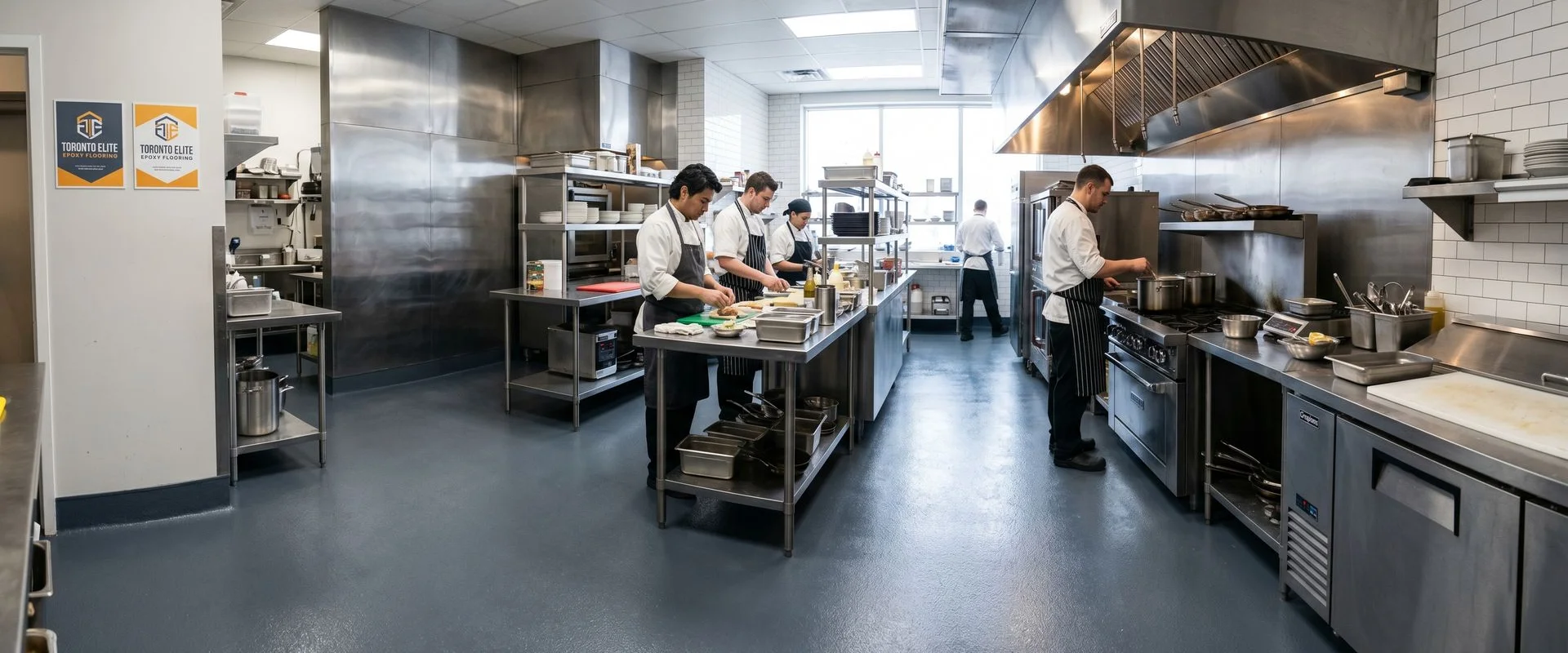
Commercial Kitchen Epoxy Flooring in Toronto, ON
CFIA-compliant seamless epoxy flooring with 4-6 inch coving, quartz anti-slip broadcast, and zero-VOC chemistry for Toronto restaurants and food service facilities. Pricing runs $5-$11 per sq ft installed; most commercial kitchens complete in 2 overnight shifts with no service disruption. Every install includes full health inspection compliance documentation and off-hours scheduling.
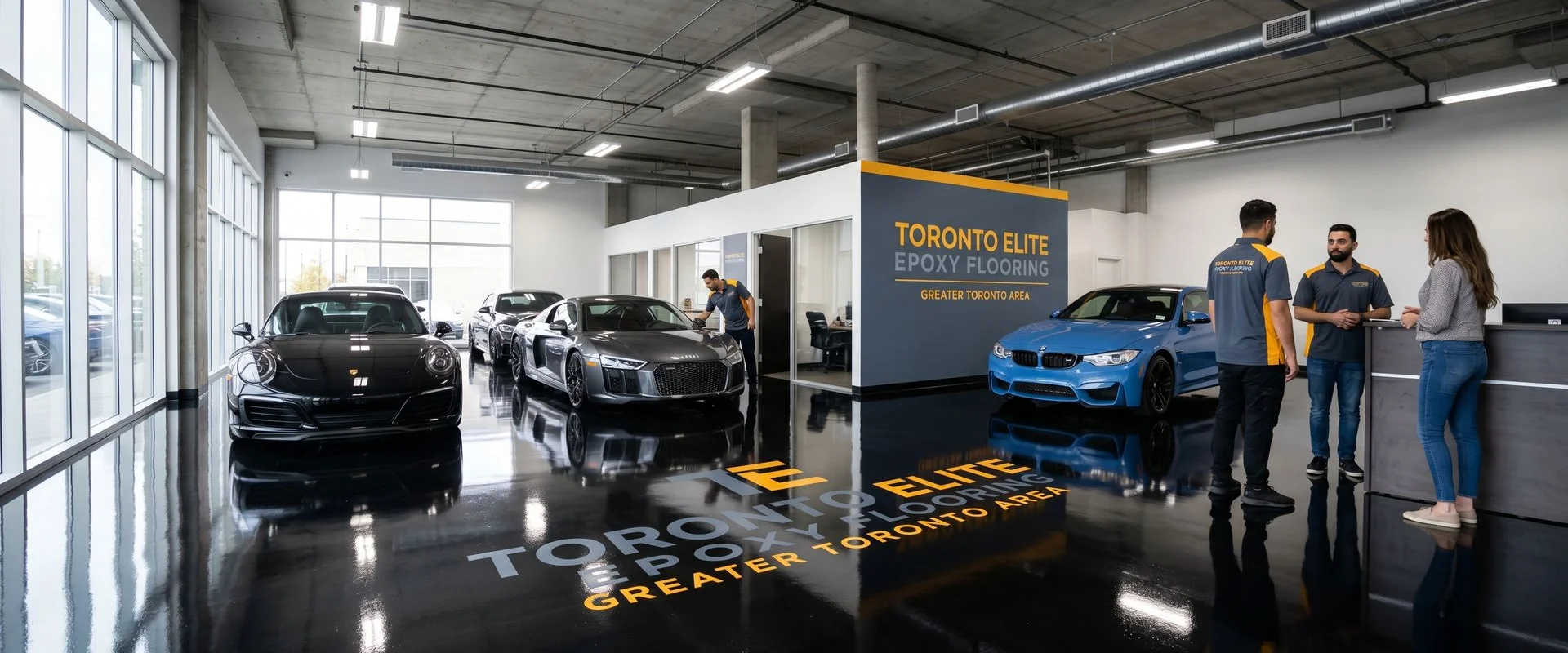
Retail Showroom Epoxy Flooring in Toronto, ON
High-gloss commercial epoxy with custom RAL colour matching, optional logo inlays, and an aliphatic polyaspartic topcoat rated for 500+ daily foot traffic without scuffing or UV yellowing. Pricing runs $4-$9 per sq ft installed; most showroom floors complete in 2-3 overnight shifts with zero business disruption. WSIB-certified crews with $2M liability coverage on every GTA install.
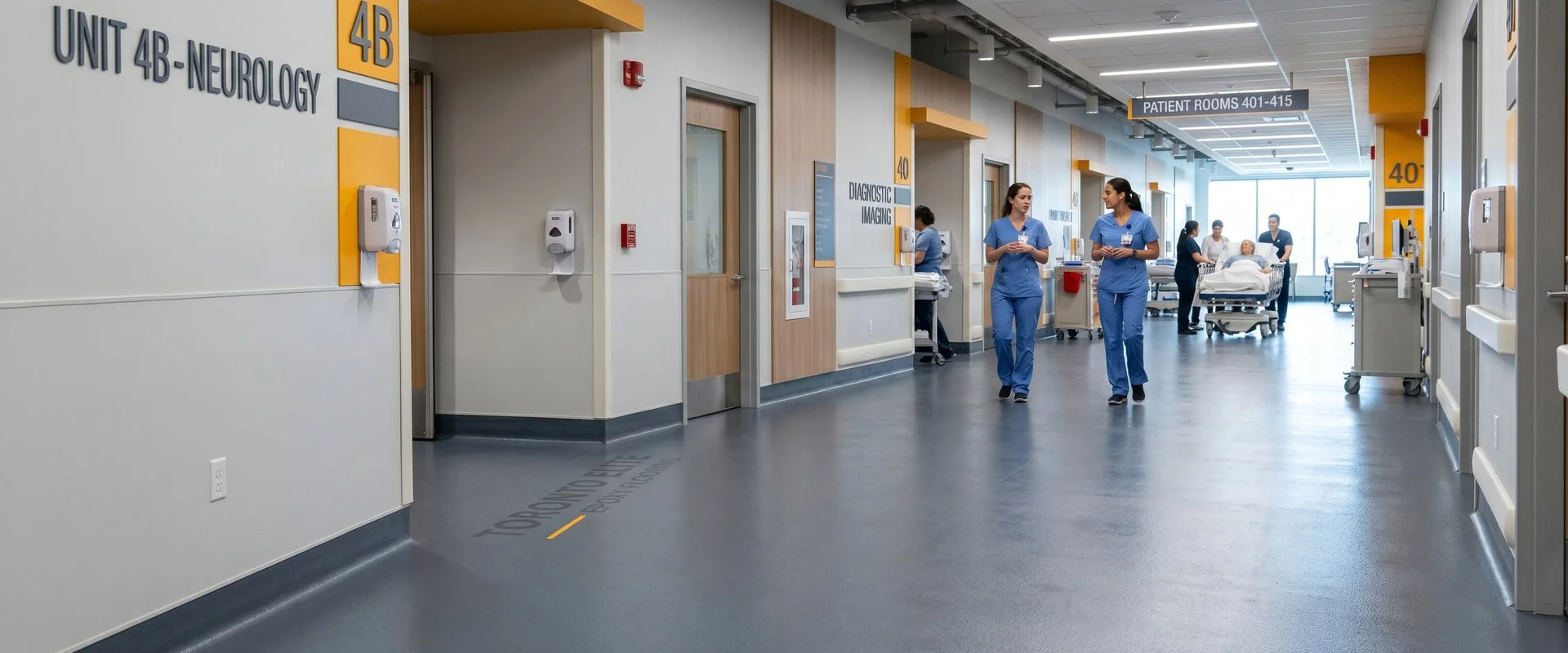
Institutional & Medical Epoxy Flooring in Toronto, ON
Seamless antimicrobial epoxy systems with 4-6 inch wall coving and zero-VOC chemistry for GTA hospitals, clinics, schools, and long-term care facilities. Pricing runs $6-$12 per sq ft installed; section-by-section scheduling keeps your facility operational throughout. WSIB-certified crews, $2M liability, and full IPAC Canada compliance documentation on every project.
Warehouse Epoxy Flooring in Toronto, ON
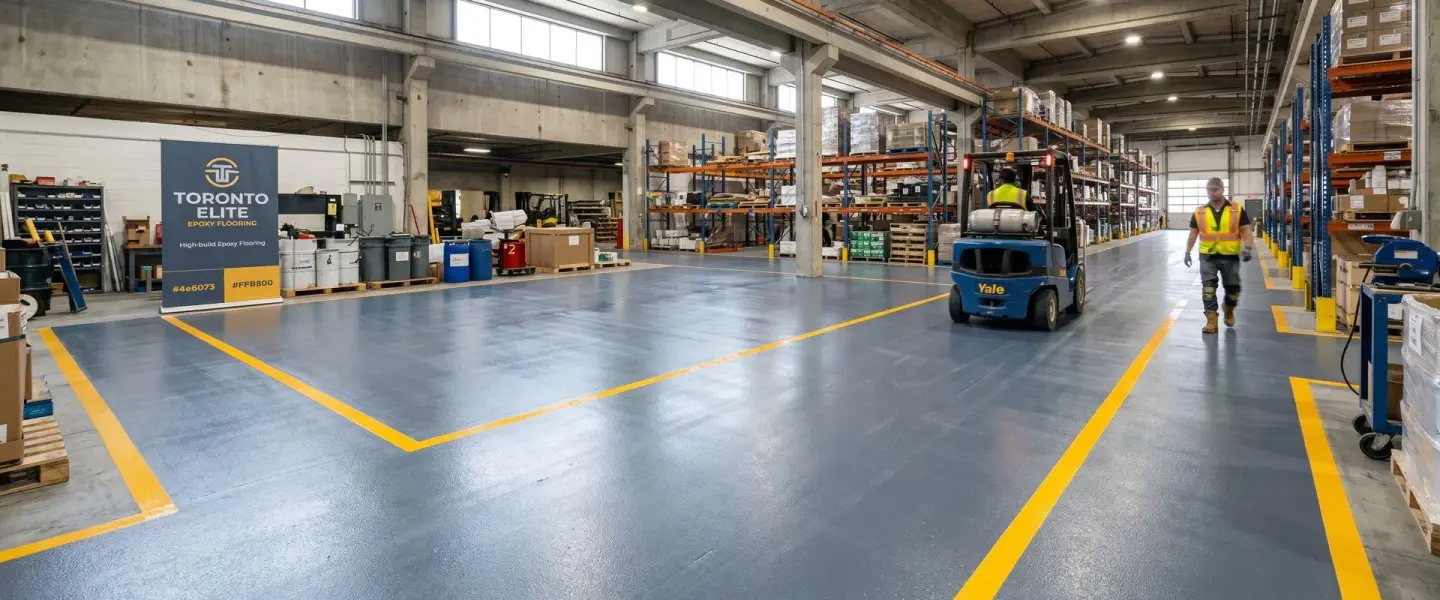
Forklift-rated 100% solid epoxy systems with shot-blast prep, chemical-resistant topcoat, and integrated line marking for GTA distribution centres and logistics hubs. Pricing runs $3-$7 per sq ft installed; large warehouse floors complete in off-hours weekend windows with WSIB-certified crews. WSIB-certified crews, liability, and full compliance documentation on every commercial project.
ESD Conductive Epoxy Flooring in Toronto, ON
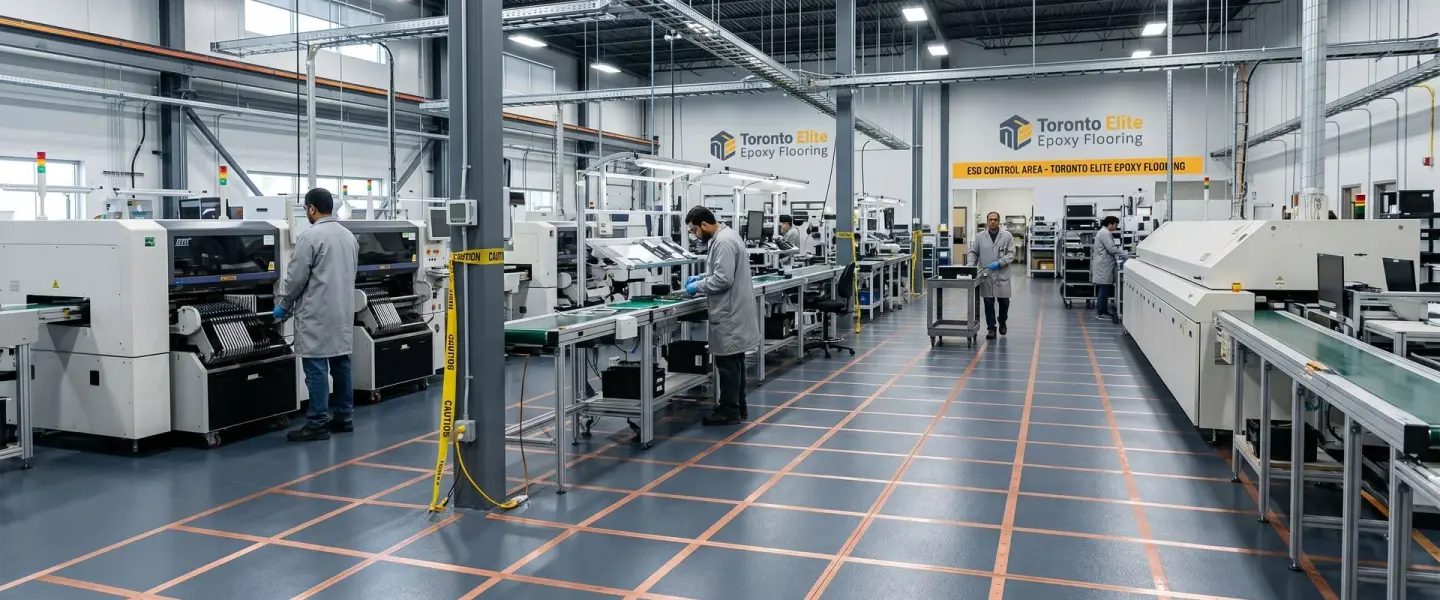
ANSI/ESD S20.20 certified conductive epoxy with copper grounding grid, verified by megohmmeter to NFPA 99 and EOS/ESD Association STM7.1 standards. Pricing runs $7-$14 per sq ft installed; resistance testing and a full compliance report are included on every GTA install. Used in electronics manufacturing, data centres, and cleanroom environments across Mississauga and Markham.
Ready to Book Commercial Epoxy?
Same-day free on-site assessment. WSIB-certified, $2M liability on every project.