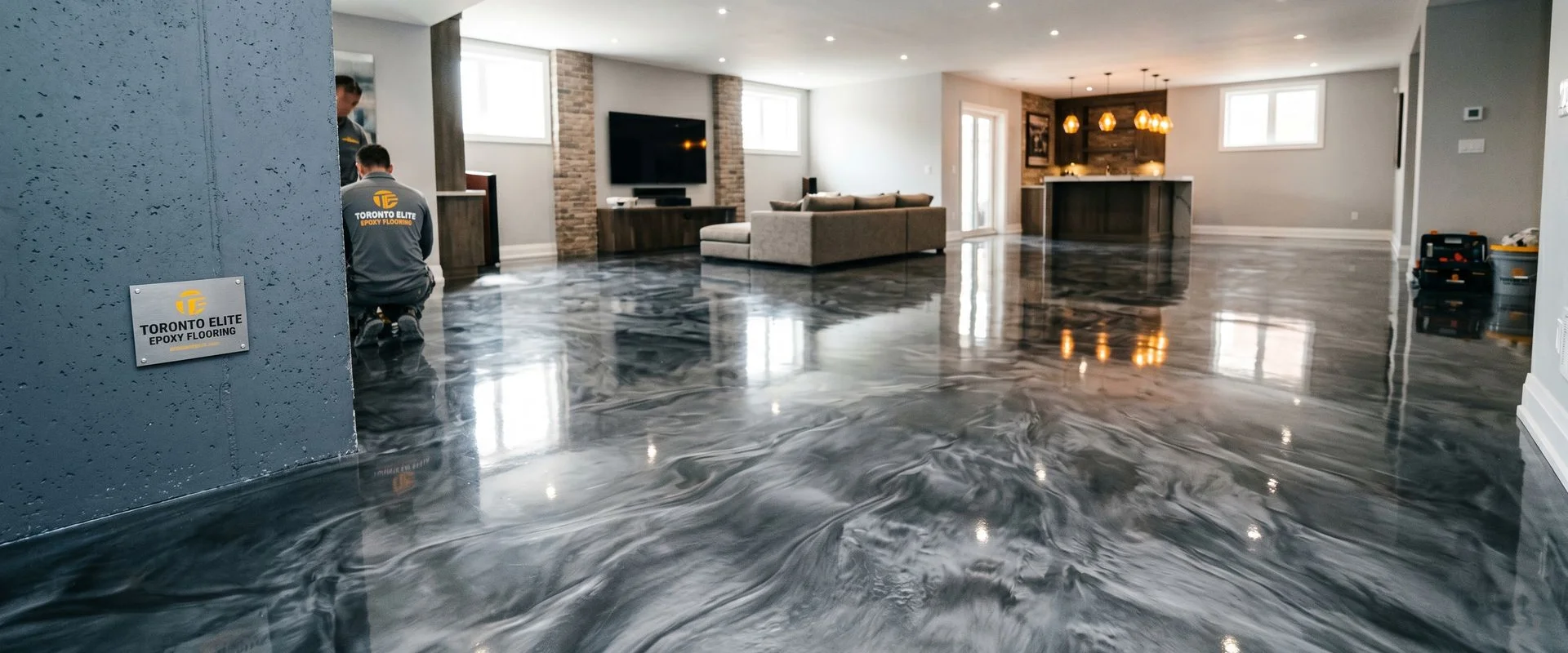
Decorative Metallic Epoxy Flooring in Toronto, ON - Custom 3D Liquid-Art Flooring Professionals
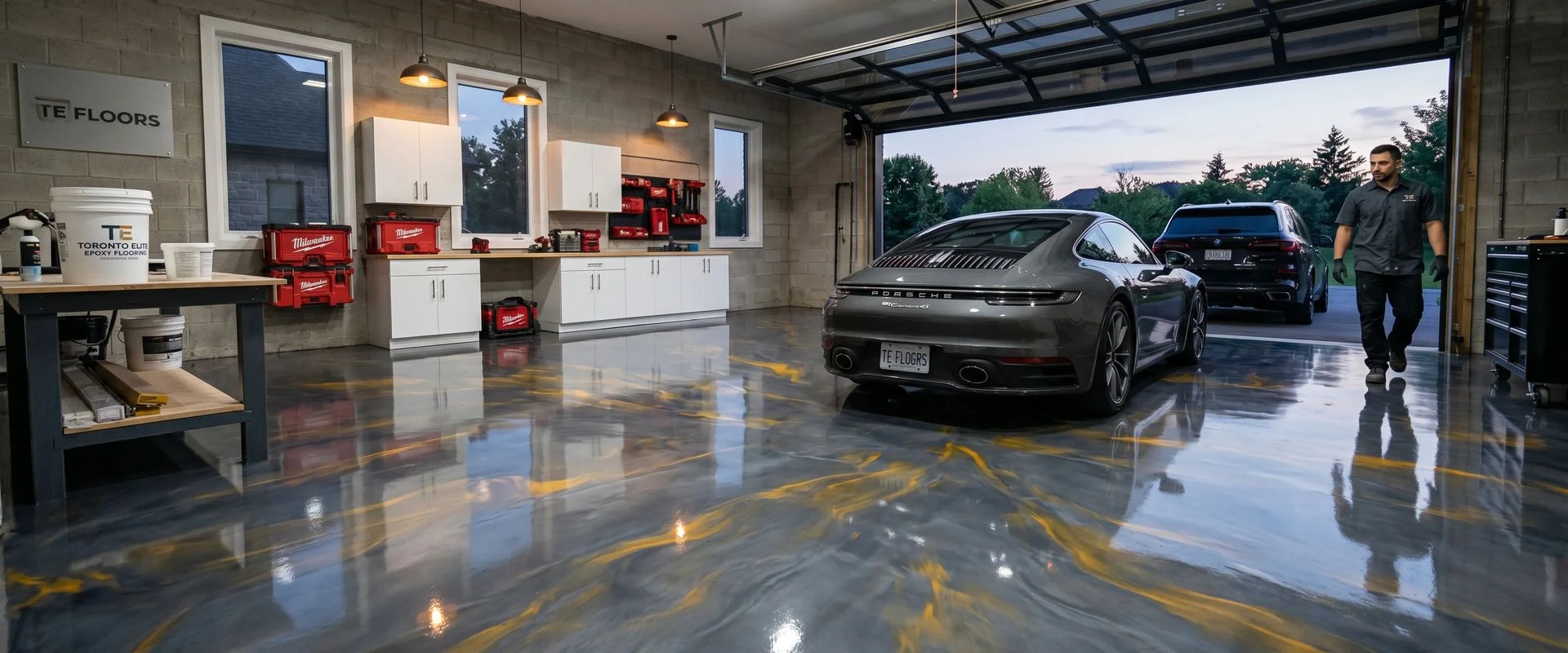
Toronto Elite Epoxy Flooring installs hand-manipulated metallic pigment systems, marble-pour and ocean-pour designs, and dual-tone 3D depth-effect floors for residential basements, home gyms, showrooms, and commercial reception areas throughout Toronto, ON. Every metallic install uses solvent-free metallic epoxy with designer-selected pigment ratios, a manipulation pass for organic movement patterns, and a UV-stable polyaspartic topcoat to lock depth and prevent colour shift.
Metallic epoxy failures are caused by two factors installers rarely disclose. Solvent-based primer or base coat applied under the metallic layer off-gasses during cure, driving solvent vapour upward through the metallic film and creating a pinhole and bubble-trail pattern that ruins the seamless depth effect, visible within the first week. Standard aromatic epoxy pigments shift under UV: Ontario summer sun and 4,000-6,500K LED retail lighting convert metallic silvers to yellow and charcoal pigments to brown within 18 months. Only zero-VOC base coats and UV-stable aliphatic polyaspartic topcoats rated for direct light exposure can maintain the designer colour accuracy a custom one-of-a-kind metallic floor demands long-term.
A residential metallic floor (500-800 sq ft) completes in 2 days; commercial reception areas with custom logo inlays run 2-3 days. Pricing ranges from $9 to $16 per sq ft installed depending on pigment count, design complexity, and topcoat sheen level. No two metallic floors are identical - every pour is a one-of-a-kind installation unique to that space.
Toronto Elite Epoxy Flooring provides decorative metallic epoxy flooring to Toronto, ON and surrounding Ontario cities, including Etobicoke, Scarborough, North York, Mississauga, Oakville, Vaughan, Brampton, Markham, Richmond Hill, and Rosedale.
Why Ordinary Flooring Falls Short for Feature Spaces
Tile grout lines, plank seams, and solid-colour paint floors are fine for utility spaces. For a basement theatre, wine cellar, luxury showroom, or statement garage, they fall short. Standard flooring can’t compete with the depth and reflectivity of a metallic pour, and it ages the same as every other floor in the building.
Custom metallic and 3D epoxy delivers a floor that looks like poured stone or liquid metal, and no two installs are identical. It’s a design decision that holds up to the same daily wear as our garage floor epoxy systems, installed by Toronto’s full-spectrum epoxy flooring contractor.
What is Decorative & Metallic Epoxy?
Decorative metallic epoxy is a multi-layer system where metallic pigments are dispersed into wet epoxy and manipulated by hand to create marbled, oceanic, or brushed-metal patterns. The result is a floor that doubles as the centrepiece of the room. No tile, no carpet, no plank flooring can replicate the depth a metallic pour gives you.
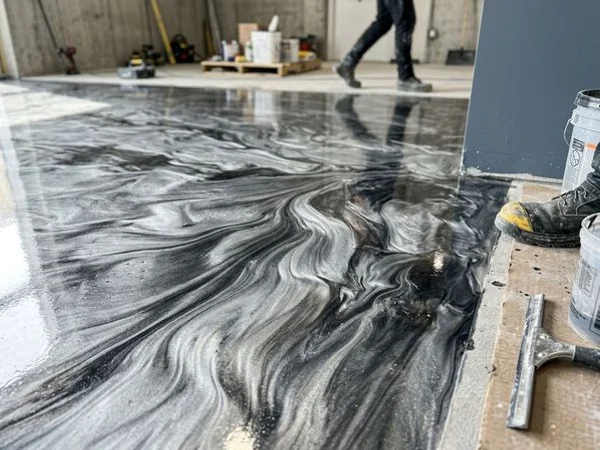
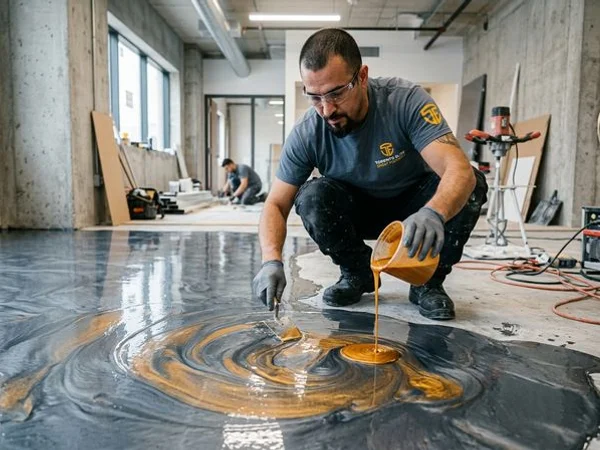
The technique is liquid-art: we pour, blow, and brush the pigments while the epoxy is wet, and the patterns lock in as the resin cures. Each install is unique by definition because the colour movement happens in real time and is never repeated exactly.
Underneath the visual layer is the same 100% solid commercial-grade epoxy and diamond-grind prep we use on every garage and commercial install. The floor is as durable as it is striking, with a clear protective topcoat to keep the depth and gloss intact for years.
What Every Metallic Epoxy Install Includes
Every metallic install includes:
- Free on-site consultation with sample boards in real materials
- Diamond grinding and full slab prep (moisture testing on basements)
- 100% solid commercial-grade epoxy base coat
- Custom metallic pigment layering, colours and pattern chosen with you
- Liquid-art application by experienced installers
- Clear urethane or polyaspartic topcoat for durability and depth
- Detailed work around walls, columns, and stairs
- Warranty on the system, in writing
What Is Metallic / 3D Epoxy and How Is It Made?
Metallic epoxy is a 100% solids epoxy resin combined with ultra-fine mica and metalite pigment particles, typically ranging from 10 to 80 microns in size. When the wet resin is manipulated with a brush, squeegee, or compressed air, the pigment particles reorient at different depths and angles, scattering light in a way that produces the illusion of depth and three-dimensional movement. The chemistry behind that effect is straightforward: mica particles are platelet-shaped and highly reflective, so their angle relative to the surface determines how much light they return to the viewer’s eye.
A properly built system starts with a concrete surface profile of CSP 2 to CSP 3, as defined by the International Concrete Repair Institute profile scale. On Toronto basement slabs - where moisture vapour emission is a consistent concern given the region’s clay-heavy soil - we run a calcium chloride test per ASTM F1869 before any product touches the concrete. Slabs reading above 3 lbs per 1,000 sq ft per 24 hours receive a moisture-tolerant epoxy primer before the decorative layers go down. Skipping this step is the single most common reason metallic floors delaminate within 18 months of install.
The decorative layer itself is a 100% solids epoxy mid-coat seeded with metallic pigment, followed by a secondary manipulation step - acetone drizzle, torch movement, or forced air - to develop the pattern. Once the mid-coat reaches a firm gel state, a second broadcast of fine metallic powder is sometimes added for additional depth before the system is sealed with an aliphatic polyurea or polyaspartic topcoat. Aliphatic chemistry is specified for UV-exposed areas because it resists the yellowing that standard aromatic epoxy topcoats develop after six to twelve months of direct sunlight. For basement applications in Leaside or Etobicoke where UV exposure is minimal, an aromatic urethane topcoat at 3 to 4 mils dry film thickness is an equally durable and more cost-effective option.
Metallic Epoxy Design Trends for Toronto Homes and Showrooms
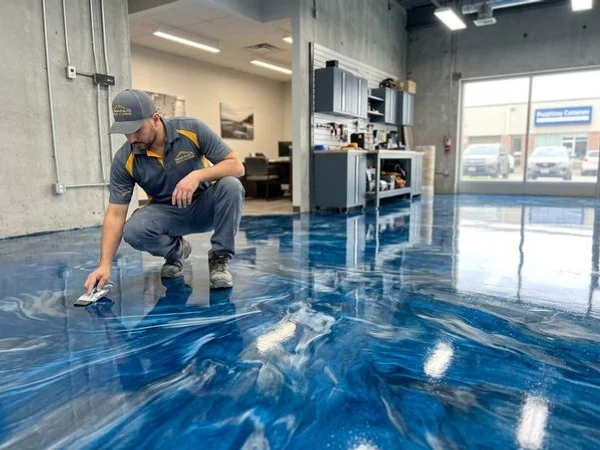
The most requested metallic finishes across the GTA in 2025 and into 2026 have shifted toward cooler, high-contrast palettes. Gunmetal Silver over a charcoal base is the dominant choice for home theatres and wine cellars in Rosedale and Forest Hill, where the goal is a moody, light-absorbing floor that reads as architectural rather than decorative. Oceanic blue-and-silver combinations - developed by pouring a translucent blue-tinted epoxy over a white base and manipulating with a heat gun - remain popular for gym conversions and luxury basement bars in Markham and Oakville, where homeowners tend to favour bolder residential palettes.
On the commercial side, showrooms in Etobicoke’s design district and auto dealerships along the 400-series corridors have moved toward brushed-copper and warm-gold metallics on light grey bases. These finishes photograph well under the 4000K LED track lighting common in retail buildouts, and they provide a visual contrast against dark display fixtures that neutral polished concrete cannot match. Architects spec-ing these spaces often reference the finish as a “liquid terrazzo” substitute that delivers the light-play of real terrazzo at roughly 40 to 60 percent of the installed cost.
Glow-in-the-dark additives have moved from novelty to a genuine design tool for stairwell landings and basement egress paths. Strontium aluminate photoluminescent powder - not the older zinc sulphide formulas - charges under standard LED ambient light and emits a blue-green glow for six to eight hours after lights-out. When specified correctly at 200 to 400 grams per square metre broadcast into the wet mid-coat, the glow effect is visible at floor level without being distracting during daytime use. This technique has seen uptake in Oakville custom homes where the basement is designed as an entertainment and media space with programmable ambient lighting.
Custom colour matching is increasingly driven by interior designers rather than homeowners. We receive finish specifications tied to Benjamin Moore or Sherwin-Williams paint codes, and pigment manufacturers supply custom-blended metallic powders matched to those references within a Delta-E tolerance of 2 or less. The matching process adds two to three weeks to the material lead time, which factors into scheduling for projects with a hard completion date.
Metallic Epoxy Cost vs Standard Flake Epoxy
The installed cost gap between a decorative metallic system and a standard full-broadcast vinyl chip floor in the GTA is real, and it is worth understanding what drives it. A standard full-broadcast vinyl flake floor on a 500 sq ft basement slab costs $5 to $7 per sq ft installed, covering diamond grind prep, a two-part epoxy base, the flake broadcast, and a polyaspartic topcoat. A single-colour metallic pour on the same slab runs $9 to $11 per sq ft. A multi-layer 3D pour with two or three pigment colours and an aliphatic polyurea topcoat reaches $13 to $16 per sq ft.
The cost difference breaks down across three factors. First, metallic pigment itself is expensive relative to vinyl chip: broadcast-grade mica metalite powders cost $80 to $140 per kg at trade pricing, and a 500 sq ft pour at medium pigment loading consumes 2 to 3 kg. Vinyl chip costs roughly $4 to $8 per kg and covers significantly more area per kilogram. Second, the labour time for a metallic pour is higher. The manipulation phase - developing the pattern while the resin is in its working window - requires two or three applicators working simultaneously, and the working window on a 100% solids epoxy at Toronto summer ambient temperatures of 25 to 30 C is typically 20 to 35 minutes for a 500 sq ft area. That leaves no room for rework, which means experienced installers only. Third, a UV-stable aliphatic polyurea topcoat adds $1.50 to $2.50 per sq ft over a standard polyaspartic finish, and it is the correct specification for any metallic floor in a space with window exposure.
For a Markham or Etobicoke basement running 600 sq ft, a realistic all-in budget for a two-colour metallic with polyaspartic topcoat is $6,000 to $8,400. That same budget on a vinyl flake system would cover a 1,000 to 1,400 sq ft garage. The choice is not about which system lasts longer - both carry the same Warranty on adhesion - but about whether the floor is serving a utility function or a design function. When clients in Rosedale or Leaside are finishing a basement to a standard where every other surface has been custom-specified, a $7 vinyl chip floor under a $15,000 bar build is a mismatch. The metallic system is the logical finish at that fit-out level. For purely functional spaces, flake is the better value and we will tell you so. Contact a Toronto epoxy flooring contractor to get a square footage estimate and material recommendation before committing to either system.
Related Questions Toronto Homeowners Ask
How thick is a metallic epoxy floor system?
A complete metallic epoxy system built to commercial specifications runs 40 to 60 mils total dry film thickness. That breaks down as 10 to 15 mils for the moisture primer, 20 to 30 mils for the pigmented metallic mid-coat, and 8 to 12 mils for the polyaspartic or polyurea topcoat. At those thicknesses the system adds less than 1.5 mm of height to the slab, which is below the threshold that requires transition strips at doorways on standard residential builds in Toronto.
Can metallic epoxy be repaired if it chips or scratches?
Spot repairs on metallic floors are possible but rarely invisible. Because the pattern in a metallic pour is created through live pigment manipulation, an exact colour and movement match on a repair patch is not achievable. Contractors working in Etobicoke and Oakville sometimes apply a full re-coat of the topcoat layer to blend a repaired area, but this only works before the base coat has UV-yellowed. The practical answer for high-use areas is to specify a harder topcoat - a 100% solids polyurea at 60 Shore D or higher - at installation, which reduces the likelihood of needing a repair in the first place.
What prep does a Rosedale or Leaside basement slab need before metallic epoxy?
Most pre-1980 Toronto basement slabs present two prep challenges: surface laitance from the original concrete pour, and elevated moisture vapour emission from the absence of a sub-slab vapour barrier. Diamond grinding to CSP 2 removes the laitance layer and opens the concrete profile for mechanical adhesion. Moisture readings above 3 lbs per 1,000 sq ft per 24 hours on the ASTM F1869 calcium chloride test require a moisture-tolerant epoxy primer before any decorative product is applied. On older Rosedale and Leaside slabs we budget for the primer as a standard line item rather than a conditional add-on, because the probability of elevated moisture on those properties is high.
How does the metallic epoxy installation affect scheduling around a renovation?
Metallic epoxy should be one of the last trades on a renovation schedule. Concrete dust and drywall compound residue contaminate the slab surface and require additional prep time if flooring goes in before other trades finish. We need the HVAC system operational during cure to maintain ambient temperature above 10 C and relative humidity below 85 percent, which are the minimum environmental conditions for a 100% solids epoxy to cure correctly. A full 3-day metallic install - grind, prime, metallic coat, topcoat - requires the space to be clear of other contractors for the entire window.
Is metallic epoxy safe for a home gym or space where people exercise barefoot?
The standard high-gloss topcoat on a metallic floor produces a surface with a wet coefficient of friction below 0.5, which is too slippery for barefoot exercise under the guidelines used for commercial fitness facilities. Specifying a matte or satin polyaspartic topcoat - or adding an anti-slip broadcast of aluminium oxide at 30 to 50 mesh - raises the dry coefficient of friction to 0.6 or higher without visually affecting the metallic pattern underneath. We add anti-slip aggregate as a standard option on gym applications in Markham and Oakville where the room serves double duty as a fitness and entertainment space.
Our Metallic Epoxy Results in Toronto
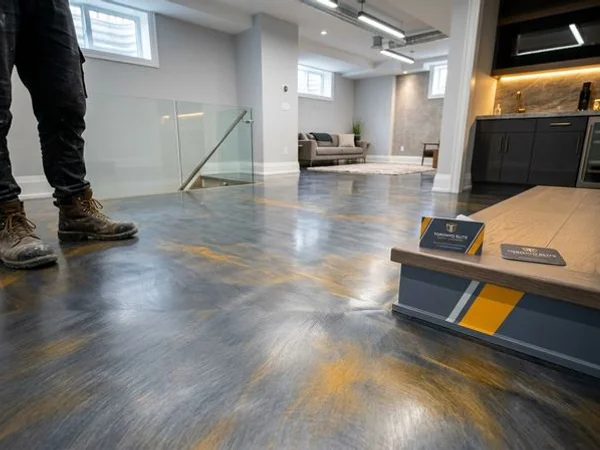
Metallic Epoxy Pricing
Pricing depends on layering, colours, and topcoat. We bring sample boards to the quote.
Why GTA Customers Choose Toronto Elite Epoxy Flooring for Metallic Epoxy
One-of-a-Kind Floors
Liquid-art metallic patterns are unique on every install. Your floor is never replicated.
Custom Colour Matching
Gunmetal Silver, brushed copper, oceanic blues, and glow options, colour-matched to your space.
Built on Our Garage System
Same diamond-grind prep and durable epoxy base as our garage floors. Looks luxe, lasts long.
Warranty
Decorative doesn't mean fragile. Backed in writing like every floor we install.
How Metallic Epoxy Works
Design Consultation
We bring sample boards in real materials so you can pick colours and pattern style on-site.
Diamond Grind Prep
Full diamond-grind prep and moisture testing on basement slabs before any metallic goes down.
Metallic Liquid Art
Metallic pigments layered into the wet epoxy and manipulated by hand for one-of-a-kind patterns.
Clear Protective Topcoat
High-gloss clear topcoat seals the design and adds depth. Warranty.
Ready for a Free On-Site Assessment?
Same-day quotes across the GTA. WSIB-certified, $2M liability on every project.
What Customers Say About Our Metallic Epoxy
"Toronto Elite did our basement in Leaside with a Gunmetal Silver metallic pour - diamond grind to CSP 3 and a full moisture test before anything went down. The 3D depth is something no tile could replicate."
"Triple-car garage with metallic gunmetal. The crew was meticulous and the result is jaw-dropping."
"Our North York home gym basement needed something beyond a standard grey flake floor. Toronto Elite poured a midnight blue and silver ocean metallic - CSP 3 prep and ASTM F2170 moisture testing before anything went down. The 3D depth shifts every time the light hits it. Over a year in and the colours are as vivid as day one."
Metallic Epoxy FAQs
Where does metallic epoxy work best?
Basements, showrooms, retail spaces, and home feature areas like wine cellars or theatres. Anywhere you want a floor that doubles as a design feature. We do not recommend it for high-traffic warehouse environments. Go with quartz-flake systems there.
Is every floor really unique?
Yes. Metallic pigments are layered into the wet epoxy and manipulated by hand, so the pattern is never replicated. You'll get a similar style across our portfolio, but no two floors are identical.
What does metallic epoxy cost in Toronto?
Decorative metallic runs $9-$16 per sq ft depending on the layering, colour count, and topcoat. We bring sample boards to the on-site quote so you can pick on real materials.
How durable is the finish?
Built on the same diamond-grind prep and 100% solid epoxy base as our garage systems, with a clear urethane or polyaspartic topcoat. It's a luxury look on a durable system, not a fragile floor finish.
Can you do glow-in-the-dark or custom colours?
Yes. Glow-in-the-dark, Gunmetal Silver, custom RGB pigment matches, and oceanic blue/teal patterns are all options. We discuss the look during the consultation.
How long does install take?
Most residential metallic floors take 3-4 days, including moisture testing on basements, prep, the metallic application, and the clear topcoat cure.
What is the difference in cost between single-colour metallic and a full 3D multi-layer pour?
A single-colour metallic with one pigment and a standard polyaspartic topcoat typically lands at $9-$11 per sq ft. A full 3D multi-layer pour with two or three pigment colours, acetone manipulation, and an aliphatic polyurea topcoat runs $13-$16 per sq ft. The price gap reflects materials and the additional hands-on time to develop the pattern.
How does metallic epoxy compare to polished concrete for a Rosedale or Leaside home?
Polished concrete gives you a matte-to-satin industrial look and typically costs $6-$10 per sq ft, but it cannot replicate the depth, colour, and 3D effect of a metallic pour. Metallic epoxy is the better choice when the floor needs to read as a design feature rather than a neutral background surface.
What warranty does metallic epoxy carry?
Every system we install carries a Warranty on adhesion and delamination, in writing. The warranty covers manufacturing defects in the epoxy base coat and topcoat. Normal surface wear from abrasive use is not covered, which is why we specify the correct topcoat hardness for each application.
Does Toronto's freeze-thaw cycle affect metallic epoxy in basements?
Properly prepared slabs with a moisture vapour emission rate below 3 lbs per 1,000 sq ft per 24 hours - verified with a calcium chloride test per ASTM F1869 - will not experience freeze-thaw-related delamination in a conditioned basement. Unheated garages and exposed slabs are a different scenario; we use a moisture-tolerant primer for those applications.
How soon can I walk or park on a metallic epoxy floor?
Light foot traffic is typically safe after 24 hours. Full cure for vehicle traffic or heavy furniture requires 72 hours with a polyaspartic topcoat, or up to 7 days with a standard urethane. We confirm the exact schedule based on the product batch and ambient temperature at the time of install.
Can metallic epoxy be applied over radiant in-floor heating?
Yes, with the correct preparation. The slab temperature must be between 10 C and 25 C during application, and the radiant system must be turned off at least 24 hours before install and kept off for 48 hours after. We verify slab temperature with a contact thermometer at multiple points before any product goes down.
Related Services
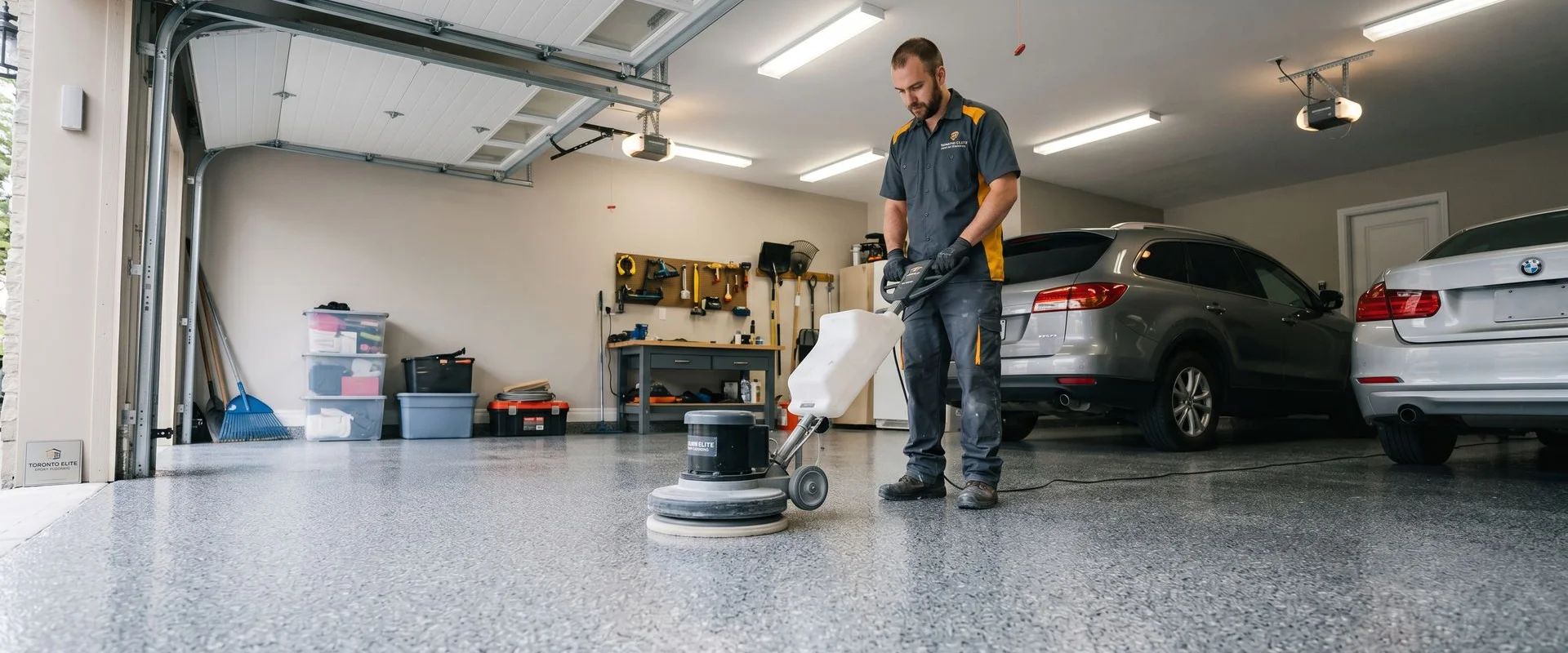
Garage Floor Epoxy in Toronto, ON
Diamond-ground to CSP 3 and moisture-tested before a 100% solid epoxy base, decorative quartz or metallic flake broadcast, and a UV-stable polyaspartic topcoat rated for Ontario road salt and hot-tire pickup. A 400 sq ft single-car garage runs $2,600-$4,000 installed and completes in 1-2 days. Every system includes anti-slip grit and WSIB-certified installation.
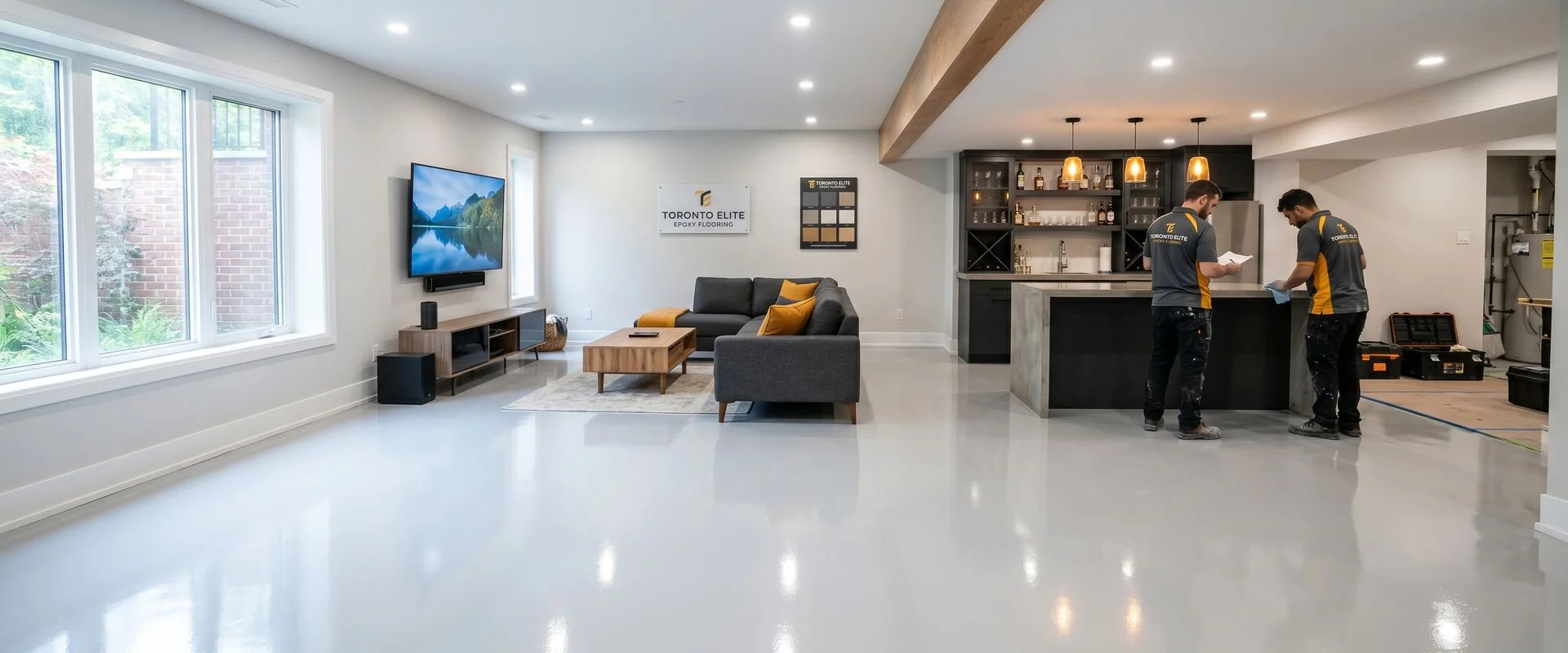
Basement Epoxy Flooring in Toronto, ON
Seamless, pet-friendly epoxy flooring for Toronto basements - ASTM F2170 moisture-tested before install, with a built-in vapour barrier primer for below-grade slabs. Pricing runs $4.50-$10 per sq ft installed; most 600 sq ft basements complete in 2 days. Zero-VOC formula is safe for occupied living spaces. WSIB-certified crews on every install.
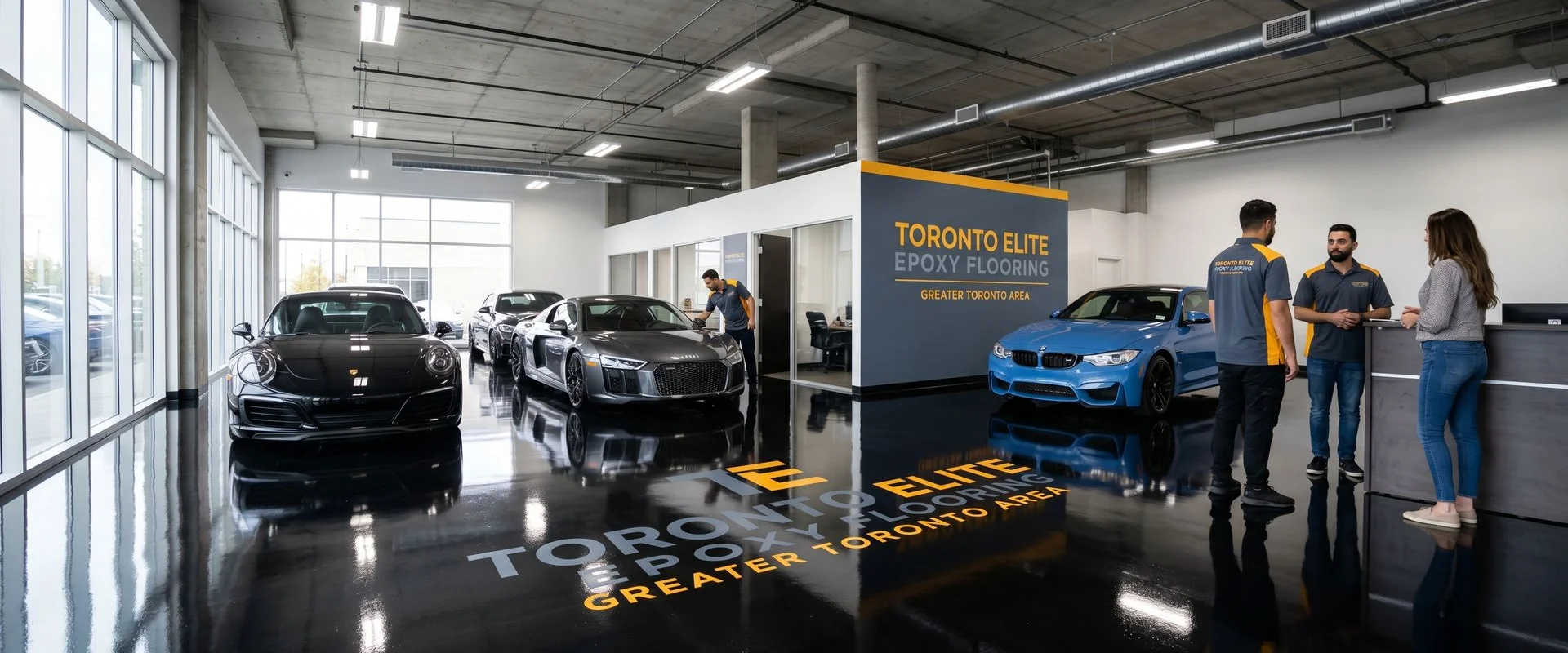
Retail Showroom Epoxy Flooring in Toronto, ON
High-gloss commercial epoxy with custom RAL colour matching, optional logo inlays, and an aliphatic polyaspartic topcoat rated for 500+ daily foot traffic without scuffing or UV yellowing. Pricing runs $4-$9 per sq ft installed; most showroom floors complete in 2-3 overnight shifts with zero business disruption. WSIB-certified crews with $2M liability coverage on every GTA install.
Ready to Book Metallic Epoxy?
Same-day free on-site assessment. WSIB-certified, $2M liability on every project.