Parking Garage Epoxy Coating in Toronto, ON - Traffic Deck & Hangar Floor Professionals
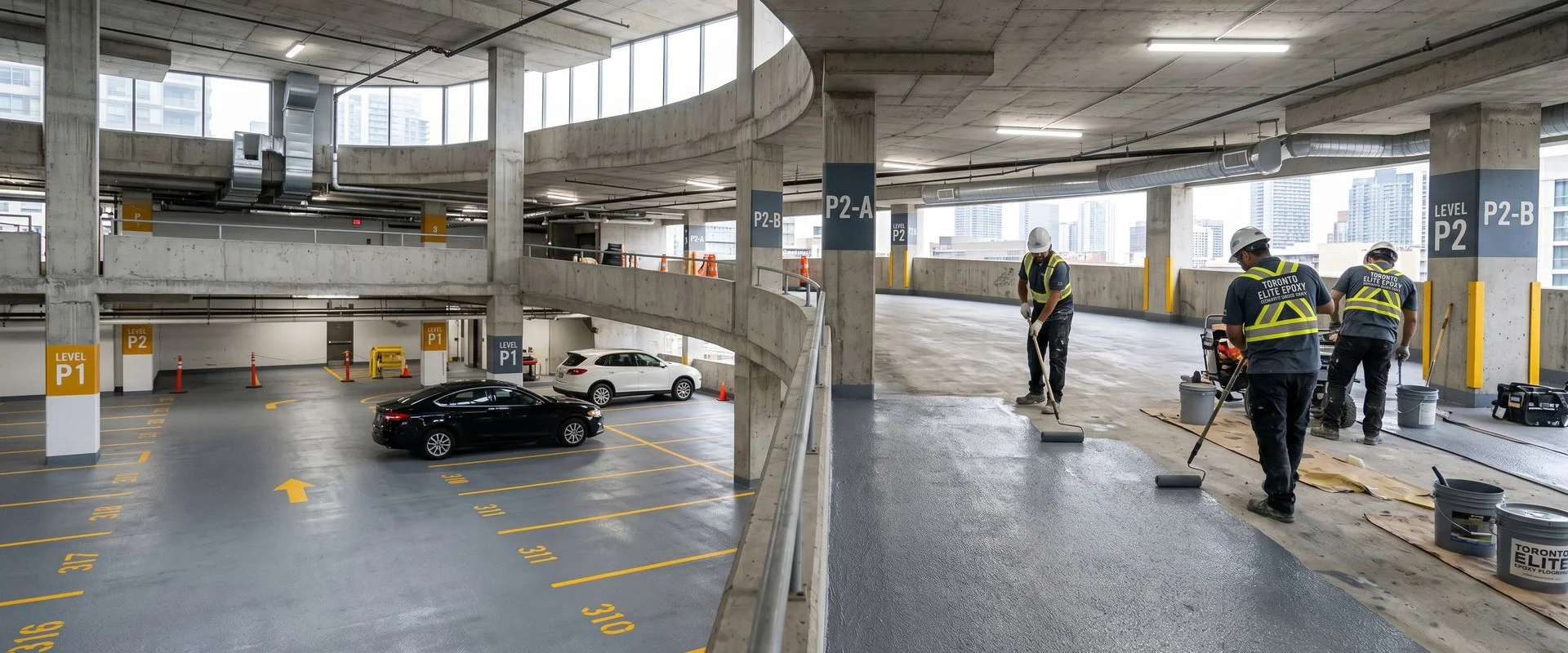
Toronto Elite Epoxy Flooring installs diamond-ground polyurea traffic deck systems, broadcast salt-impermeable coatings, and slope-to-drain waterproof membranes for condominium parkades, commercial parking structures, and aircraft hangars throughout Toronto, ON. Every parking garage install includes line marking, stall numbering, directional arrows, and phased section-by-section scheduling so the structure stays accessible throughout the project.
Parking structures are the most chemically aggressive concrete environment in Ontario. Vehicle underbodies track de-icing salts (sodium chloride, magnesium chloride, and calcium chloride blends) onto deck surfaces, where chloride ions penetrate unprotected concrete at 5-10 mm per year and initiate rebar corrosion. Above-grade decks face ASTM C672 scaling conditions from 60-90 days of de-icing salt exposure per Ontario winter, spalling unprotected concrete and cracking non-flexible deck coatings at expansion joints and column bases within 3-5 years. A polyurea traffic deck membrane rated to 400% elongation at -30°C is the minimum specification for a deck coating that bridges expansion joint movement without splitting through freeze-thaw cycling.
Parking deck projects typically run 5,000-100,000 sq ft and complete in phased overnight shifts over 1-4 weeks depending on structure size and traffic patterns. Pricing ranges from $4 to $8 per sq ft installed depending on traffic deck system specification, waterproof membrane depth, and line marking complexity. All systems are rated for Ontario freeze-thaw cycles and road salt chloride penetration.
Toronto Elite Epoxy Flooring provides parking garage epoxy coatings to Toronto, ON and surrounding Ontario cities, including Etobicoke, Scarborough, North York, Mississauga, Oakville, Vaughan, Brampton, Markham, Richmond Hill, Burlington, and Hamilton.
What is Parking Garage & Hangar Epoxy?
Parking decks and aircraft hangars are the most demanding floors in our portfolio - constant vehicle traffic, oil drips and fuel, sudden temperature swings, and (for suspended decks) the structural waterproofing role of holding water back from the level below.
The right system depends on what the deck is doing. At-grade lots use high-build vehicle-rated epoxy with embedded line marking. Suspended condo or commercial decks need waterproof traffic-deck membranes with crack-bridging properties. Aircraft hangars take chemical and fuel resistance plus aviation-spec line marking.
We carry WSIB, $2M liability, and provide compliance documentation for condo corp, commercial, and aviation contracts. As Toronto’s full-spectrum epoxy flooring contractor, we run parking-deck projects with the same in-house crew and equipment behind our warehouse epoxy flooring systems.
What’s Included
- Structure-specific survey (at-grade, suspended, hangar)
- Substrate repair, crack stitching, and expansion-joint detailing
- Vehicle-rated high-build epoxy or traffic-deck membrane
- Oil-, fuel-, and chemical-resistant topcoats
- Embedded line marking, stall lines, and wayfinding
- Off-hours and multi-shift scheduling
- Full compliance documentation
High-Traffic Deck Coatings for Parking Structures and Hangars
The GTA’s climate puts parking garage coatings through a stress test that most systems fail within three to five years. Toronto averages roughly 30 freeze-thaw cycles per winter, and the chloride loading from road salt tracked in by vehicles is among the highest in Canada - a combination that rapidly degrades standard rigid epoxies through crack propagation and delamination. Structures in North York and Scarborough that were coated with conventional materials in the early 2010s are now showing the consequences: spalled concrete, corroding rebar, and recurring water infiltration claims from the units below.
Vehicle-rated high-build epoxy systems for at-grade lots are formulated to 100% solids at 80-125 mils dry film thickness, providing the compression strength (typically 10,000-12,000 psi) needed to resist point loads from passenger vehicles and light commercial trucks. Anti-slip broadcast aggregate - aluminium oxide at 60-80 grit - is embedded into the wear course at 12-18 oz per sq ft and locked under a UV-stable aliphatic polyurea topcoat rated to withstand salt, petroleum products, and direct sunlight without yellowing. The aliphatic chemistry is critical: cheaper aromatic epoxy or polyurethane topcoats chalk and discolour within 18-24 months in outdoor or semi-exposed GTA parking environments.
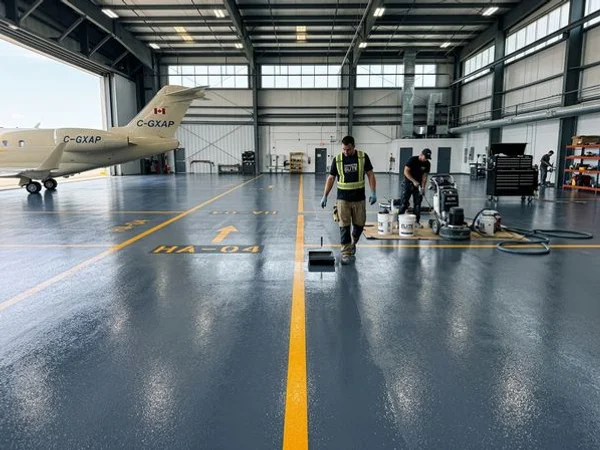
Aircraft hangar projects introduce a different set of chemical demands. Jet fuel (Jet-A), hydraulic fluid (Skydrol), and deicing glycols are all aggressive solvents that will attack standard epoxy resins over time. Hangar floors for fixed-base operators and private aviation facilities in the Brampton and Mississauga corridor - serving Pearson-area tenants - are specified with novolac epoxy base coats, which use a multi-ring aromatic structure to resist a broader range of chemicals than standard bisphenol-A epoxy. Where electrostatic discharge is a concern around fuel-handling areas, we install conductive epoxy primer systems tested to ASTM F150 with a verified resistance of 25,000-1,000,000 ohms. Aviation line marking follows Transport Canada facility guidelines and is embedded under the topcoat for permanence rather than painted on top.
Surface preparation on all high-traffic deck projects is performed to ASTM D4259 and ICRI CSP 3-4 profile using ride-on diamond grinders and rotary scarifiers. No coating manufacturer’s warranty - including Tremco, Sika, or Sherwin-Williams - is valid on a surface prepared below CSP 3. For projects in Vaughan industrial parks and Scarborough commercial properties where scheduling is tight, we bring multiple grinders to achieve the required profile in a single shift rather than extending prep over multiple days.
Waterproof Traffic-Deck Membranes vs Standard Epoxy
The distinction between a traffic-deck membrane and a standard parking-garage epoxy is not a matter of quality grade - it is a matter of structural function. Standard rigid epoxy, even at 100% solids and 100 mils DFT, has zero crack-bridging ability and no designed waterproofing continuity. When a suspended parking deck moves - and all concrete decks move with thermal cycling and load - a rigid coating cracks at every existing hairline, every cold joint, and every area of differential deflection. Once cracked, it channels water and chloride directly into the concrete, accelerating carbonation and rebar corrosion. Property managers overseeing condo towers in Mississauga and North York are now routinely dealing with six-figure concrete restoration bills on structures where traffic-deck membranes were not specified at the time of construction or during the first resurfacing.
A properly designed traffic-deck membrane system is a multi-layer assembly. The sequence begins with a penetrating concrete primer to consolidate the substrate and improve adhesion, followed by a base membrane coat - typically a cold-applied modified polyurethane or polyurea at 60-80 mils - into which a polyester reinforcing fleece is embedded at all cracks, construction joints, and drain flashings. A second membrane coat brings the system to full thickness and waterproof continuity. The wear course is a high-build aliphatic polyaspartic or aliphatic polyurea at 40-60 mils, chosen for its combination of flexibility, abrasion resistance, and UV stability. Total installed membrane thickness runs 150-220 mils depending on the specification. Systems meeting ASTM C836 for crack-bridging ability at -29 degrees Celsius are required on all GTA suspended decks given our climate range.
Cost difference between the two system types is substantial and should be budgeted accurately at the RFQ stage. At-grade lots with high-build epoxy typically install at $8-$14 per sq ft CAD, while suspended-deck membrane systems with full expansion-joint detailing run $18-$32 per sq ft. The premium reflects material cost (membrane chemistry is roughly 3x the cost of standard epoxy resin per litre), labour intensity (5-7 applied layers versus 2-3), and the detailing time required at drains, curbs, and expansion joints - areas where leaks originate if shortcuts are taken. For a 20,000 sq ft suspended deck in a mid-rise condo, the difference between the two systems might be $200,000-$360,000 in installation cost, but a single water-infiltration claim through a failed coating can exceed that within two or three years of failure.
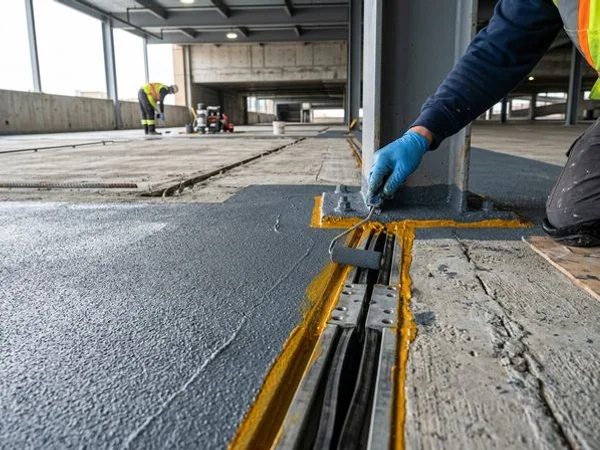
Expansion joints require independent treatment within any membrane system. We use pre-compressed polyurethane foam backer rod and two-part polyurethane joint sealant, applied in a profile that allows the joint to cycle through its full thermal movement range without tearing the sealant face. On structures in Brampton and Vaughan where joints have widened due to years of deferred maintenance, we use a pre-formed neoprene compression seal within a recessed pocket before overplying with the membrane. All joint details are documented photographically and included in the project closeout package provided to the property manager or condo corporation.
Line Marking, Safety Striping, and Wayfinding for GTA Parking Structures
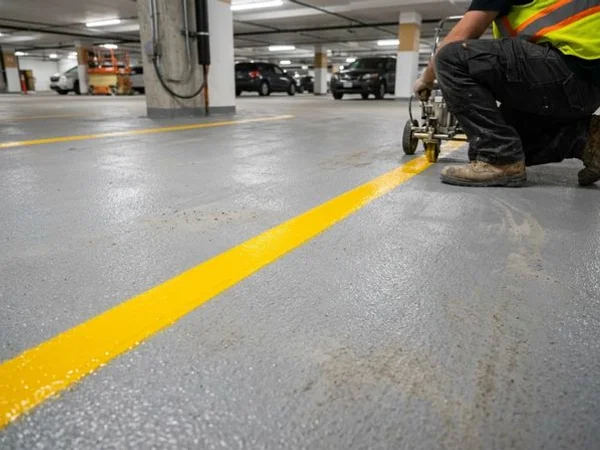
A parking deck coating without embedded line marking is an incomplete installation. Drive-aisle widths, stall boundaries, accessible parking designations, fire lane clearances, and pedestrian crossing zones are all governed by the City of Toronto zoning by-laws and Ontario’s Accessibility for Ontarians with Disabilities Act requirements. Lines and symbols that are simply painted over a coated deck surface wear off under tire abrasion within one to two seasons - particularly in multi-level structures in Vaughan and Mississauga where vehicle volume is high and snow removal equipment runs on the deck through winter. We embed all line marking and stall striping under the topcoat layer, which means the markings are protected by the full film thickness of the coating and last the full service life of the deck rather than needing annual repainting.
Accessible parking stall markings require specific dimensions and the international accessibility symbol installed to Ontario Building Code standards. We confirm all accessible stall counts, dimensions, and signage requirements against the building permit drawings before the line marking layout is taped. For condo corporation clients in North York and Scarborough, where the proportion of accessible stalls relative to total stall count is fixed by the Ontario Building Code and enforced through property standards, getting the layout right before topcoat application avoids costly compliance corrections later.
Wayfinding elements - directional arrows, entrance and exit designations, level numbering - are also embedded under topcoat using the same tape-and-pour method. Colour-coding by level is a common request on multi-level decks in Mississauga commercial centres where disoriented drivers are a common frustration, and we accommodate custom colour schemes in the traffic-deck membrane selection. All line marking layouts are provided in a drawn plan for client sign-off before application begins.
Related Questions Toronto Homeowners Ask
How much does it cost to epoxy a parking garage floor in the GTA?
At-grade surface lots with a two-coat 100% solids epoxy system, embedded anti-slip aggregate, and line marking typically cost $8-$14 per sq ft installed in the Toronto market. Suspended condo or commercial decks requiring a full traffic-deck membrane with expansion-joint detailing run $18-$32 per sq ft. The single largest cost variable is substrate condition - heavy spalling, exposed rebar, or failed prior coatings add concrete repair costs of $4-$12 per sq ft before the coating phase begins.
What type of epoxy is used for aircraft hangar floors near Pearson Airport?
Hangar floors serving aviation facilities in the Brampton and Mississauga corridor are typically specified with novolac epoxy base coats for broad chemical resistance to jet fuel, Skydrol hydraulic fluid, and glycol-based deicers. Where fuel-handling operations create static discharge risk, conductive epoxy primer systems tested to ASTM F150 are installed below the main coating. Aliphatic polyurea topcoats provide UV stability and resistance to the high-intensity cleaning chemicals used in aviation maintenance environments.
How long does parking garage epoxy coating last in Toronto’s climate?
A correctly specified aliphatic polyurea or polyaspartic topcoat on an at-grade lot should deliver 8-12 years of service life before a maintenance recoat is needed. Suspended-deck traffic-deck membrane systems, when installed with proper expansion-joint detailing, carry 15-20 year service lives. Toronto’s 30-plus freeze-thaw cycles per winter are the primary durability challenge - systems that meet ASTM C836 crack-bridging at -29 degrees Celsius perform significantly better over a 10-year window than systems specified only for temperate climates.
Can parking garage line marking be done without closing the whole structure?
Yes. We work level-by-level or zone-by-zone, keeping the rest of the structure accessible throughout the project. Line marking is embedded under the topcoat rather than applied on top - this approach requires the topcoat to be wet when the stall lines and directional arrows are laid in, which is why the sequence is planned carefully with property management and security. Overnight and weekend scheduling is available for high-occupancy condo towers in North York and Scarborough where daytime closures are not practical.
Do condo corporations in Toronto typically require WSIB clearance for parking deck work?
Yes, virtually every condo corporation and commercial property management company in the GTA requires a current WSIB clearance letter and certificate of insurance before a contractor can begin work on common-element areas. We provide both documents at contract signing and can supply updated clearance letters at any point during a multi-phase project. WSIB compliance is also a standard requirement under Ontario’s Occupational Health and Safety Act for any work on a construction project site, which includes parking deck resurfacing.
As a Toronto epoxy flooring contractor, we serve the full range of parking structure types across the GTA - from single-level surface lots in Scarborough and North York to multi-level suspended condo decks in Mississauga and Vaughan. Every project is quoted after an on-site structural survey, not from a per-square-foot rate sheet, because the substrate condition and deck type determine the correct system and the honest price.
Our Parking & Hangar Results in Toronto
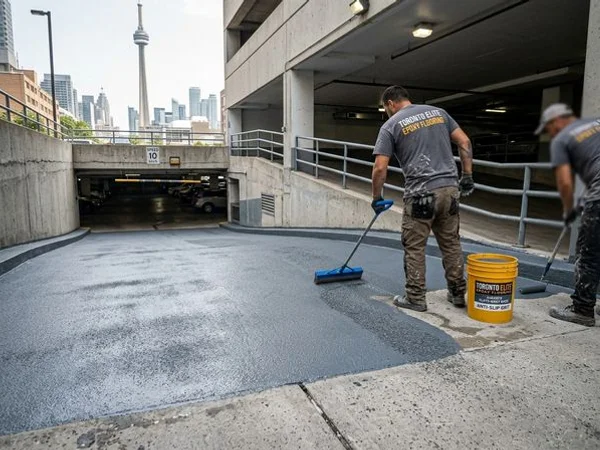
Parking & Hangar Pricing
Why GTA Customers Choose Toronto Elite Epoxy Flooring for Parking & Hangar
Traffic-Deck Membrane Experience
Suspended decks need waterproof crack-bridging - not just paint. We install the right system.
Oil & Fuel Resistant
Spec'd to handle constant vehicle drips, hydraulic fluids, and fuel.
Off-Hours Scheduling
Multi-shift sequencing so parking levels stay operational.
WSIB + Insured
Full compliance for condo, commercial, and aviation contracts.
How Parking & Hangar Works
Structure Survey
We assess the deck type (at-grade vs suspended), traffic class, and waterproofing needs.
Substrate Repair
Crack stitching, spall repair, and detailing for expansion joints.
Membrane + Topcoat
Traffic-deck membrane where structural waterproofing is required, then high-build topcoat.
Line Marking + Reopen
Stall lines, directional arrows, and safety zones embedded under the topcoat.
Ready for a Free On-Site Assessment?
Same-day quotes across the GTA. WSIB-certified, $2M liability on every project.
What Customers Say About Our Parking & Hangar
"Condo amenity room re-coated overnight. Building manager was thrilled with how quiet and clean they kept the work."
"Toronto Elite coated our Malton warehouse parking area - diamond grind to CSP 3, 100% solids epoxy, and embedded anti-slip aggregate. Forklifts and delivery trucks running over it daily with zero delamination after two winters."
"Suspended parking deck membrane installed sequentially level-by-level. Zero issues, perfect waterproofing."
Parking & Hangar FAQs
Do you install traffic-deck membranes?
Yes. Suspended decks (above habitable space) need waterproof crack-bridging traffic-deck membrane systems - not standard epoxy. We install Bakor, Tremco, and equivalent systems with detailed expansion-joint work.
Can you do aircraft hangar floors?
Yes. High-build epoxy systems with chemical and fuel resistance, ESD options where required, and aviation line marking. Off-hours scheduling for active facilities.
How do you handle parking garage line marking?
Stall lines, directional arrows, and safety zones are embedded under the topcoat for permanent visibility - no peeling tape, no painted lines that fade in one season.
Can you work around a condo's daytime traffic?
Yes. We sequence work level-by-level or section-by-section, coordinate with property management and security, and schedule overnights or weekends.
What does parking garage epoxy coating cost in Toronto?
At-grade lots with high-build epoxy typically run $8-$14 per sq ft installed, depending on substrate condition and line marking complexity. Suspended decks requiring a full traffic-deck membrane system range from $18-$32 per sq ft due to the added waterproofing layers, expansion-joint detailing, and material cost of the membrane itself. Aircraft hangar floors with chemical-resistant topcoats and ESD provisions sit in the $12-$22 per sq ft range. All pricing is in CAD and requires an on-site survey.
How long does a parking garage epoxy project take?
A single-level at-grade lot (5,000-10,000 sq ft) typically takes 3-5 days including surface prep, coating, and line marking cure time. A multi-level suspended condo deck is usually sequenced over 2-4 weeks, working one level at a time so the rest of the structure stays operational. We schedule around building access windows and can run overnight or weekend shifts.
How long does the coating last in a Toronto parking garage?
A properly installed polyaspartic or aliphatic polyurea topcoat on a parking deck should last 8-12 years under normal vehicle traffic before needing a maintenance recoat. The underlying traffic-deck membrane on a suspended structure carries a longer service life of 15-20 years when expansion joints are detailed correctly. Toronto's freeze-thaw cycles are the biggest durability variable - that is why CSP 3-4 surface prep and crack-bridging ability matter more here than in milder climates.
What is the difference between a traffic-deck membrane and regular parking garage epoxy?
Standard high-build epoxy is a rigid coating suitable for at-grade slabs where waterproofing the structure below is not a concern. A traffic-deck membrane is a flexible, crack-bridging, fully waterproof system installed on suspended decks to prevent water and chloride ingress into the concrete and the habitable space below. Membranes are multi-layer systems - primer, base membrane, reinforcing fabric, wear course, and UV-stable topcoat - and cost 2-3x more than standard epoxy per square foot.
Do you carry WSIB and liability insurance for parking garage work?
Yes. We carry active WSIB coverage and $2M commercial general liability insurance. Certificates of insurance and WSIB clearance letters are provided with every commercial or condo contract at no additional charge - a standard requirement for property management companies and condo corporations across the GTA.
Can you resurface a parking garage floor that already has old paint or a failed coating?
Yes, but the failed coating must be removed first. We use diamond grinding at CSP 3-4 profile to strip old paint, failed epoxy, or failed waterproofing down to bare concrete. Applying new coating over a failed system is the most common cause of early delamination - skipping this step is not something we do regardless of cost pressure.
Do you handle expansion joint repairs in parking garages?
Yes. Expansion joint detailing is included in every suspended-deck project. Failed or open joints are prepped, cleaned, and treated with a flexible sealant or backer-rod and sealant system compatible with the membrane being installed. Joints that are not properly detailed are the number-one point of water infiltration in Toronto parking structures.
Is anti-slip grit included in the parking garage coating?
Broadcast anti-slip aggregate is standard on all vehicle-trafficked surfaces and any pedestrian walkway areas within the structure. We use aluminium oxide or silica carbide grit broadcast into the topcoat for a permanent anti-slip profile that does not wear off like surface-sprinkled additives.
Related Services
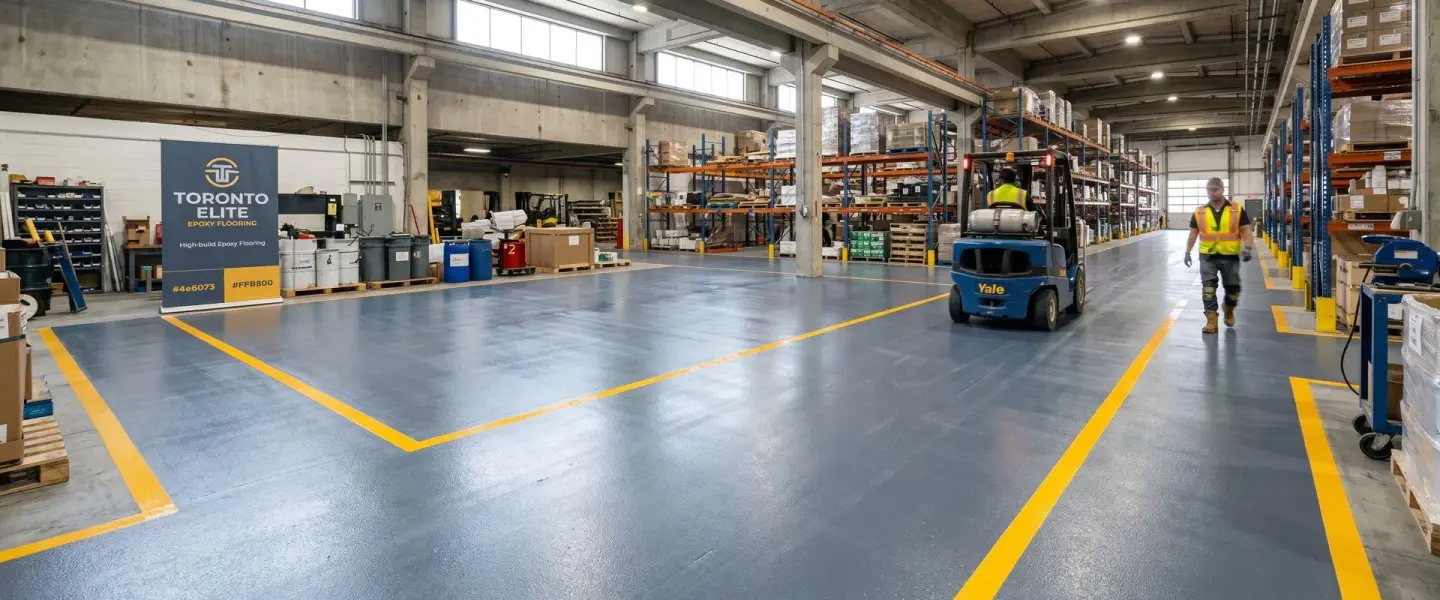
Warehouse Epoxy Flooring in Toronto, ON
Forklift-rated 100% solid epoxy systems with shot-blast prep, chemical-resistant topcoat, and integrated line marking for GTA distribution centres and logistics hubs. Pricing runs $3-$7 per sq ft installed; large warehouse floors complete in off-hours weekend windows with WSIB-certified crews. WSIB-certified crews, liability, and full compliance documentation on every commercial project.
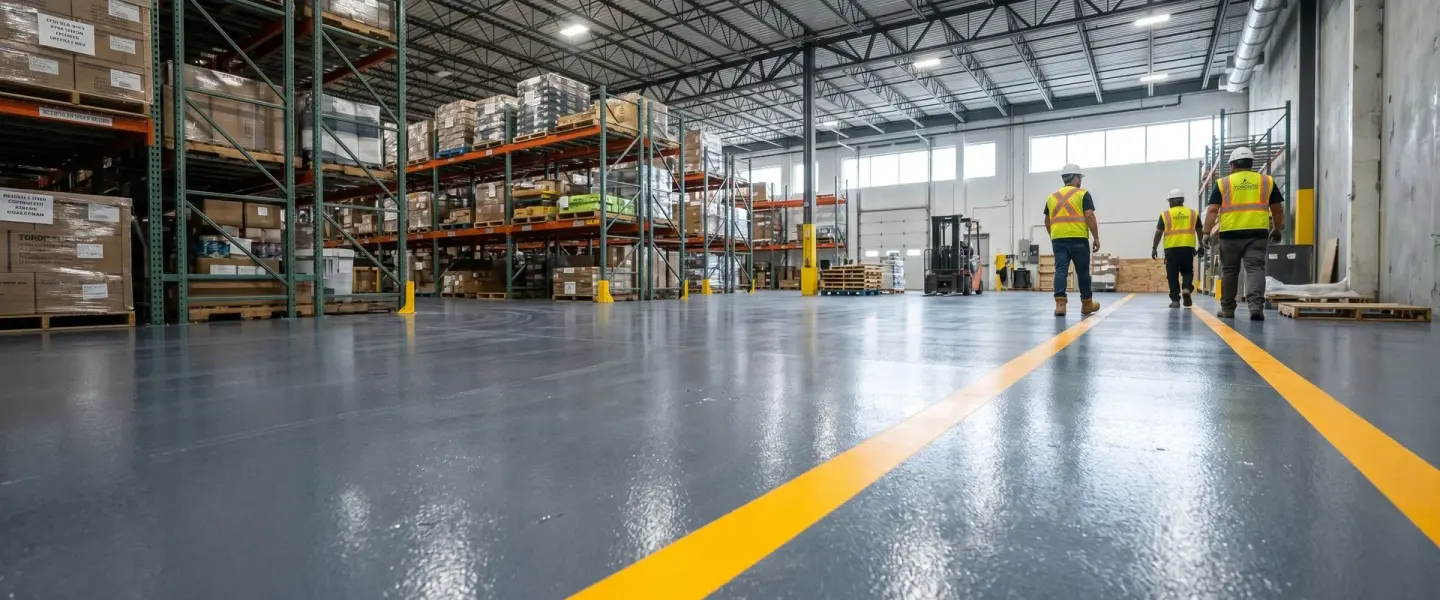
Commercial & Industrial Epoxy Flooring in Toronto, ON
100% solid commercial-grade epoxy systems shot-blast to CSP 3-4 for facilities running forklifts, food production, or 24-hour operations in the GTA. Pricing runs $3.50-$8 per sq ft installed; off-hours scheduling returns your floor before the next shift. WSIB-certified crews, $2M liability, and full compliance documentation on every project.
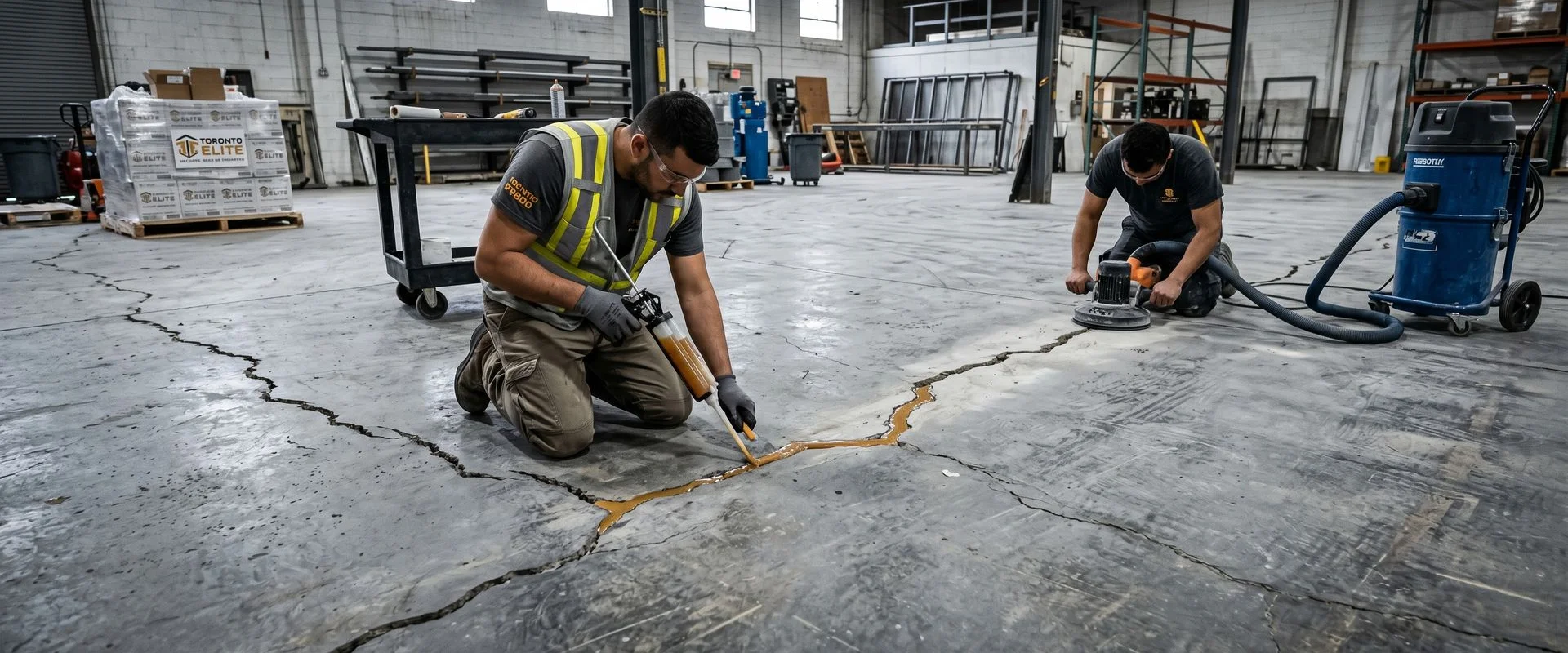
Concrete Repair & Restoration in Toronto, ON
Structural crack stitching, polyurea injection, spall patching, and self-levelling underlayment to restore any GTA concrete slab to a CSP 3 bondable surface before coating. Crack repair starts at $8-$18 per linear foot; slab resurfacing from $3 per sq ft. CSP 3 surface profile confirmed by grind gauge before any coating is applied.
Ready to Book Parking & Hangar?
Same-day free on-site assessment. WSIB-certified, $2M liability on every project.