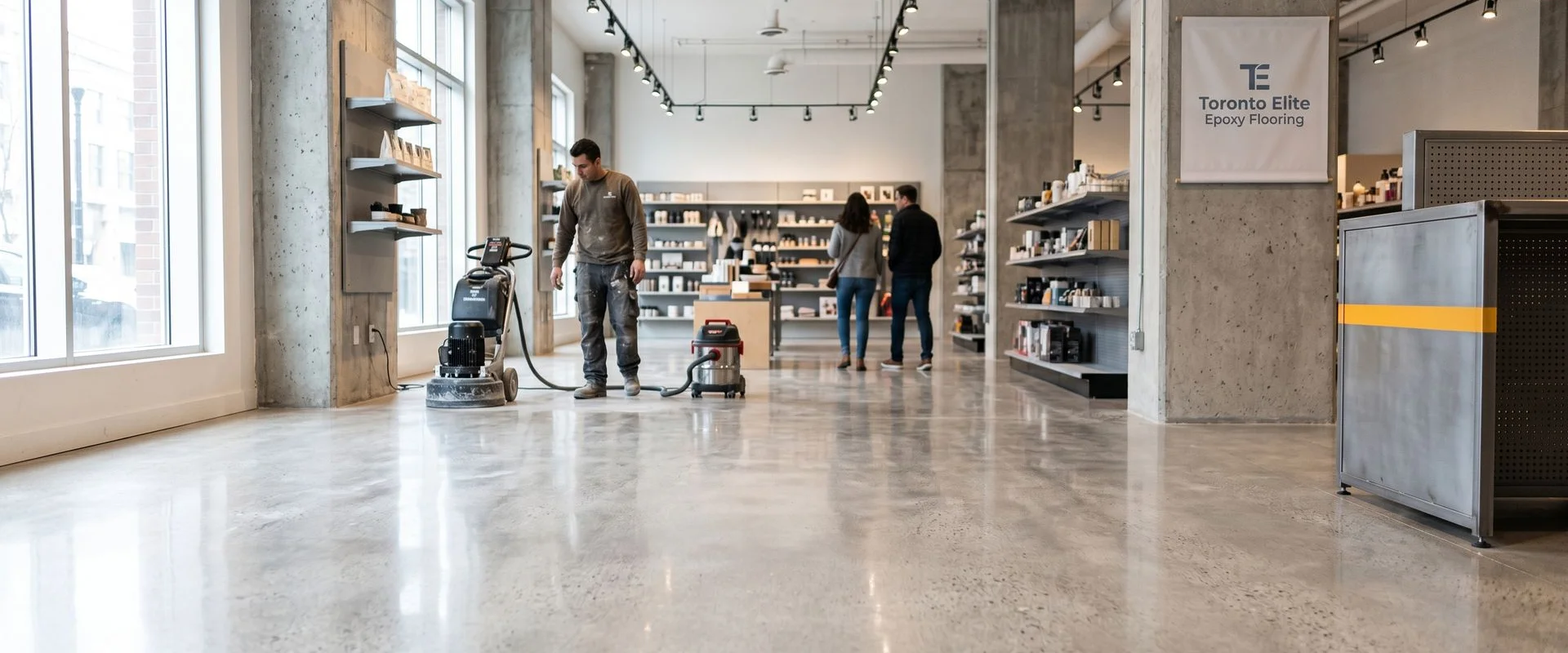
Concrete Polishing in Toronto, ON - Diamond-Ground Densified Floor Professionals
Toronto Elite Epoxy Flooring performs multi-pass diamond grinding, lithium silicate densifier application, and polished concrete finishing for retail stores, office lobbies, restaurants, schools, and commercial showrooms throughout Toronto, ON. Every polished concrete project uses a graduated grit sequence from 30-grit coarse to 3,000-grit fine, with sheen level selection (matte, satin, high-gloss) and optional decorative scoring, aggregate exposure, or concrete dye treatments.
Concrete polishing fails when installers apply a fixed grit sequence without assessing slab hardness first. Ontario concrete with high fly ash content - common in 1970s-1990s poured foundations across North York, Etobicoke, and Scarborough - produces variable hardness across a single pour, with soft paste zones at Mohs 3-4 and hard aggregate zones at Mohs 6-7. A fine grit sequence applied to a soft zone burns the paste and glazes the surface rather than cutting it, producing a cloudy finish that cannot be corrected without restarting the full progression from coarse. Lithium silicate densifier penetration depth - 3-5 mm on a properly sequenced slab - is the variable that determines final sheen longevity and scratch resistance under daily commercial traffic.
Standard commercial polish projects run 1,000-20,000 sq ft and complete in 2-5 days depending on slab hardness and desired sheen level. Pricing ranges from $3 to $8 per sq ft installed depending on grit progression, densifier depth, and decorative treatment. Polished concrete eliminates wax stripping, re-coating, and ongoing floor maintenance costs for the life of the slab.
Toronto Elite Epoxy Flooring provides concrete polishing to Toronto, ON and surrounding Ontario cities, including Etobicoke, Scarborough, North York, Mississauga, Oakville, Vaughan, Brampton, Markham, Richmond Hill, Burlington, Ajax, and Oshawa.
What is Concrete Polishing?
Concrete polishing is a mechanical process that takes a rough concrete slab and grinds it through progressively finer diamond grits until you reach the sheen level you want. There’s no separate coating - the floor you walk on is the slab itself, hardened and dust-proofed with a lithium silicate densifier.
For retail, showrooms, and warehouses, polished concrete gives you a hard, light-reflective, low-maintenance surface without the peel-and-fail risk of a coating. Done properly, it lasts the life of the slab. As Toronto’s full-spectrum epoxy flooring contractor, we’ll tell you honestly when a polish beats a coating - and when a retail showroom epoxy finish is the better call for your space.
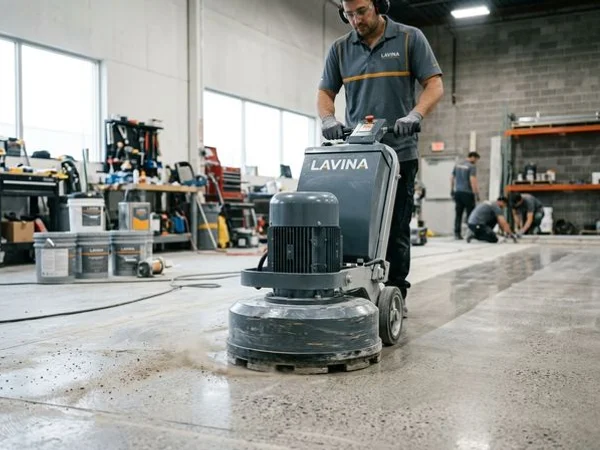
We run multi-grit grinding with vacuum-attached equipment (Lavina, HTC) and a densifier pass between grits. You pick the final sheen - matte for industrial, satin for retail, high-gloss for premium showroom space.
What’s Included
- Slab assessment and sheen selection with sample boards
- Multi-grit diamond grinding (4-7 passes depending on target sheen)
- Lithium silicate densifier application
- Polish to your selected sheen (matte / satin / high-gloss)
- Optional staining or dyeing for colour effect
- HEPA-filtered vacuum equipment - minimal dust during install
- Off-hours scheduling for retail and warehouse environments
Polished Concrete vs Epoxy: Which Floor Is Right for You
The most common question we field from facility managers across the GTA is whether polished concrete or an epoxy system makes more sense for their space. The honest answer depends on four factors: what the floor needs to resist, how it will be maintained, what the ownership timeline looks like, and what the slab itself is telling you.
Polished concrete is the better choice when the goal is a permanent, low-cost-to-maintain floor with a clean industrial or modern retail aesthetic. Retail units in Leaside and boutique showrooms in Rosedale regularly choose polished concrete at an 800-grit satin finish because the reflective surface amplifies natural light, reduces lighting energy costs, and requires nothing more than a pH-neutral damp mop and an annual burnish. There is no coating to peel, no recoat cycle to budget for, and no delamination risk if a forklift drops a pallet.
Epoxy systems - particularly broadcast polyaspartic, aliphatic polyurea topcoats, or chemical-resistant novolac builds - are the right call when the floor faces regular chemical exposure, needs a vapour barrier, requires CFIA-compliant seamless sanitation, or when the owner wants specific colour and decorative aggregate. A warehouse in Markham processing industrial solvents needs a novolac epoxy rated for chemical immersion, not a mechanically polished slab. A Mississauga food-processing facility required to pass CFIA inspections needs a seamless urethane cement or epoxy system, not a bare-concrete surface that can harbour bacteria in micro-surface porosity. For residential garages, a broadcast polyaspartic with anti-slip aggregate outperforms polished concrete because the surface is far more chemically resistant to road salt, motor oil, and brake fluid.
Cost is another real differentiator. In the GTA market, polished concrete typically runs $4-$9 per square foot depending on slab condition and target sheen. A comparable broadcast polyaspartic system runs $5-$12 per square foot, but includes colour, chip, and metallic options that polished concrete cannot replicate. The lifetime cost equation often favours polished concrete in high-traffic commercial spaces because recoat cycles every 7-10 years are eliminated. If you are in a leased space with a 5-year lease and no renewal expectation, a mid-range polyaspartic system may be the more financially sensible floor.
How Concrete Polishing Works and How Long It Lasts
The concrete polishing process follows a strict grit progression that cannot be rushed without permanently compromising the result. We start with metal-bond diamond tooling at a coarse grit - typically 30 or 50 grit - to flatten the slab, remove existing coatings or glue residue, and achieve a Concrete Surface Profile of CSP 1-2 as defined by ICRI (International Concrete Repair Institute) guidelines. Skipping grits or running each pass too quickly leaves sub-surface scratching that becomes visible under raking or directional light, particularly in high-gloss finishes at the 1,500-3,000 grit level.
After the initial coarse grinding passes, we apply a lithium silicate densifier. Lithium silicate penetrates the concrete matrix, reacts with free lime and calcium hydroxide in the paste, and forms calcium silicate hydrate crystals that fill the pore structure. The result is a measurably harder surface - typically an increase of 20-30% in surface hardness measured by Mohs scale comparison testing - and a permanently dust-proofed floor. Sodium silicate densifiers are cheaper but leave a surface residue that can cause hazing; lithium silicate penetrates without residue, which is why it is the professional standard for GTA commercial polishing.
Following densifier cure (typically 1-4 hours depending on ambient temperature and concrete porosity), we continue through resin-bond diamond pads at 100, 200, 400, 800, 1,500, and 3,000 grit, depending on the target sheen. A matte finish stops at 400-grit and is common for warehouse and industrial spaces in Richmond Hill and Oakville industrial parks where traction matters more than reflectivity. A satin finish at 800-grit suits retail and commercial showroom environments. High-gloss at 1,500-3,000 grit is specified for premium lobby floors and hospitality spaces where maximum light reflection is the priority.
Durability is the most important long-term consideration. Polished concrete does not have a coating that wears through - the floor is the slab. In moderate foot-traffic retail environments, a satin-polished slab may show minor surface dulling after 5-7 years in high-traffic corridors, which is corrected by a single burnishing pass rather than a full recoat. ASTM E303 slip resistance testing on a properly maintained polished concrete surface at 400-grit or higher typically returns a Dynamic Coefficient of Friction (DCOF) above the 0.42 minimum threshold required for commercial flooring under ANSI A137.1. Wet-slip performance can be further improved with a penetrating silane/siloxane guard coat that does not change the sheen level.
Concrete Staining, Dyeing, and Decorative Options for Polished Slabs
Polished concrete does not have to be grey. Acid staining and water-based reactive dyes applied to the slab between grinding passes permanently alter the colour of the concrete matrix rather than sitting on top of it as a coating would. The result is a floor whose colour is inside the slab - it cannot peel, chip, or delaminate because there is no film to detach. This is a meaningful advantage in high-traffic retail environments across the GTA where a topcoat might show scratch marks or wear lines within a few years.
Acid staining uses a dilute hydrochloric acid solution with metallic salts - typically ferric nitrate for amber and brown tones, cupric nitrate for blue-green, and sodium ferrocyanide for yellow. The acid opens the pore structure of the concrete, the metallic salts react with free lime in the cement paste, and the result is a permanent mineral colour that intensifies with additional polish passes. The colour range is limited to earth tones - browns, russets, greens, and golds - because the chemistry is based on naturally occurring mineral reactions. Acid stain is the preferred choice for restaurant and hospitality spaces in Leslieville and the Distillery District, where the patinated, aged appearance supports the design direction.
Water-based dye penetrates the concrete pore structure without the acid reaction step, which means the colour palette is unlimited - any pigment that can be dissolved in a water-based carrier can be applied. Dye colours are more uniform than acid stain, which makes them the right specification for corporate lobbies and branded retail environments in Vaughan and Mississauga where a specific Pantone or brand-matched colour is required. Water-based dyes are applied after the initial coarse grinding passes and before the densifier, so the dye sits within the top 1-3 mm of the polished slab rather than on the surface. A clear guard coat or lithium silicate densifier locks the colour during subsequent polish passes.
One practical consideration for GTA commercial projects: dye application is temperature and humidity sensitive. Application below 10 degrees Celsius or above 75% relative humidity causes uneven absorption, which produces blotchy colour rather than a uniform wash. This matters for retail strip plazas in Brampton and Etobicoke where the slab is often at grade level with limited climate control in winter. We assess ambient conditions before scheduling dye work and use propane heat and dehumidifiers in shoulder seasons to hold the installation window.
Related Questions Toronto Homeowners Ask
How much does concrete polishing cost per square foot in Toronto?
Most GTA commercial concrete polishing projects run between $4 and $9 per square foot, with the final number driven by slab condition, number of grit passes, and target sheen level. A 5,000 sq ft warehouse in Oakville or Richmond Hill polished to a 400-grit matte finish lands closer to $4-$5 per square foot, while a premium 3,000-grit high-gloss lobby floor in a Rosedale commercial building can reach $8-$10 per square foot due to the additional diamond passes and longer labour time.
How long does a polished concrete floor take to install?
A standard 3,000-5,000 sq ft commercial floor takes 2-4 days from coarse grinding through final polish. The densifier application requires a 1-4 hour cure window before grinding can resume, which adds time but is non-negotiable for a durable result. Large Markham or Richmond Hill warehouse floors of 20,000 sq ft or more are typically scheduled across consecutive overnight or weekend shifts to avoid operational downtime, with each shift covering one to two grit progression stages.
Can polished concrete be done over a previously coated floor?
Yes, but it adds cost and time. Existing epoxy, urethane, or VCT tile adhesive must be stripped or ground off before diamond polishing can begin. Shot blasting is often required to achieve the CSP 1-2 profile needed for clean polishing. Depending on adhesive thickness and bond strength, additional grinding passes at 16 or 30 grit are needed before the standard progression begins. We assess this during the site walk and quote accordingly - there are no surprise charges after the project starts.
Does polished concrete require sealing after the polish?
The lithium silicate densifier applied mid-process is not a topical sealer - it chemically modifies the slab rather than sitting on top of it. For most retail and warehouse environments in the GTA, the densified and polished slab performs without a topical guard. For environments with regular liquid spills, cooking oils, or de-icing salt tracked in from Oakville or Leaside parking lots, a penetrating silane/siloxane guard coat is applied to the final polished surface. This improves stain resistance without changing the sheen level or creating a surface film that can scratch or delaminate.
What slip resistance standard does polished concrete meet?
Polished concrete polished to 400-grit matte or 800-grit satin typically meets or exceeds the DCOF 0.42 minimum for level commercial flooring under ANSI A137.1 when dry. Wet-surface DCOF performance drops at higher gloss levels - a 3,000-grit high-gloss floor is noticeably more slippery when wet. For environments with water or cleaning fluid present, we recommend stopping at 800-grit or applying a penetrating grip additive. WSIB compliance in Ontario requires that commercial flooring in food service and industrial settings meet slip-resistance standards, and we provide DCOF test results on request for projects requiring documentation.
As a Toronto epoxy flooring contractor, we have completed polished concrete projects across the GTA from small Leaside retail units to large-format Markham distribution centres. Every project starts with an honest slab assessment and a frank conversation about whether polishing or a coated system is the better long-term investment for your specific facility.
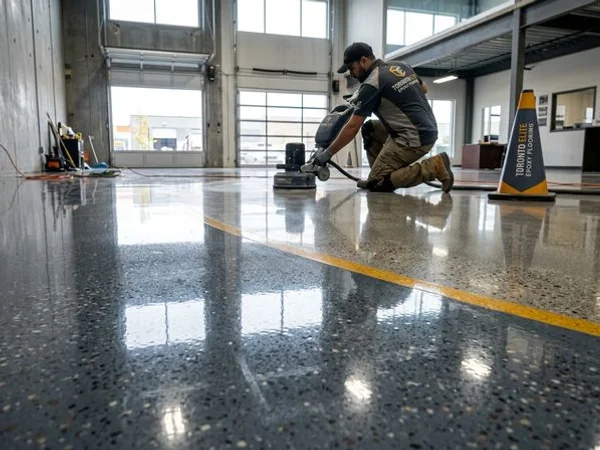
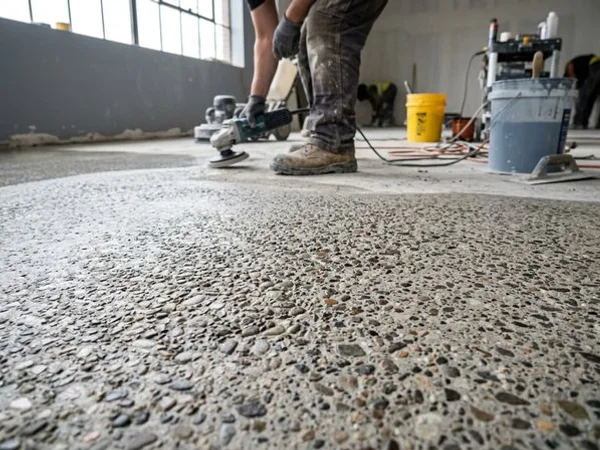
Our Concrete Polishing Results in Toronto
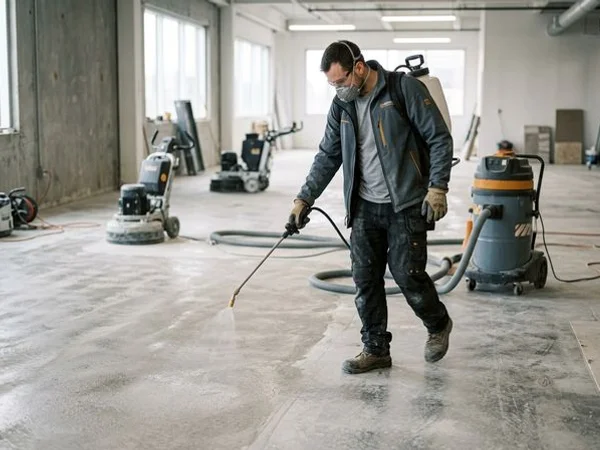
Concrete Polishing Pricing
Pricing depends on slab condition, sheen level, and square footage.
Why GTA Customers Choose Toronto Elite Epoxy Flooring for Concrete Polishing
No Coating to Fail
Polished concrete is the slab itself - no peel, no delaminate. Maintained by re-polishing.
Choice of Sheen
Matte for industrial, satin for retail, high-gloss for showroom. You pick.
Low Maintenance
Damp mop, occasional burnish, no waxing or stripping. Cheaper to maintain long-term.
Off-Hours Installs
Multi-shift scheduling for retail and warehouse environments.
How Concrete Polishing Works
Slab Assessment
We check slab hardness, aggregate exposure preference, and the sheen level you want.
Multi-Grit Grinding
Progressive diamond pads expose aggregate and flatten the surface.
Densifier Application
Lithium silicate densifier hardens the slab and reduces dust.
Polish to Sheen
Polished to your chosen sheen - matte, satin, or high-gloss.
Ready for a Free On-Site Assessment?
Same-day quotes across the GTA. WSIB-certified, $2M liability on every project.
What Customers Say About Our Concrete Polishing
"Had Toronto Elite polish our showroom in Vaughan - 800-grit satin with lithium densifier, WSIB-compliant crew, done over a weekend. The floor reflects light like a mirror and we haven't touched it beyond a damp mop."
"Polished concrete in our retail unit - three years on, still gorgeous and we've never re-coated anything."
"Honest assessment: they told us polished concrete was the better call than epoxy for our warehouse. It was."
Concrete Polishing FAQs
Polished concrete or epoxy - which is right?
Polished concrete works best for retail, showrooms, and warehouses where you want the bare-concrete look and minimal long-term maintenance. Epoxy works better for garages, basements, and any space that needs chemical resistance, custom colour, or a vapour barrier.
How long does polished concrete last?
It is the slab - so as long as the slab does. Routine maintenance is damp mopping plus an occasional burnish. Heavy traffic may eventually require a re-polish, but that's a refresh, not a replacement.
Can you polish a stained or damaged slab?
Stains can often be ground out during the multi-grit process. Severe damage may need patching first - we'll cover that during the site walk.
What sheen level should I choose?
Matte (400-grit) for industrial, satin (800-grit) for retail and showroom, high-gloss (1500-3000 grit) for premium spaces. We bring sample boards during the assessment.
Does it create a lot of dust during install?
No. We use HEPA-filtered vacuum-attached grinders. The slab densifier also dust-proofs the floor permanently - a major reason facilities choose polishing over bare slab.
What does concrete polishing cost in Toronto?
Most GTA commercial jobs run between $4 and $9 per square foot depending on slab condition, number of grit passes, and final sheen level. A 5,000 sq ft warehouse floor at satin sheen typically falls in the $25,000-$35,000 range. Heavily damaged or previously coated slabs cost more because additional grinding passes are required.
How does polished concrete compare to a polyaspartic coating for cost?
Polished concrete has a higher upfront cost per square foot than a broadcast polyaspartic system, but eliminates ongoing recoat cycles. A polyaspartic topcoat on a properly prepared slab may need refreshing every 5-10 years in high-traffic retail environments. Polished concrete typically requires only periodic burnishing, which is far cheaper than a full recoat.
Does polished concrete meet CFIA or food-safe flooring requirements?
A densified and sealed polished concrete floor can meet CFIA sanitation requirements when the surface is free of cracks and properly maintained. For processing areas with heavy chemical wash-downs, a novolac epoxy or urethane cement system is often the better compliance choice. We can advise based on your facility's inspection requirements.
What is the CSP profile used for concrete polishing in Toronto?
The starting CSP (Concrete Surface Profile, per ICRI guidelines) for polishing is typically CSP 1-2, achieved with metal-bond diamond tooling during the initial coarse grinding passes. Slabs with existing coatings may require shot blasting to CSP 3 before diamond grinding begins to ensure proper aggregate exposure.
How long does a concrete polishing project take?
A typical 3,000-5,000 sq ft commercial floor takes 2-4 days including densifier cure time. Larger warehouse jobs in Richmond Hill or Markham industrial parks are scheduled in overnight or weekend shifts to minimise operational disruption. We do not rush grit progression - skipping grits results in visible scratching under directional light.
Is there a warranty on polished concrete work?
We warranty the workmanship - meaning the grind, densifier application, and polish progression - for 2 years against process defects like uneven sheen or visible grinding scratches. The slab itself carries no coating, so there is no delamination risk. Warranty is void if the floor is exposed to acids or heavily abrasive cleaning agents that etch the surface.
Can polished concrete be done in a garage or residential basement?
Yes, but it requires careful moisture assessment first. GTA residential slabs in Leaside, Rosedale, and older Oakville homes often have higher vapour transmission rates than modern commercial pours. If the moisture vapour emission rate exceeds 3 lbs per 1,000 sq ft per 24 hours, a vapour barrier treatment must precede polishing to prevent eventual surface hazing.
Related Services
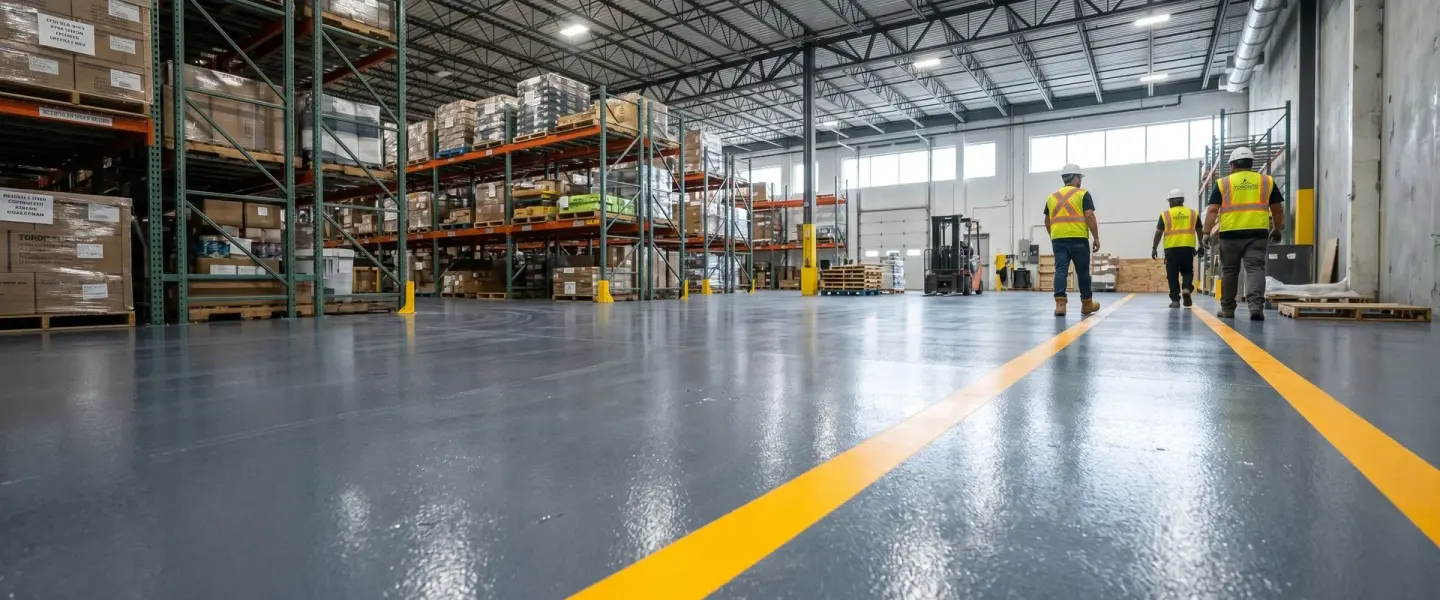
Commercial & Industrial Epoxy Flooring in Toronto, ON
100% solid commercial-grade epoxy systems shot-blast to CSP 3-4 for facilities running forklifts, food production, or 24-hour operations in the GTA. Pricing runs $3.50-$8 per sq ft installed; off-hours scheduling returns your floor before the next shift. WSIB-certified crews, $2M liability, and full compliance documentation on every project.
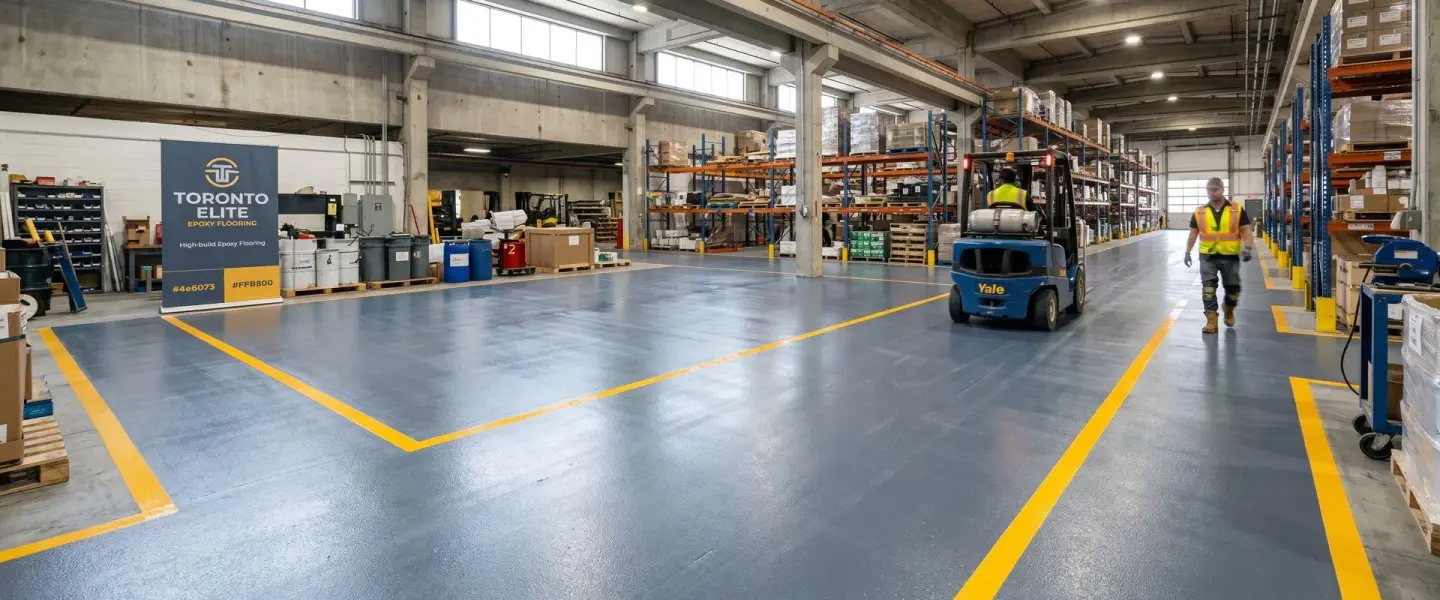
Warehouse Epoxy Flooring in Toronto, ON
Forklift-rated 100% solid epoxy systems with shot-blast prep, chemical-resistant topcoat, and integrated line marking for GTA distribution centres and logistics hubs. Pricing runs $3-$7 per sq ft installed; large warehouse floors complete in off-hours weekend windows with WSIB-certified crews. WSIB-certified crews, liability, and full compliance documentation on every commercial project.

Retail Showroom Epoxy Flooring in Toronto, ON
High-gloss commercial epoxy with custom RAL colour matching, optional logo inlays, and an aliphatic polyaspartic topcoat rated for 500+ daily foot traffic without scuffing or UV yellowing. Pricing runs $4-$9 per sq ft installed; most showroom floors complete in 2-3 overnight shifts with zero business disruption. WSIB-certified crews with $2M liability coverage on every GTA install.
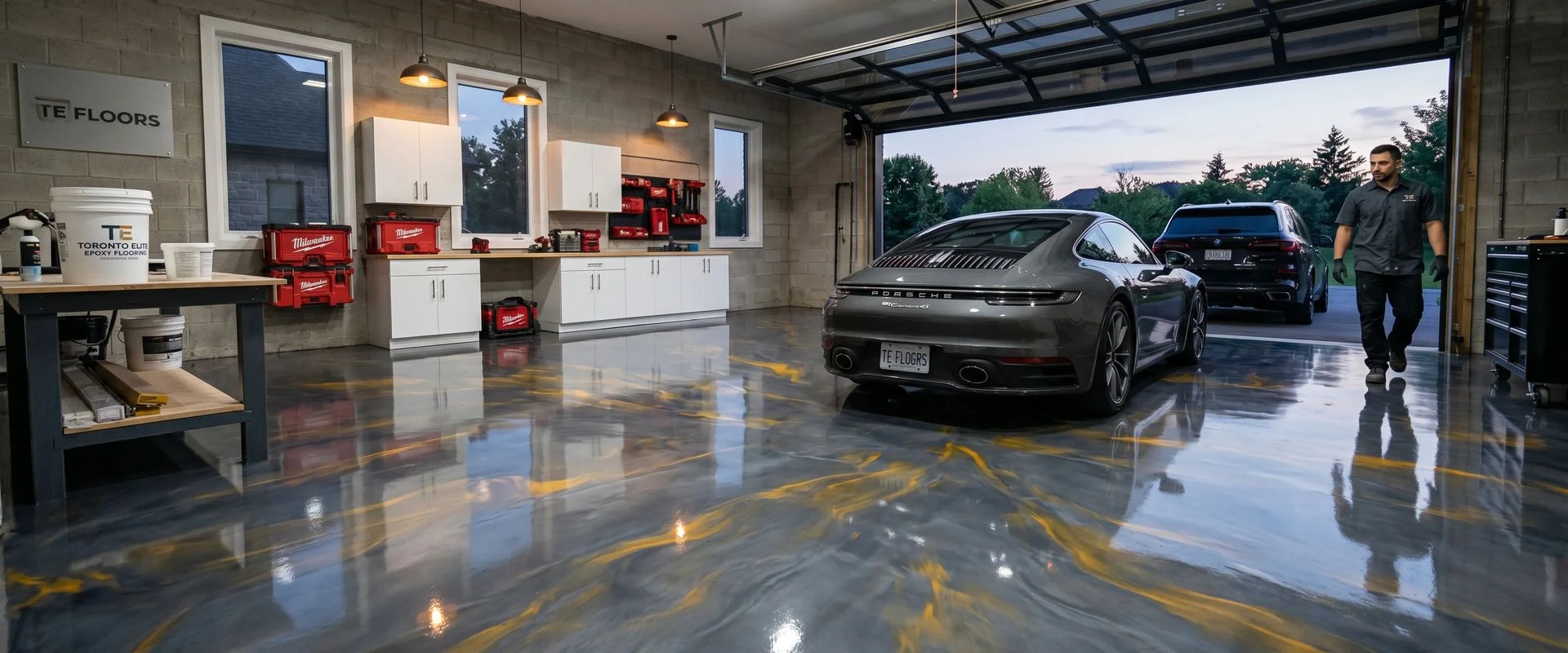
Ready to Book Concrete Polishing?
Same-day free on-site assessment. WSIB-certified, $2M liability on every project.