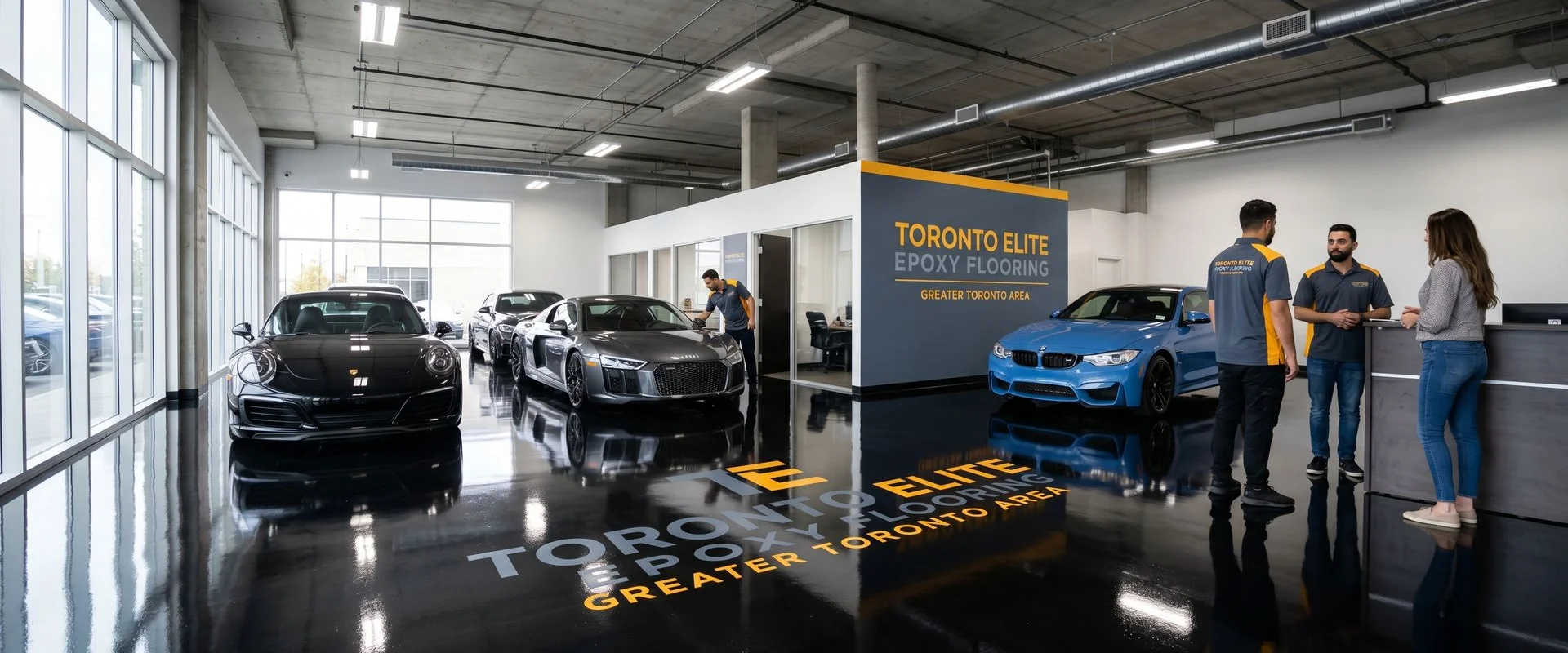
Retail Showroom Epoxy Flooring in Toronto, ON - High-Gloss Commercial Floor Professionals
Toronto Elite Epoxy Flooring installs custom RAL-matched solid-colour, metallic accent, and logo inlay epoxy systems for boutiques, car dealerships, fitness studios, and commercial showrooms throughout Toronto, ON. Every showroom install uses aliphatic polyaspartic topcoat chemistry rated for UV stability and anti-scuff performance under 500+ daily foot traffic, with overnight scheduling so retail operations open on time without a day of closure.
Retail and showroom floors face abrasion and UV load that standard epoxy specifications underestimate. Hard-soled shoes, trolley wheels, and pallet jacks crossing a floor 1,000-5,000 times daily strip low-solids coatings to bare concrete within a single season. Modern retail LED lighting at 4,000-6,500K colour temperature emits sufficient UV output to yellow standard aromatic epoxy topcoats within 12 months - converting a bright white or light grey showroom floor to dingy amber under the very lighting designed to showcase the space. Aliphatic polyaspartic topcoats rated for UV stability and Shore D 78+ abrasion hardness are the minimum specification for a retail floor that holds colour and finish under daily commercial traffic.
Showroom floor projects typically run 500-5,000 sq ft and complete in 1-3 overnight shifts depending on design complexity and coating layers. Pricing ranges from $5 to $12 per sq ft installed depending on colour specification, metallic or flake broadcast, logo inlay work, and topcoat tier. Anti-scuff and anti-mark topcoat upgrades are available for high-trolley-traffic retail environments.
Toronto Elite Epoxy Flooring provides retail showroom epoxy flooring to Toronto, ON and surrounding Ontario cities, including Etobicoke, Scarborough, North York, Mississauga, Oakville, Vaughan, Brampton, Markham, Richmond Hill, and Burlington.
What is Retail & Showroom Epoxy?
A showroom floor is part of the merchandising - customers form an impression the moment they step in. High-gloss epoxy with brand-matched colour and optional logo inlay turns a plain concrete slab into a statement floor that supports the rest of the retail design.
We work with your brand colours, install in your closed hours, and use traffic-rated polyaspartic topcoats so the floor reopens for business the next day. Custom layering - including a decorative metallic finish, marbled, two-tone, or logo inlay - is part of the consultation, delivered by Toronto’s full-spectrum epoxy flooring contractor.
What’s Included
- Brand-colour consultation with sample boards
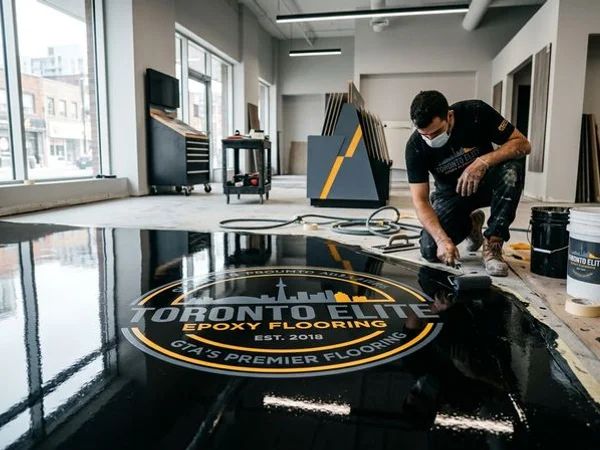
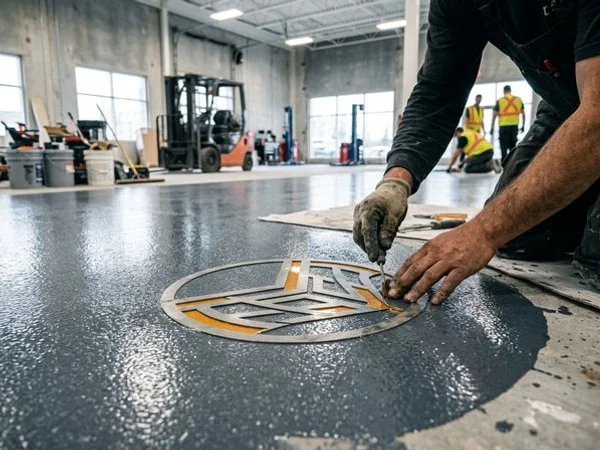
- Optional logo inlay design and execution
- Off-hours diamond-grind prep
- 100% solid epoxy base in your brand colour
- Optional metallic layering or two-tone effects
- Traffic-resistant polyaspartic topcoat
- 24-hour return to service for most installs
- Warranty on the system
High-Gloss Showroom Floors with Custom Branding Options
A retail floor in a Vaughan auto dealership carries different demands than a boutique showroom on Queen West, but both share one requirement: the floor has to look deliberate. Achieving a controlled, brand-accurate gloss finish starts with concrete surface profile. We grind to ICRI CSP 2-3 on most retail slabs, which gives the epoxy enough mechanical bond to hold under shopping cart wheels, display case loads, and constant foot traffic without lifting at the edges or blistering under the topcoat. Before any colour goes down, a moisture test per ASTM F2170 confirms the slab is below 75% relative humidity - a reading that often surprises owners of slab-on-grade units in Mississauga retail plazas built before 2010.
The colour system itself uses 100% solids epoxy broadcast in custom-mixed pigments, not water-based products that thin under traffic. For brand-critical colours, we mix to a Pantone or RAL reference and produce physical sample boards in the actual epoxy material - not a paint swatch - so you approve the exact colour before a single litre is poured. Logo inlays go down through one of two methods: masked pours, where tape outlines control the colour boundary with sub-millimetre edge precision; or pre-cut vinyl decals laminated under the topcoat, which suit complex vector graphics with fine detail. Both methods place the logo beneath the topcoat, meaning it cannot be scuffed off by foot traffic or cleaning equipment.
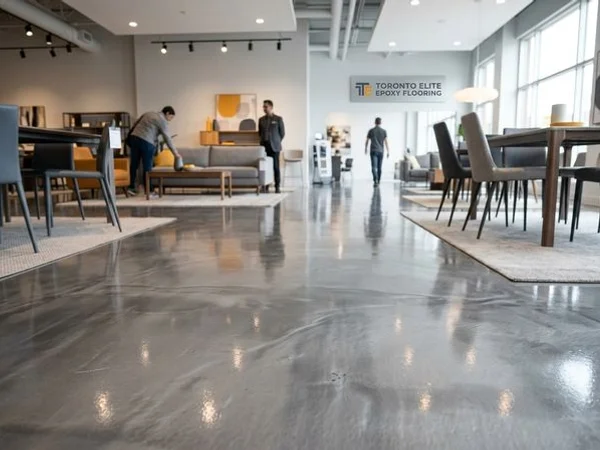
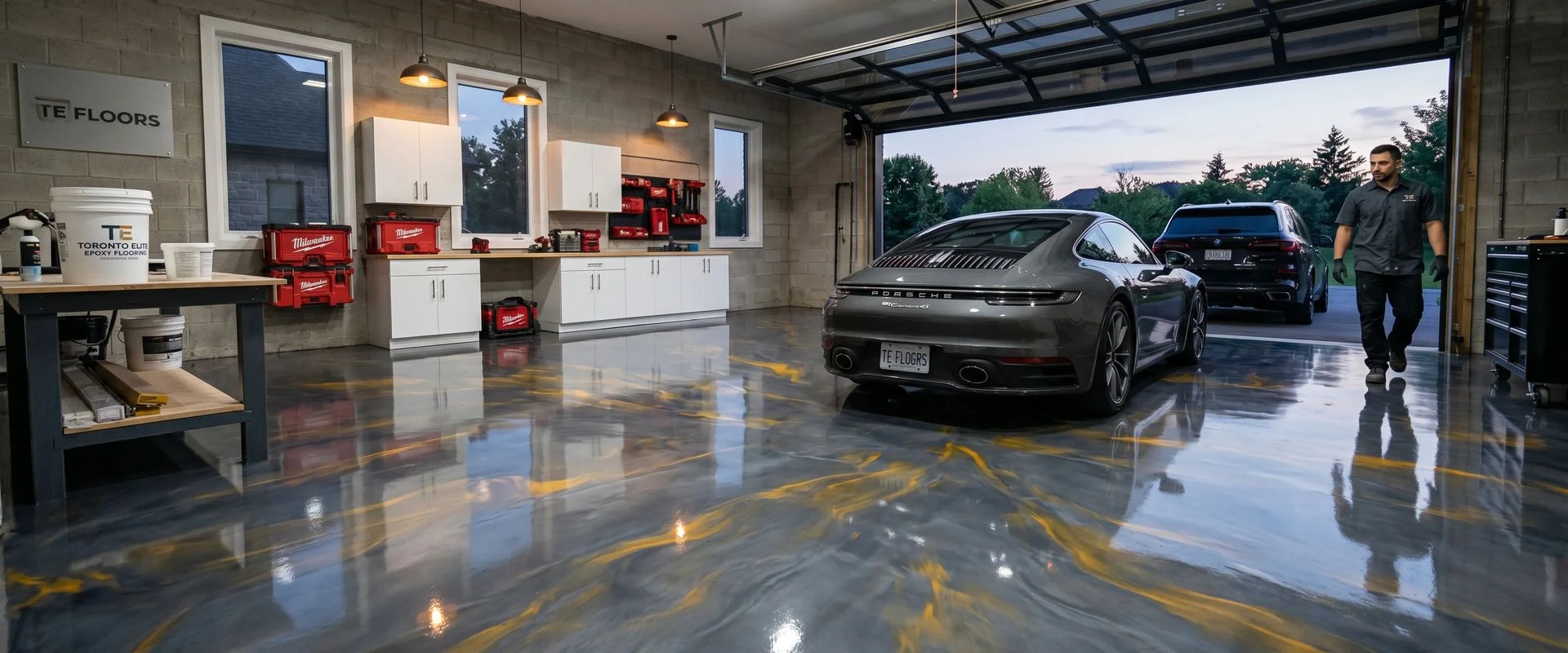
Metallic systems are a strong choice for high-end furniture showrooms and automotive retailers in North York and Richmond Hill, where the visual effect needs to read well under track lighting. We use aluminium or pearl metallic pigments suspended in epoxy at 100-200 grams per square metre, manipulated wet to produce flowing, three-dimensional patterns that photograph well and change appearance as customers move through the space. The aliphatic polyurea or aliphatic polyaspartic topcoat applied over the metallic layer provides UV stability, which prevents the colour from yellowing under the fluorescent and LED lighting arrays typical of large-format retail in the GTA. For a 3,000 sq ft showroom, a metallic epoxy system with a polyaspartic topcoat typically runs between $28,000 and $42,000 CAD installed, depending on design complexity and surface condition.
Keeping Showroom Epoxy Scratch- and Traffic-Resistant
The topcoat is what keeps a retail floor looking new at month 18, not month one. Most epoxy installers apply a standard aliphatic polyurethane topcoat, which performs adequately in low-traffic offices. For retail showrooms in Oakville, where luxury goods and auto accessory retailers see hundreds of daily visitors, we specify aliphatic polyaspartic or aliphatic polyurea - products with a Shore D hardness above 75 and an abrasion resistance that meets or exceeds ASTM D4060 Taber abrasion standards at the 1,000-cycle test weight. That hardness difference is measurable: a standard polyurethane topcoat at Shore D 60 shows visible scuffing from dragged chair legs within 90 days; a polyaspartic at Shore D 80 resists that same scuffing for years under equivalent traffic.
Anti-slip performance is a separate variable from gloss, and the two can be managed independently. For showroom entryways, fitting room corridors, and any zone that sees tracked-in moisture from Toronto’s wet seasons, we broadcast 60-mesh aluminium oxide into the wet topcoat at 80-120 grams per square metre. This brings the coefficient of friction to 0.6 or above per ASTM D2047, which satisfies WSIB slip-and-fall guidelines for commercial spaces without producing a visibly gritty or matte surface. Customers in a Mississauga furniture showroom or a North York electronics retailer will not notice the aggregate from standing height - the floor still reads as high-gloss.
Maintenance protocol directly affects how long a showroom floor retains its appearance. Epoxy and polyaspartic topcoats are chemically resistant to most cleaning products, but retail floor care products that contain strong solvents or citrus-based degreasers will attack the topcoat over time. We provide a written care guide with every commercial install: neutral-pH cleaner at one part per sixty parts water, weekly damp mopping, and quarterly inspection of high-traffic transition zones near entry doors. A Toronto epoxy flooring contractor who delivers only the install without a care protocol is leaving the client to guess, and poor cleaning choices are the leading cause of premature gloss loss on showroom floors in the GTA. Recoating with a fresh polyaspartic topcoat every five to seven years, at roughly $2-$4 per square foot, restores the original gloss and extends the base system life indefinitely.
Auto Dealerships, Boutiques, and Large-Format Retail: How Specifications Differ
The specification for a retail showroom epoxy floor is not the same across store types, and applying a residential-grade or generic commercial formula to the wrong retail environment is how floors fail well before their design life. Three client categories in the GTA illustrate the differences clearly.
Auto dealerships - particularly the Toyota, BMW, and Lexus franchises clustered along Highway 400 in Vaughan and along Dixie Road in Mississauga - require a floor that performs under vehicle weight, hot tires from freshly driven cars, and the aesthetic requirement of a mirror-like showroom surface. For these spaces, the base coat is a 100% solids high-build epoxy at 20-30 mils dry film thickness, the midcoat is a clear gloss coat that fills surface porosity, and the topcoat is a two-component aliphatic polyaspartic at Shore D 80 or above. The topcoat must be rated for dynamic hot-tire contact rather than static heat - a specification that rules out standard polyurethane topcoats, which soften under tires driven directly from a highway at 100 km/h. The floor surface profile must also be flat to within 3mm over a 3-metre straightedge before the base coat is applied, because reflective high-gloss finishes telegraph every surface undulation.
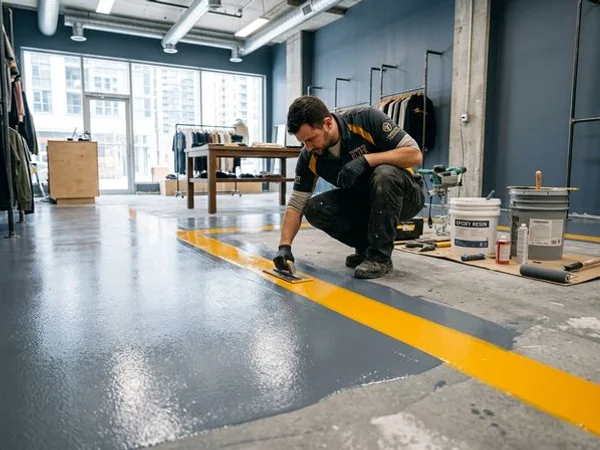
Boutique retail in Yorkville, Queen West, and the Distillery District has different priorities. Floor area is typically smaller - 500 to 2,000 sq ft - but the visual requirement is more demanding and the installation window is narrower. Boutiques often operate six to seven days a week with no multi-day closure available. We schedule these jobs as single-night installs using polyaspartic systems that cure to foot traffic in 4 to 6 hours. The colour work is done using Pantone or RAL reference matching with physical sample board sign-off, and logo or pattern inlays are pre-confirmed to the millimetre using a floor tape layout before the first litre is mixed. A botched colour on a Queen West boutique floor is not correctable without a full strip-and-redo - the sample board approval process eliminates that risk entirely.
Large-format retail in Scarborough Town Centre or Square One Mississauga operates at a different scale. Floor areas of 5,000 to 30,000 sq ft require multiple crew working in coordinated sections, each section timed so the epoxy base on one zone is ready for broadcast while the adjacent zone is still being prepped. Pot life management is critical at GTA summer temperatures: a 100% solids epoxy at 25 degrees Celsius has a working pot life of 25 to 40 minutes, and on a 10,000 sq ft floor that is not enough time for a single crew to spread a full batch. We use temperature-controlled mixing stations and smaller batch sizes to extend effective working time without compromising film build.
Off-Hours Installation: How We Work Around Your Business Hours
Retail floor installation in a trading centre or strip plaza means working within the service hours of the surrounding tenants, the building management schedule, and the individual store’s opening time. A floor that is not ready when staff arrive for the morning shift is not just an inconvenience - it can trigger lease penalty clauses for operational disruption and damage relationships with building management.
Our off-hours process starts with a pre-installation walkthrough with the store manager and building operations contact. We confirm power supply location, ventilation access, and the earliest entry and latest exit times. Most retail installs in Yorkdale, Sherway Gardens, and Fairview Mall are scheduled to run between 10 pm and 6 am, which requires fast-cure systems and pre-staged materials so no time is lost during the installation window.
Polyaspartic topcoats applied at the end of the installation window are the reason 24-hour return to service is achievable. At 20 degrees Celsius, an aliphatic polyaspartic reaches foot-traffic hardness in 4 to 6 hours and full Shore D hardness in 24 hours. We apply the final coat no later than 2 am on a standard overnight install, which means 6 am opening is reachable. Low-VOC formulations mean off-gassing does not require extended ventilation beyond the installation window itself - a critical point for enclosed mall environments where neighbouring tenants share HVAC.
Related Questions Toronto Homeowners Ask
How much does it cost to epoxy a retail showroom floor in Toronto?
Retail showroom epoxy in Toronto ranges from $8 to $18 per square foot installed, depending on finish type and surface condition. A solid-colour system with polyaspartic topcoat on a prepared slab runs at the lower end; a metallic system with logo inlays and custom colour matching on a slab requiring crack repair lands at the higher end. A 2,500 sq ft Vaughan auto showroom, for example, typically costs $25,000 to $38,000 CAD fully completed.
How long does a showroom epoxy installation take from start to finish?
Most retail showroom installs take two to three nights of off-hours work for a floor up to 5,000 sq ft. Night one covers diamond grinding and crack repair; night two applies the epoxy base and any logo inlay; night three applies the topcoat. Polyaspartic topcoats cure to foot traffic in four to six hours, so the floor is ready when staff arrive for the morning shift.
What is the difference between polyaspartic and polyurethane topcoats for showrooms?
Polyaspartic topcoats cure faster, reach higher Shore D hardness values (75-82 versus 55-65 for polyurethane), and provide better UV stability for colour retention under retail lighting. Polyurethane costs roughly $0.75 to $1.00 less per square foot but shows scuff marks sooner under heavy foot traffic. For showrooms in Richmond Hill or Oakville where gloss longevity matters, polyaspartic is the better long-term investment.
Can showroom epoxy be installed over an existing coated or polished concrete floor?
It depends on what is currently on the slab. Existing coatings must be removed by diamond grinding or shot blasting to expose bare concrete before new epoxy can bond properly. Grinding over an existing coating to achieve CSP 2-3 adds $1.50 to $2.50 per square foot to the project cost and extends the prep timeline by one additional night. We always test adhesion of the existing surface before quoting to avoid surprises.
Does showroom epoxy hold up in high-heel traffic zones?
Yes, when the right topcoat is specified. High-heel impact concentrates load at roughly 1,000 PSI on the tip, which can dent softer coatings. Aliphatic polyaspartic topcoats at Shore D 78-82 resist high-heel denting under normal retail traffic volumes. Boutique retailers in Toronto’s Distillery District and Yorkville who see fashionable clientele daily benefit most from specifying the harder topcoat rather than a standard polyurethane finish.
Our Showroom Epoxy Results in Toronto
Showroom Epoxy Pricing
Why GTA Customers Choose Toronto Elite Epoxy Flooring for Showroom Epoxy
Brand Colour Matching
Custom-mixed pigments to your brand colours, with optional logo inlays.
Traffic-Resistant
Scratch- and traffic-resistant topcoat keeps showroom floors looking new under daily customer foot traffic.
Off-Hours Schedule
Install at night or on weekends so your store stays open every business day.
Warranty
Commercial system warranty terms apply - backed in writing.
How Showroom Epoxy Works
Brand Consultation
We work with your colour palette and any logo or wayfinding inlays you want.
Off-Hours Prep
Diamond-grind prep overnight or on weekends so retail hours aren't affected.
Colour + Logo Install
Brand-matched epoxy base, optional logo inlay or metallic layering, traffic-rated topcoat.
Reopen Fresh
Polyaspartic topcoat gives you 24-hour return to service. Customers walk into a new space.
Ready for a Free On-Site Assessment?
Same-day quotes across the GTA. WSIB-certified, $2M liability on every project.
What Customers Say About Our Showroom Epoxy
"Toronto Elite coated our Vaughan auto dealership floor over two nights - diamond grind to CSP 3 and a polyaspartic topcoat. Six months of daily showroom traffic and the gloss is still flawless."
"Coated our Queen West showroom over a weekend, off-hours so we never closed. Incredible gloss and the warranty is in writing."
"Branded epoxy with our logo inlay. Customers comment on the floor every week."
Showroom Epoxy FAQs
Can you match my brand colours?
Yes. We mix custom pigments to your brand spec. We bring sample boards in the actual material so you can confirm the colour before install.
Can you install a logo into the floor?
Yes. Logo inlays are done with masked pours or pre-cut decals laminated under the topcoat. We design with your brand assets and confirm position before install.
How long will my showroom be closed?
For most retail installs, we schedule overnight or weekend work with fast-cure polyaspartic so the showroom reopens for the next business day.
How durable is the floor under foot traffic?
Very durable. We use traffic-rated topcoats - typically polyaspartic - that resist scratching, dragged furniture, and high-heel impact. Maintenance is damp mopping.
What does showroom epoxy cost?
Custom-quoted because logo inlays and brand-colour mixes vary widely. We provide a line-item quote after a site walk and brand consultation.
What is the typical cost range for retail showroom epoxy in Toronto?
Basic solid-colour epoxy with a polyaspartic topcoat runs roughly $8-$12 per square foot installed. Metallic systems with custom colour mixing add $3-$5 per square foot. Logo inlays are quoted per design depending on size and complexity. A 2,000 sq ft retail floor typically lands between $18,000 and $30,000 CAD fully installed.
How does showroom epoxy compare to polished concrete for retail spaces?
Polished concrete offers a matte-to-satin look but provides limited colour range and no logo capability without expensive overlays. Epoxy gives you full colour control, higher gloss levels (70-85 gloss units versus 40-60 for polished concrete), and allows brand inlays. Polyaspartic topcoats on epoxy also outperform polished concrete sealer in scratch resistance under shopping cart and high-heel traffic.
What warranty comes with a commercial showroom epoxy install?
Our commercial epoxy systems carry a written warranty covering delamination, peeling, and topcoat failure under normal retail traffic conditions. Warranty terms are outlined in the project contract before work begins. Proper concrete prep to CSP 2-3 profile per ICRI guidelines is the foundation of any valid warranty claim.
Does Toronto's climate affect showroom epoxy installations?
Indoor retail and showroom installs are not exposed to freeze-thaw cycles, so climate is less of a factor than for exterior coatings. However, new slab moisture readings must test below 75% relative humidity per ASTM F2170 before epoxy is applied - a critical step for Toronto buildings where slab-on-grade construction is common in Mississauga and Vaughan retail plazas.
Can anti-slip additives be added without affecting the gloss level?
Yes, with the right product selection. Aluminium oxide broadcast into the topcoat at a fine particle size (60-80 mesh) increases slip resistance to ASTM D2047 standards while preserving a high-gloss appearance. This is standard practice for showroom entryways and wet-traffic zones where WSIB slip-and-fall exposure is a concern.
How soon can we reopen after a showroom epoxy install?
Aliphatic polyaspartic topcoats cure to foot traffic in 4-6 hours and reach full vehicle load capacity in 24 hours at 20 degrees Celsius. Most Toronto retail installs are completed Thursday night through the weekend and are open for Monday business. Cure times extend slightly in cold weather, which is factored into our scheduling from October through March.
Related Services
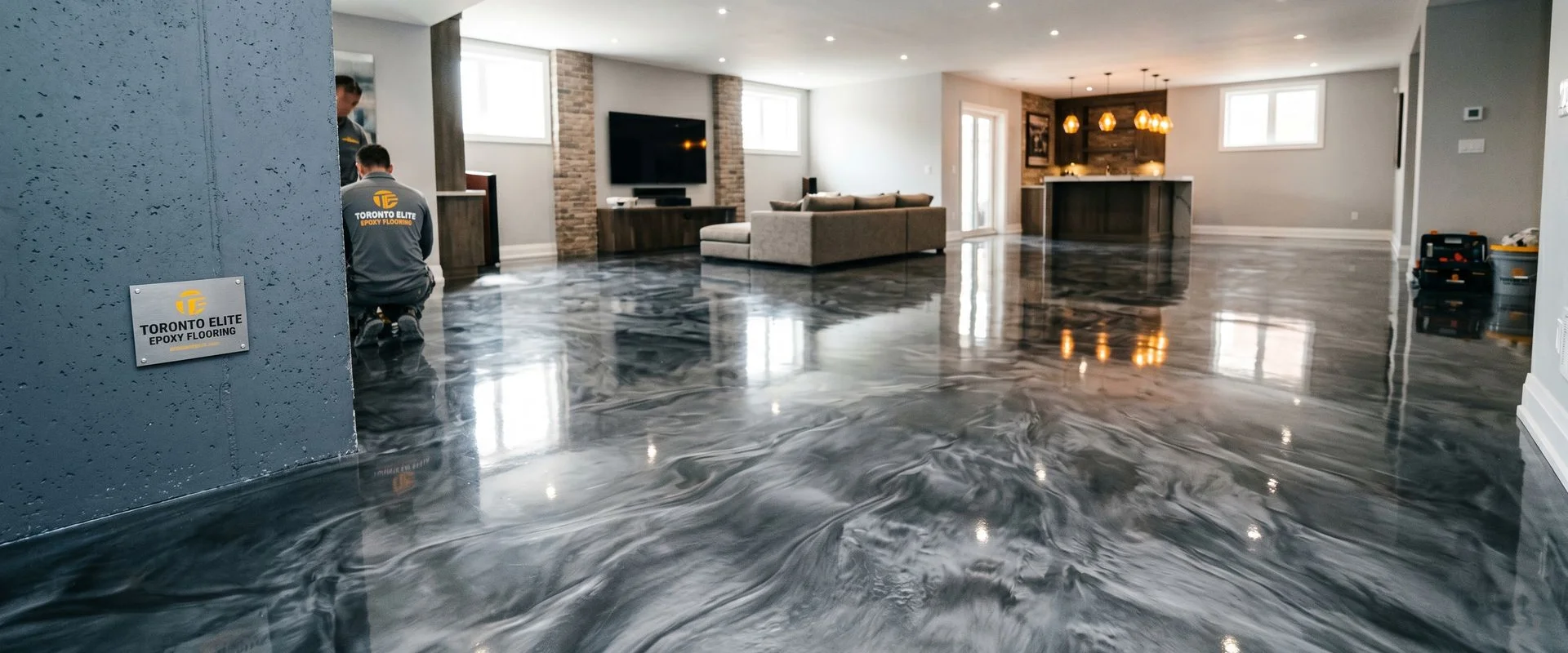
Decorative Metallic Epoxy Flooring in Toronto, ON
Hand-manipulated metallic pigment systems that create a unique 3D liquid-art effect - no two floors identical. Pricing runs $9-$16 per sq ft installed; a 500 sq ft basement or showroom completes in 2-3 days. UV-stable aliphatic polyaspartic topcoat keeps colours vivid under Ontario sun and retail LED lighting for 15+ years.
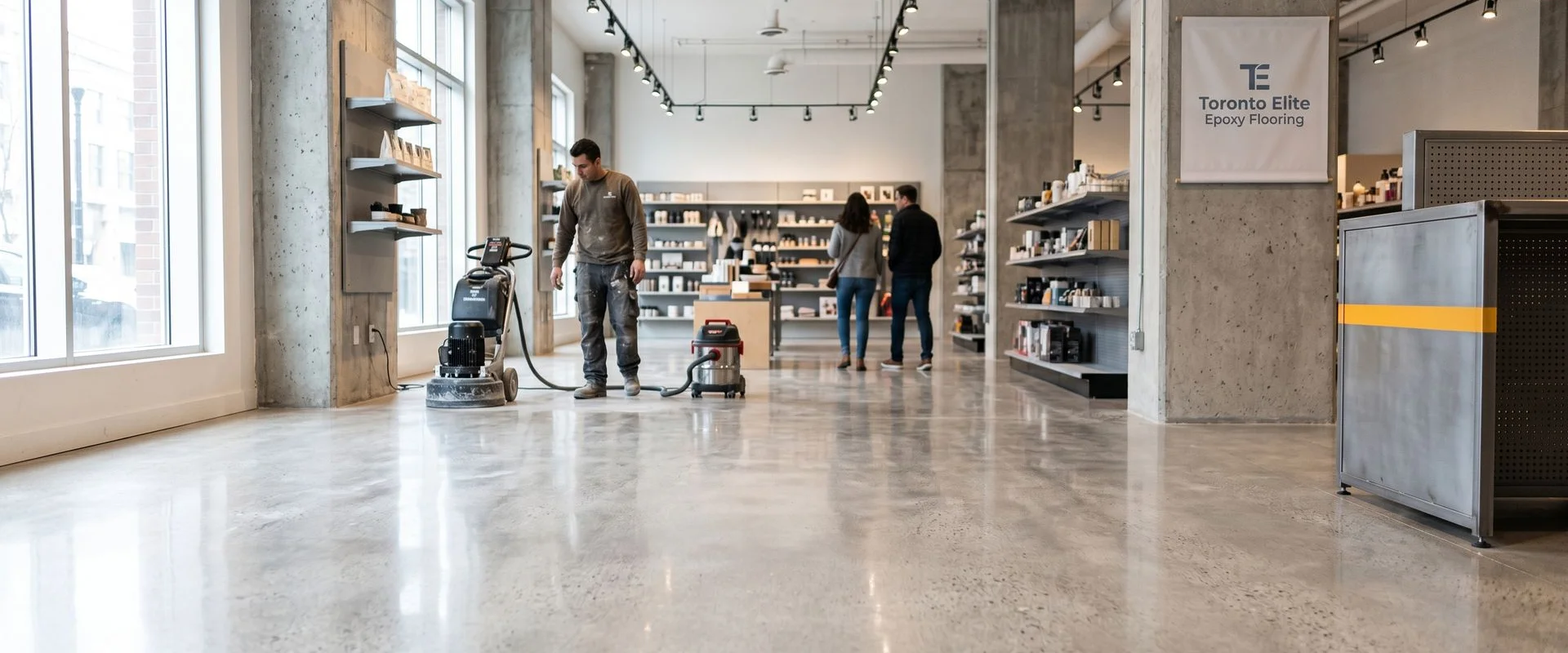
Concrete Polishing in Toronto, ON
Multi-pass diamond grinding through 1,500-grit with lithium densifier creates a low-maintenance polished concrete surface that reflects light and eliminates wax or topcoat reapplication. Pricing runs $3-$8 per sq ft installed; most commercial floors complete in 2-3 days. Popular in GTA retail, restaurant, and office builds for its 20+ year lifespan.
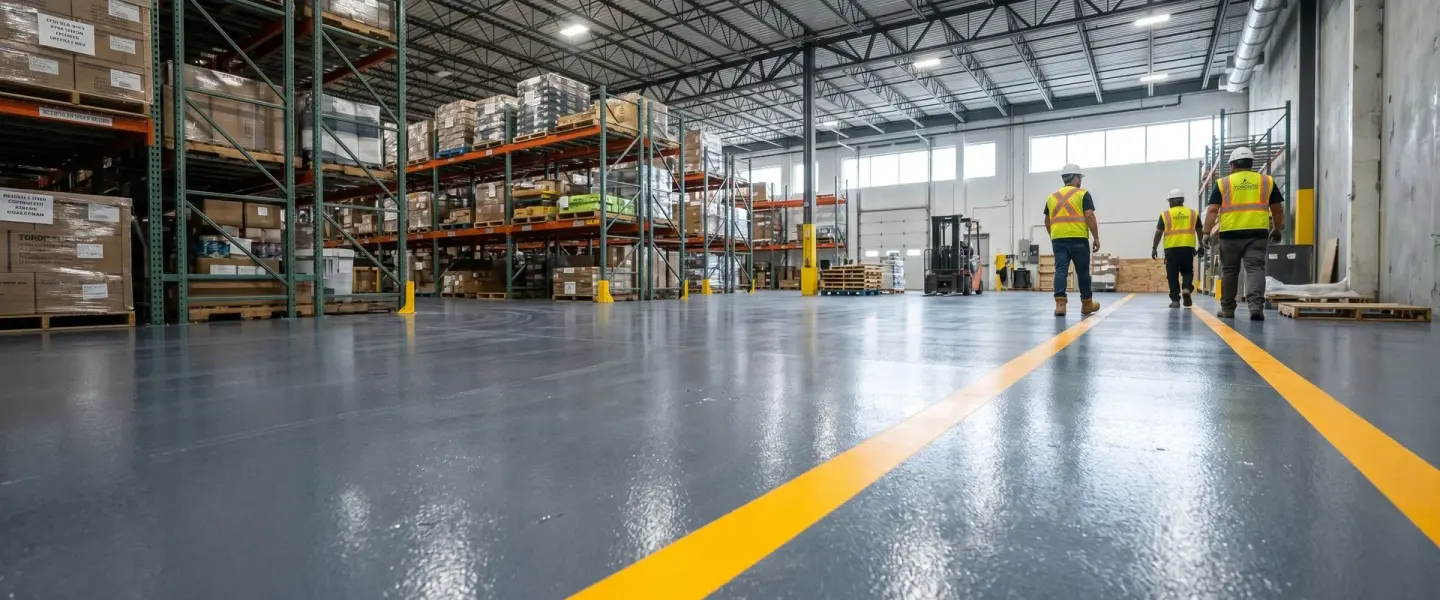
Commercial & Industrial Epoxy Flooring in Toronto, ON
100% solid commercial-grade epoxy systems shot-blast to CSP 3-4 for facilities running forklifts, food production, or 24-hour operations in the GTA. Pricing runs $3.50-$8 per sq ft installed; off-hours scheduling returns your floor before the next shift. WSIB-certified crews, $2M liability, and full compliance documentation on every project.
Ready to Book Showroom Epoxy?
Same-day free on-site assessment. WSIB-certified, $2M liability on every project.