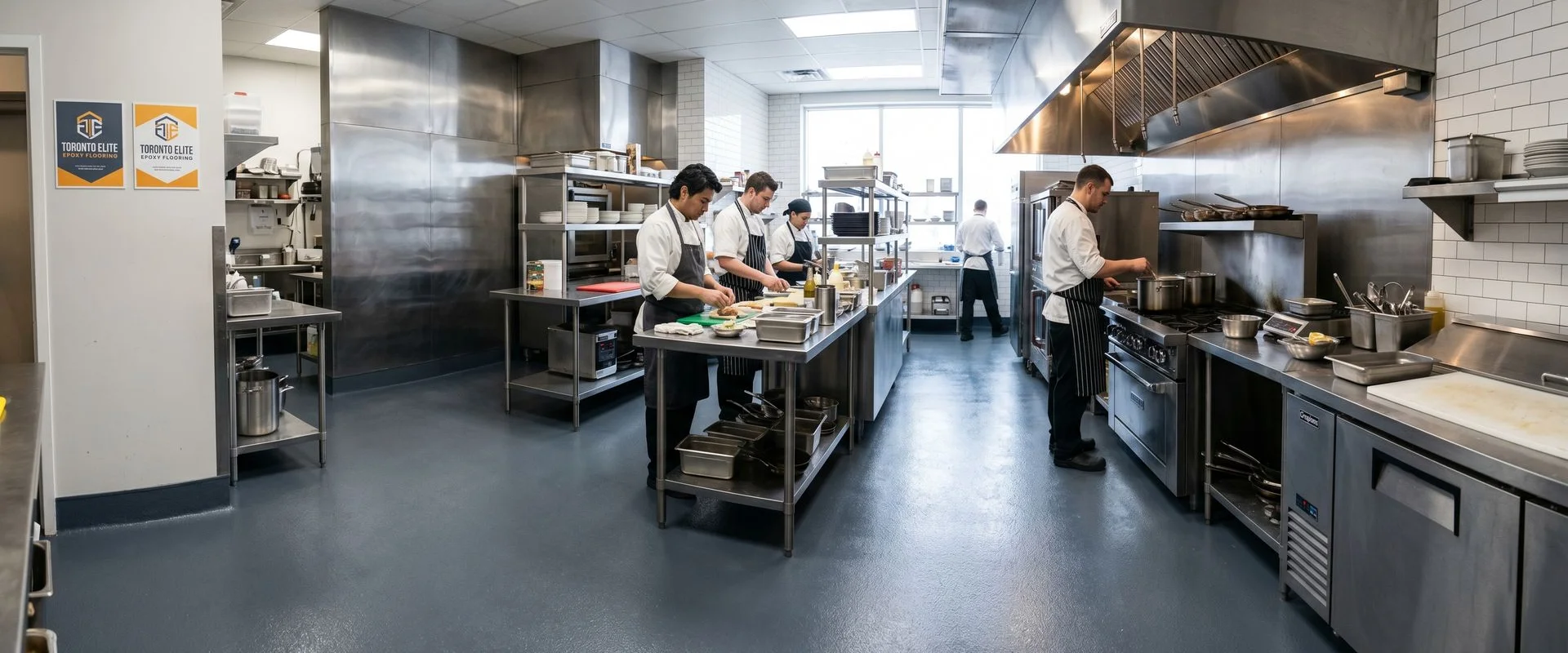
Commercial Kitchen Epoxy Flooring in Toronto, ON - CFIA-Compliant Seamless Floor Professionals
Toronto Elite Epoxy Flooring installs CFIA-compliant seamless quartz anti-slip systems, slope-to-drain floor layouts, and 4-6 inch coved base detailing for restaurants, food processing facilities, institutional kitchens, and commercial prep areas throughout Toronto, ON. Every commercial kitchen install uses zero-VOC chemistry for occupied-facility application, overnight scheduling to avoid service interruption, and hot-water and degreaser-rated topcoats tested against daily sanitization cycles.
Commercial kitchens operate under conditions that fail every standard flooring material. Daily hot-water washdowns at 60-82°C create thermal cycling that cracks grout joints and lifts vinyl tile adhesive within 18 months. Quaternary ammonium sanitisers at 200-400 ppm and sodium hypochlorite degreasers applied daily degrade standard polyurethane topcoats to a chalky, porous surface that absorbs grease and fails health inspection. Toronto Public Health and York Region Environmental Health inspectors specifically cite grout lines, floor-wall junctions without integral coving, and cracked tile as critical violations under Ontario Regulation 562 - each one is an automatic re-inspection trigger that closes the kitchen until corrected.
Commercial kitchen floor projects typically run 200-3,000 sq ft and complete in 1-3 overnight shifts depending on drain layout complexity and cove height. Pricing ranges from $8 to $15 per sq ft installed depending on slope-to-drain engineering, anti-slip grit grade, coved base specification, and topcoat chemistry. Health inspection compliance documentation is included with every project.
Toronto Elite Epoxy Flooring provides commercial kitchen epoxy flooring to Toronto, ON and surrounding Ontario cities, including Etobicoke, Scarborough, North York, Mississauga, Oakville, Vaughan, Brampton, Markham, Richmond Hill, and Burlington.
What is Commercial Kitchen Epoxy?
A commercial kitchen floor has to do four things at once: pass health code, stay slip-resistant when wet, take constant heat and grease, and survive aggressive wash-downs with hot water and cleaners. Tile fails on the grout. Sheet vinyl fails on the seams. Properly spec’d commercial epoxy passes on all four.
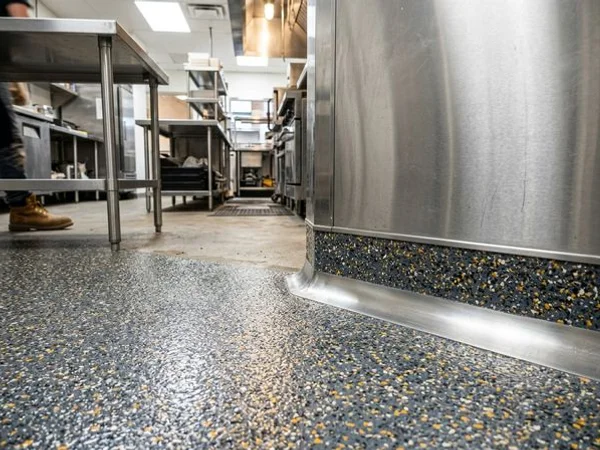
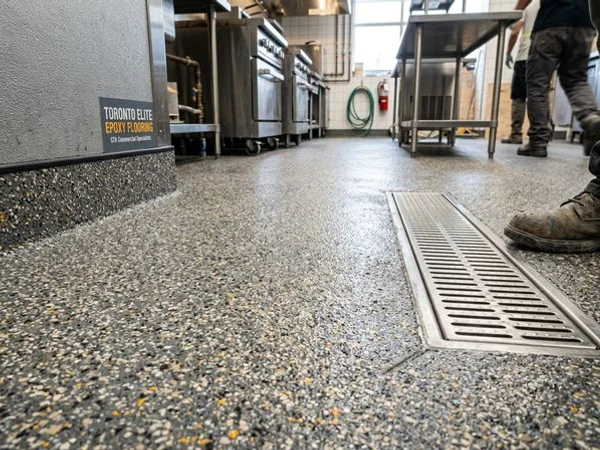
Our kitchen system installs seamless coving 4-6 inches up the wall, which eliminates the wall-floor joint where bacteria normally collect. The floor itself is 100% solid zero-VOC epoxy with quartz broadcast for anti-slip texture, sealed with a food-safe topcoat matched to your cleaning chemistry. Drains and trench drains get detailed integration so water has no entry point under the coating.
Every install is scheduled around your service hours - overnight or weekends - so the kitchen reopens for the next shift. Fast-cure systems are available where downtime is critical. We bring the same standard to every job as Toronto’s full-spectrum epoxy flooring contractor, and the kitchen system shares its sanitary coving and chemical-resistant build with our broader commercial and industrial coatings.
What’s Included
- CFIA-compliant, zero-VOC materials throughout
- Seamless coving (4-6”) up the walls
- Shot-blast or diamond-grind surface prep
- 100% solid epoxy base coat
- Quartz broadcast for anti-slip texture
- Food-safe topcoat matched to cleaning chemistry
- Detailed integration with floor drains and trench drains
- Off-hours installation around your service hours
- Health-inspection-ready handover
Is Epoxy Flooring CFIA and Health-Code Compliant?
The Canadian Food Inspection Agency does not certify specific coating products, but it does require that food-facility floors be smooth, non-absorbent, easily cleanable, and free from cracks or open joints. A 100% solids epoxy system installed over properly prepared concrete meets every one of those requirements, whereas the grout joints in quarry tile and the seams in sheet vinyl are direct failures of the non-absorbent and easily cleanable criteria. Toronto Public Health inspectors operating under Ontario Regulation 493/17 (Food Premises) apply the same standard across every restaurant, catering operation, and food-processing facility in the city.
Restaurants in Scarborough and North York that have switched from grout-jointed tile to seamless epoxy consistently report faster pass times on re-inspection, partly because inspectors can visually confirm the absence of wall-floor joints and grout lines in a single walkthrough. The specific material requirements are no less relevant for smaller operators: a Vaughan catering prep kitchen and a North York ghost kitchen face the same Ontario Food Premises Regulation requirements as a full-service restaurant.
For federally registered food establishments - meat processors, federally inspected packing houses, and cold-storage facilities - the CFIA’s Meat Hygiene Manual of Procedures Chapter 3 requires impervious, non-slip, easily cleanable surfaces and specifies that floors in wet processing areas must drain effectively without pooling. Our kitchen system addresses each of these points: the coving eliminates wall-floor joints, the seamless topcoat is impervious, and we detail every floor drain and trench drain to eliminate pooling at the perimeter. Materials used carry zero-VOC certification and are food-safe once cured to the manufacturer’s minimum cure schedule.
Anti-Slip and Seamless Coving for Commercial Kitchens
The ASTM E2349 standard for slip and trip hazard prevention and NFPA 101 Life Safety Code both reference walkway surfaces in occupancies where wet contamination is foreseeable - commercial kitchens are the canonical example of that environment. The practical way to meet those requirements is quartz broadcast: dry quartz aggregate (typically 20-40 mesh) is broadcast into a wet base coat layer, the excess is swept, and a food-safe topcoat is applied over the aggregate. The result is a surface with measurable co-efficient of friction above 0.6 wet - the threshold used in most Ontario WSIB slip-and-fall assessments. The texture is grippy underfoot but smooth enough that mops and floor squeegees glide across it without snagging.
Seamless coving is the other non-negotiable element. Standard practice is a 6-inch cove running up every wall and around every floor penetration, formed from epoxy mortar and finished with the same base coat and topcoat as the floor. This detail eliminates the largest bacteria-harbouring site in a commercial kitchen and is the single most frequently cited correction in Toronto Public Health inspection reports for food facilities with existing tile floors. Etobicoke food processors that have operated under CFIA oversight for years often cite coved coving as the specification that finally satisfied their federal inspector after years of patching grout.
Installation sequence matters as much as material selection. Concrete surface profile (CSP) per ICRI Technical Guideline 310.2R should be CSP 3-4 for a mechanical-bond system carrying the traffic loads of a commercial kitchen. We achieve CSP 3-4 consistently using shot-blasting rather than acid etching, because acid etching leaves residual salts that compromise bond strength over time. In an Etobicoke or Mississauga industrial kitchen, where the floor may see forklift traffic from a loading dock as well as kitchen foot traffic, hitting the correct CSP is critical to achieving the 2,000 psi tensile bond strength that separates a coating that lasts a decade from one that delaminates within two years.
Epoxy vs Quarry Tile for Restaurant Kitchen Floors
Quarry tile was the default commercial kitchen floor for decades in Toronto because it is durable, heat-resistant, and familiar to inspectors. It also has three failure modes that epoxy does not share. First, grout joints crack under thermal cycling and rolling load, and once cracked they are essentially impossible to clean to a bacteriologically acceptable standard. Second, the wall-floor joint accumulates grease and biofilm regardless of how frequently it is cleaned. Third, retiling requires days of closure - tile is set in mortar, grouted, and then cannot be loaded for 48-72 hours after the final grout application.
Epoxy sidesteps all three failure modes. There are no grout joints, no wall-floor joint, and no prolonged cure before foot traffic. In terms of direct cost, quarry tile installation for a 1,200 square foot Scarborough restaurant kitchen currently runs $18,000-$36,000 installed, depending on tile selection and the extent of mortar bed work required. An equivalent epoxy system - shot-blast prep, 100% solids base, quartz broadcast, food-safe topcoat, and 6-inch coved coving - runs $9,600-$21,600 for the same space. The epoxy also installs in 1-3 overnight shifts, while tile work requires 3-5 days of full closure.
The chemical resistance comparison also favours epoxy when the cleaning programme involves strong sanitisers. Quaternary ammonium compounds, sodium hypochlorite at standard dilution, and most food-service degreasers are fully compatible with a standard food-safe epoxy topcoat. For operations using aggressive caustic cleaning compounds at high concentration - a common practice in Vaughan and Mississauga meat-processing plants - a novolac epoxy or aliphatic polyurea topcoat extends chemical resistance to pH levels and solvent exposures that would discolour or etch a standard epoxy. The upcharge for a novolac or aliphatic polyurea topcoat over a standard system is typically $1.50-$3.00 per square foot and is worth specifying for any kitchen with an aggressive cleaning programme.
The one area where quarry tile maintains an advantage is thermal shock from direct steam exposure. Continuous steam discharge directly onto the floor - from a steam kettle drain running hot condensate, for example - can cause thermal stress cracking in a standard epoxy system over time. For those specific situations, a polyurea or polyaspartic topcoat with higher flexibility ratings handles thermal cycling better than a rigid epoxy, and we spec accordingly when the site survey identifies that condition. A Toronto epoxy flooring contractor who scopes the specific conditions in your kitchen before specifying a system, will catch that detail at the survey stage rather than after installation.
Commercial Kitchen Epoxy Cost and Project Timelines in the GTA
Kitchen flooring quotes in the GTA vary significantly based on floor area, existing surface condition, and how much downtime the facility can absorb. A standard ghost kitchen or small restaurant kitchen of 300 to 600 sq ft with a sound concrete slab, minimal crack repair, and a single overnight install window typically runs $4,500 to $8,000 CAD fully installed including coving. That covers diamond grinding to CSP 3, the broadcast epoxy base coat, quartz anti-slip aggregate, and a food-safe topcoat rated for continuous wet-cleaning. Large institutional cafeterias in North York or Scarborough schools, where floor areas of 2,000 to 5,000 sq ft are common, are priced on a per-square-foot basis after a site assessment and typically run $5 to $9 per square foot depending on slab condition and the complexity of drain and equipment integration.
Downtime is the variable that most kitchens try to minimise, and it is the main reason we specify fast-cure polyurea and polyaspartic systems for kitchen work. A standard 100% solid epoxy base coat requires 8 to 12 hours between the base coat and topcoat at 20 degrees Celsius - workable on a weekend closure but tight for a one-night install. Polyaspartic systems cure to foot traffic in 4 to 6 hours, which means a properly staged overnight installation in a Mississauga restaurant kitchen can have the floor walk-on ready by 5 am and fully operational by the morning service. We confirm cure window scheduling with the kitchen manager before quoting so the system spec matches the actual operational timeline rather than an optimistic assumption.
Related Questions Toronto Homeowners Ask
How much does commercial kitchen epoxy cost per square foot in Toronto?
Most commercial kitchen epoxy systems in the GTA run $8-$18 per square foot installed, with the spread driven primarily by coving lineal footage and drain count rather than floor area. A kitchen with a simple rectangular layout and two floor drains will be at the lower end of that range; a kitchen with extensive equipment alcoves, multiple trench drains, and significant concrete repair will move toward the upper end.
How many nights does a commercial kitchen epoxy install actually take?
A straightforward kitchen under 1,000 square feet typically takes 2 overnight shifts: one for shot-blast prep and any concrete repair, one for coving, base coat, broadcast, and topcoat. Kitchens in the 1,000-2,500 square foot range usually need 3 nights. The schedule is set at the site survey and built around your service hours so no revenue days are lost.
What happens if the epoxy fails or starts to peel in a Scarborough or Etobicoke restaurant?
Delamination on a properly prepared and installed system is rare, but when it does occur it is almost always traceable to one of three causes: inadequate surface prep (CSP below 3), undisclosed moisture vapour emission above 3 lbs per 1,000 sq ft per 24 hours on the concrete slab, or chemical exposure outside the rated tolerance of the topcoat. All three are addressed at the site survey. Our 5-year warranty covers adhesion failure and delamination under normal commercial use.
Can commercial kitchen epoxy be installed in a food truck commissary or shared kitchen space in Mississauga?
Yes. Commissary kitchens and shared food-prep facilities face the same Ontario Food Premises Regulation requirements as a dedicated restaurant kitchen, and the same seamless coving and anti-slip quartz broadcast spec applies. Shared kitchens often have more complex drain layouts and heavier rolling traffic than single-operator kitchens, which is a reason to spec a thicker base coat (typically 60-80 mils versus 40-60 mils for lighter-use kitchens).
Does a new commercial kitchen epoxy floor require any special maintenance to keep CFIA compliance?
The floor itself requires no periodic resealing or recoating under normal use. Routine maintenance is mopping with a pH-neutral or mildly alkaline food-service cleaner - the same products already in use in most Toronto commercial kitchens. The one maintenance action that matters for long-term compliance is prompt repair of any mechanical damage (a deep gouge from a dropped piece of equipment, for example), because a breached topcoat can harbour bacteria in the same way grout does.
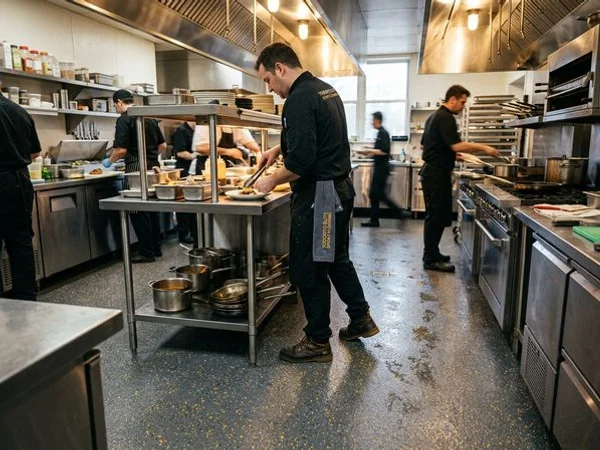
Our Kitchen Epoxy Results in Toronto
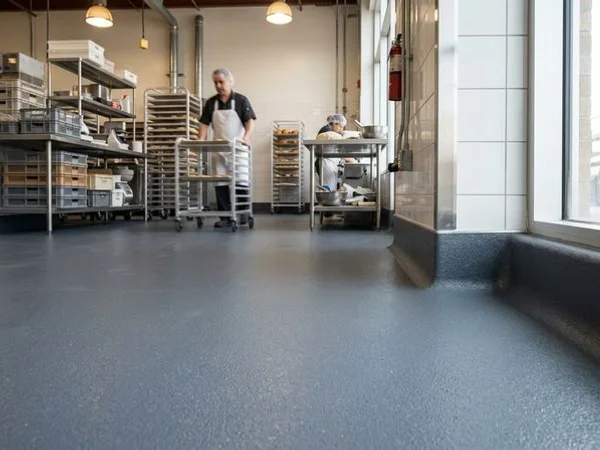
Kitchen Epoxy Pricing
Pricing depends on coving lineal footage, drain detailing, and chemistry.
Why GTA Customers Choose Toronto Elite Epoxy Flooring for Kitchen Epoxy
CFIA Compliant
Seamless coving, antimicrobial options, and zero-VOC materials matched to health-code standards.
Anti-Slip Standard
Quartz broadcast under the topcoat - grippy in wet areas without being hard to clean.
Off-Hours Installs
Overnight or weekend scheduling so your kitchen never loses a service day.
Drain Integration
Seamless detailing into floor drains and trench drains - no failed perimeters.
How Kitchen Epoxy Works
Site Survey
We scope coving footage, drain locations, and chemistry of cleaners and food contact.
Off-Hours Shot-Blast Prep
Overnight prep so the kitchen reopens for service.
Cove + Base + Anti-Slip
Seamless coving 4-6 inches up the wall, 100% solid base, quartz-broadcast anti-slip.
Cure + Reopen
Fast-cure systems return your kitchen to service in 24 hours or less.
Ready for a Free On-Site Assessment?
Same-day quotes across the GTA. WSIB-certified, $2M liability on every project.
What Customers Say About Our Kitchen Epoxy
"Replaced our tile kitchen floor with seamless coved epoxy. Cleaning time dropped, health inspection passed first try, and the kitchen reopened the next morning."
"Toronto Elite coated our Vaughan catering prep kitchen overnight - CSP 3 shot-blast, 100% solids base, quartz broadcast topcoat. WSIB paperwork was in order and the floor passed our health inspection without a single note."
"Coated our Port Credit retail food space over a weekend. High gloss, anti-slip, and finished before we re-opened."
Kitchen Epoxy FAQs
Is the floor CFIA and health-code compliant?
Yes. Our kitchen systems include seamless coving (4-6 inches up the wall), zero-VOC materials, and food-safe topcoats compliant with CFIA and Ontario public-health code requirements.
Can you install while we stay open?
We install off-hours - overnight or during your scheduled closure. Most kitchen installs are done in 1-3 nights with the floor ready for service the next morning.
How slip-resistant is it when wet?
Quartz broadcast is built into the topcoat to create a textured anti-slip surface that stays grippy when wet from washdowns, ice, or grease. Slip-resistance is part of the spec from day one.
How do you handle drains and trench drains?
We detail the epoxy into the drain perimeter so there's no seam where bacteria collect or water gets under the floor. Trench drains get extra detailing to handle constant wash-down.
What does kitchen epoxy cost?
Custom-quoted after a site visit. Pricing depends on square footage, coving lineal footage, drain count, and chemistry of cleaners used.
How does the cost of commercial kitchen epoxy compare to retiling?
Epoxy typically runs $8-$18 per square foot installed in the GTA, depending on coving footage and drain count. Retiling a commercial kitchen with quarry tile runs $15-$30 per square foot once you factor in setting mortar, grout, and labour. Epoxy also avoids the ongoing cost of grout sealing and grout replacement every 2-5 years.
What is the warranty on a commercial kitchen epoxy floor?
We warranty our kitchen systems for 5 years against adhesion failure and delamination under normal commercial use. The warranty covers the full system - coving, base coat, broadcast layer, and topcoat - not just individual components. Warranty is void if undisclosed chemical exposure exceeds the system's rated tolerance.
How long does a commercial kitchen epoxy installation take?
Most kitchens up to 1,500 square feet are completed in 1-3 overnight shifts. Larger facilities or those requiring significant concrete repair before coating may need 4-5 nights. We schedule around your service hours so no revenue days are lost.
Can epoxy handle the heavy kitchen equipment and foot traffic?
Yes. A properly spec'd 100% solids epoxy system handles rolling equipment loads up to 10,000 lbs per wheel, constant foot traffic, and dropped equipment. The quartz broadcast layer also protects the surface from abrasion from grit tracked in from loading docks.
What cleaning chemicals are safe to use on commercial kitchen epoxy?
We match the topcoat chemistry to your cleaning programme at the site survey. Quaternary ammonium sanitisers, diluted bleach, and most food-service degreasers are compatible with our standard topcoat. High-concentration caustic cleaners (pH above 12) or undiluted solvent degreasers can attack some systems - we spec a chemical-resistant novolac topcoat for those environments.
Is commercial kitchen epoxy available for Mississauga and Vaughan locations?
Yes. We serve the full GTA including Mississauga, Vaughan, Scarborough, North York, and Etobicoke. Site surveys are free within the GTA and scheduling is coordinated around each location's service hours.
How soon after installation can the kitchen go back into service?
Standard systems are walk-ready in 24 hours and ready for full equipment load and wash-down in 48-72 hours. Fast-cure polyaspartic or polyurea topcoats can reduce return-to-service time to 12-18 hours where same-night reopening is required.
Related Services
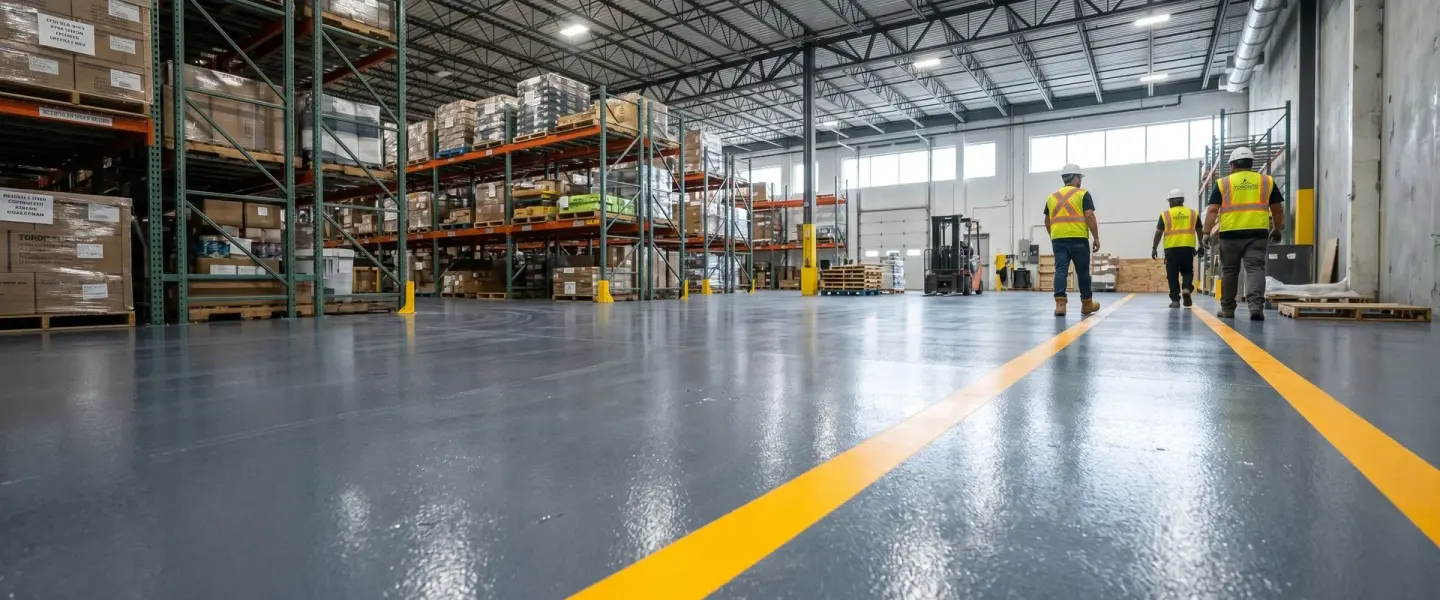
Commercial & Industrial Epoxy Flooring in Toronto, ON
100% solid commercial-grade epoxy systems shot-blast to CSP 3-4 for facilities running forklifts, food production, or 24-hour operations in the GTA. Pricing runs $3.50-$8 per sq ft installed; off-hours scheduling returns your floor before the next shift. WSIB-certified crews, $2M liability, and full compliance documentation on every project.
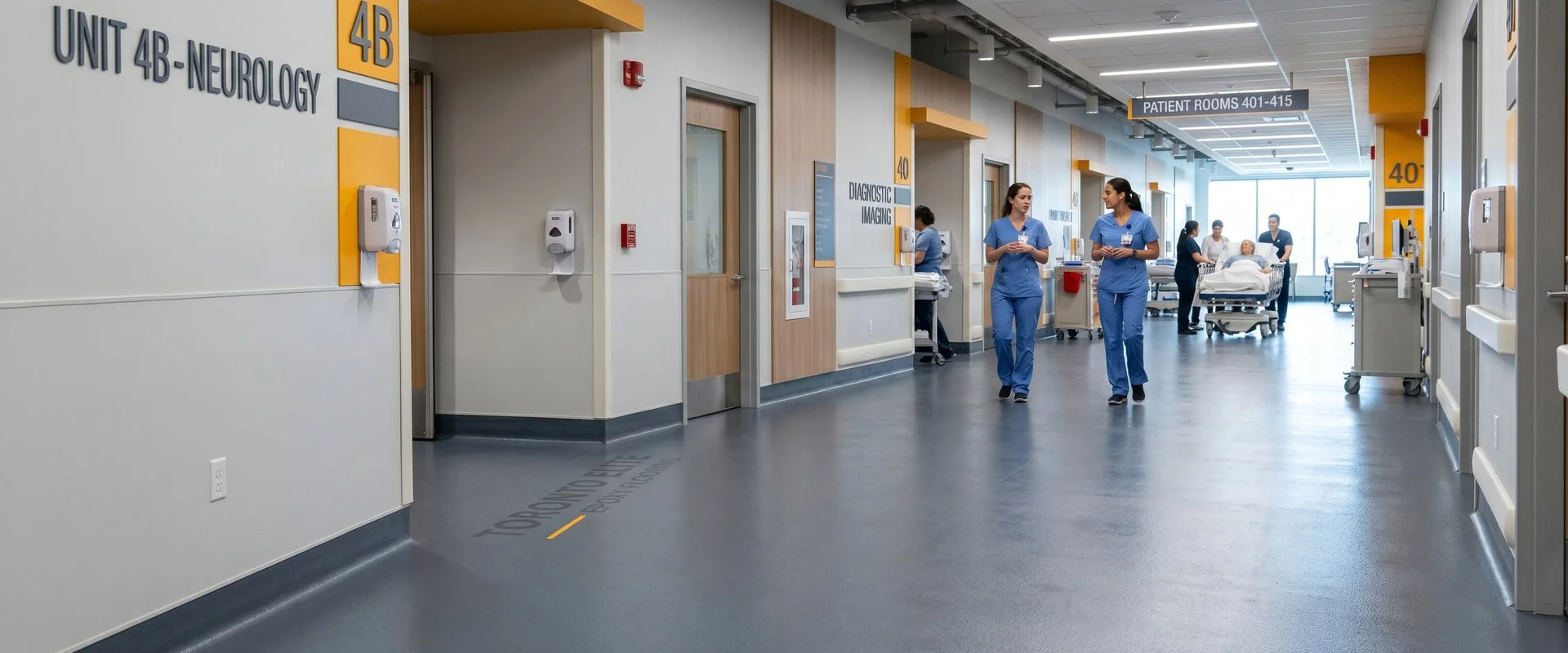
Institutional & Medical Epoxy Flooring in Toronto, ON
Seamless antimicrobial epoxy systems with 4-6 inch wall coving and zero-VOC chemistry for GTA hospitals, clinics, schools, and long-term care facilities. Pricing runs $6-$12 per sq ft installed; section-by-section scheduling keeps your facility operational throughout. WSIB-certified crews, $2M liability, and full IPAC Canada compliance documentation on every project.

Retail Showroom Epoxy Flooring in Toronto, ON
High-gloss commercial epoxy with custom RAL colour matching, optional logo inlays, and an aliphatic polyaspartic topcoat rated for 500+ daily foot traffic without scuffing or UV yellowing. Pricing runs $4-$9 per sq ft installed; most showroom floors complete in 2-3 overnight shifts with zero business disruption. WSIB-certified crews with $2M liability coverage on every GTA install.
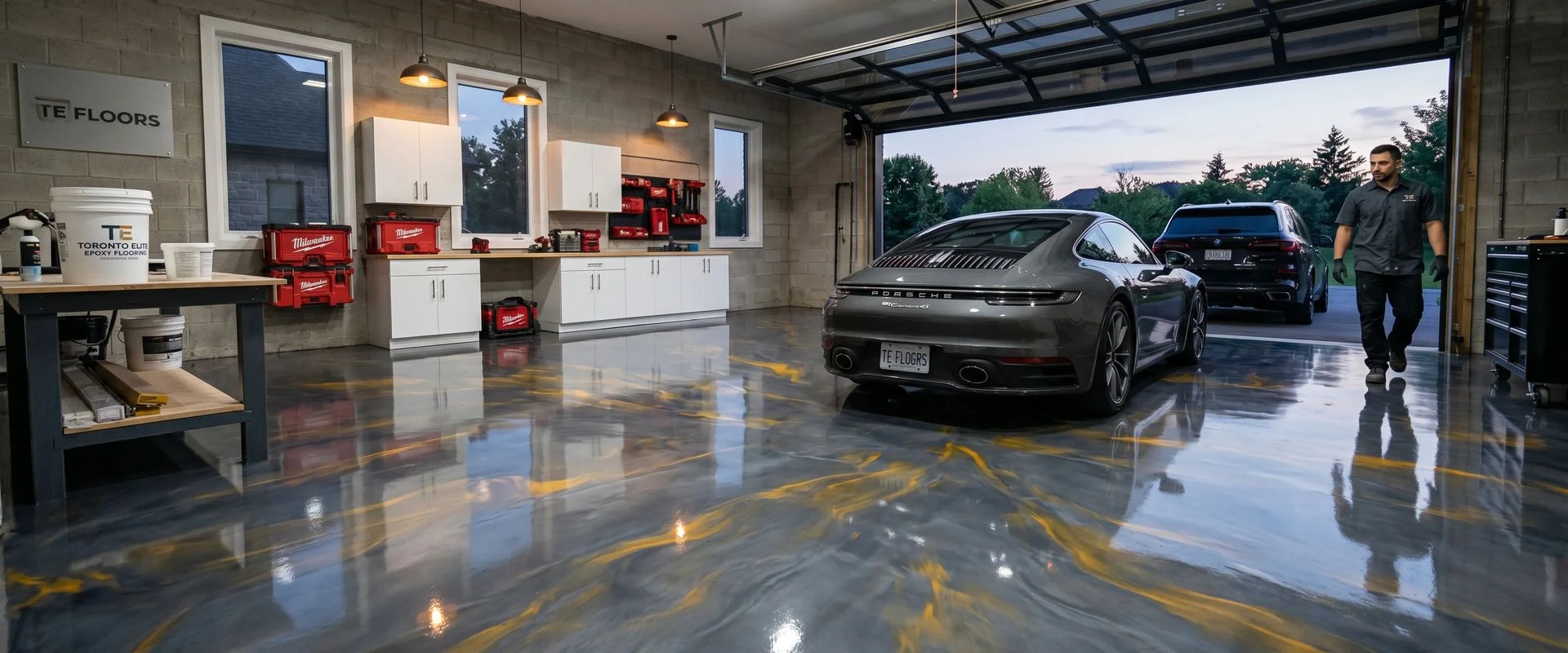
Ready to Book Kitchen Epoxy?
Same-day free on-site assessment. WSIB-certified, $2M liability on every project.