Institutional & Medical Epoxy Flooring in Toronto, ON - Antimicrobial Floor Coating Professionals
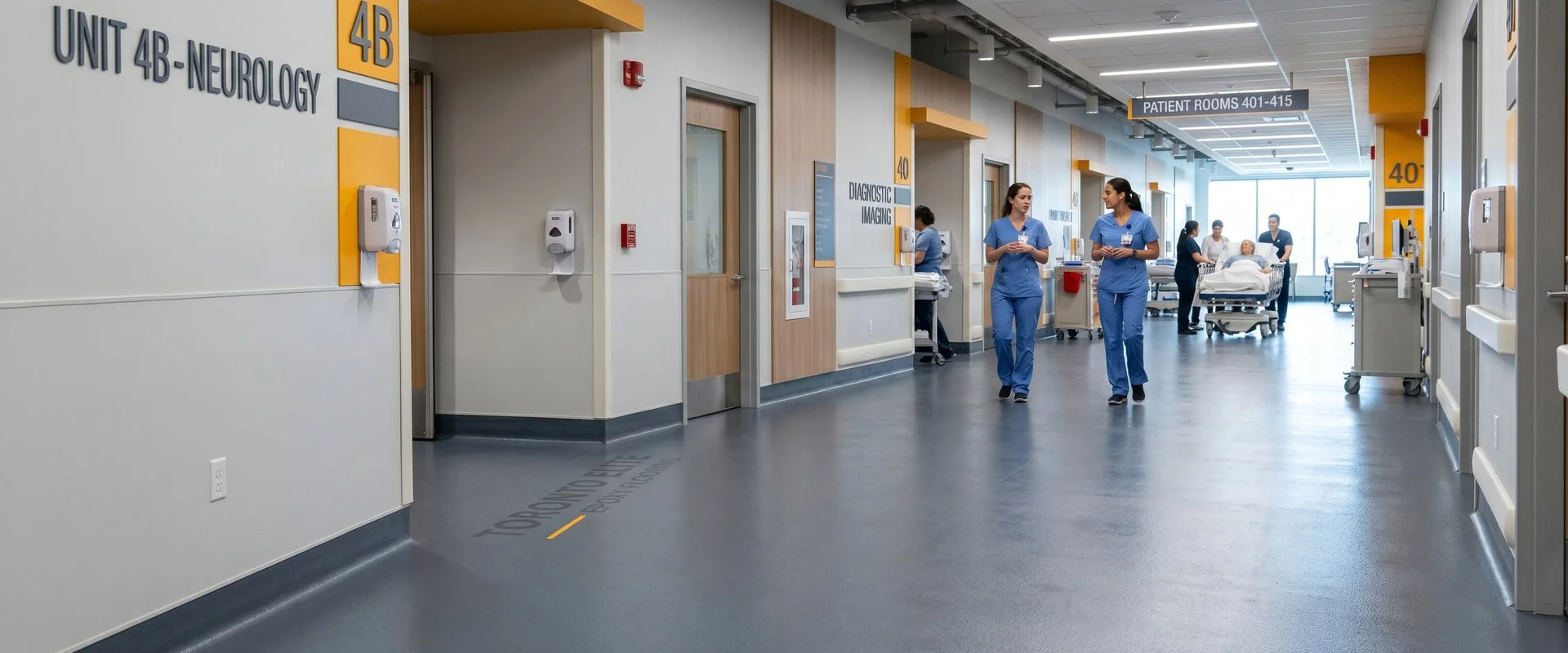
Toronto Elite Epoxy Flooring installs IPAC Canada-compliant antimicrobial seamless epoxy systems, 4-6 inch wall coving, and autoclave-spill-rated topcoats for hospitals, long-term care facilities, dental clinics, medical offices, and schools throughout Toronto, ON. Every institutional install uses zero-VOC chemistry, phased section-by-section scheduling to keep facilities fully operational, and heavy equipment-rated base coat application that handles mobile X-ray units, hospital beds, and MRI suite floor loads.
Healthcare floors must resist chemical agents that standard flooring cannot handle. Hospital-grade quaternary ammonium disinfectants at 400-1,000 ppm, sodium hypochlorite solutions up to 10,000 ppm, and peracetic acid sterilants used in operating suites degrade standard polyurethane topcoats to a porous, cratered surface within 18 months of daily disinfection cycles. IPAC Canada guidelines require seamless flooring with 4-inch integral wall coving to eliminate horizontal surfaces where pathogens accumulate - grout joints, vinyl tile seams, and floor-wall junctions without coving are persistent biofilm harbours that fail IPAC audit in any high-risk classification zone including isolation rooms, procedure suites, and clinical laboratories.
Medical and institutional floor projects typically run 500-10,000 sq ft per phase and complete in off-hours overnight shifts to maintain IPAC compliance and avoid patient contact disruption. Pricing ranges from $8 to $15 per sq ft installed depending on coving specification, antimicrobial additive tier, heavy equipment ratings, and compliance documentation requirements. Full written IPAC documentation and infection control protocols are included.
Toronto Elite Epoxy Flooring provides institutional and medical epoxy flooring to Toronto, ON and surrounding Ontario cities, including Etobicoke, Scarborough, North York, Mississauga, Oakville, Vaughan, Brampton, Markham, Richmond Hill, and Hamilton.
What is Institutional & Medical Epoxy?
Healthcare and education floors operate under tighter rules than any other commercial environment - infection control, slip resistance, durability under constant cleaning, and the requirement to install while the facility stays operational.
Our institutional and medical systems include antimicrobial additives in both the base coat and topcoat, seamless coving 4-6 inches up the walls to eliminate bacteria-collecting joints, and zero-VOC, low-odour materials so we can install in occupied facilities. Slip-resistant topcoats handle wet-cleaning routines without becoming hazards.
We carry WSIB certification, $2M liability, and Canadian Inspection Agency certification, with full compliance documentation provided for hospital, school, and municipal contracts. As Toronto’s full-spectrum epoxy flooring contractor, we pair these antimicrobial systems with ESD conductive flooring wherever a facility needs static control in operating theatres or labs.
What’s Included
- Facility survey with infection-control and facilities team
- Off-hours, low-odour scheduling
- Antimicrobial 100% solid epoxy base
- Seamless coving 4-6 inches up walls
- Slip-resistant antimicrobial topcoat
- Drain integration and equipment-pad detailing
- Section-by-section sequencing for occupied facilities
- Full compliance documentation
Seamless Antimicrobial Floors for Hospitals and Schools
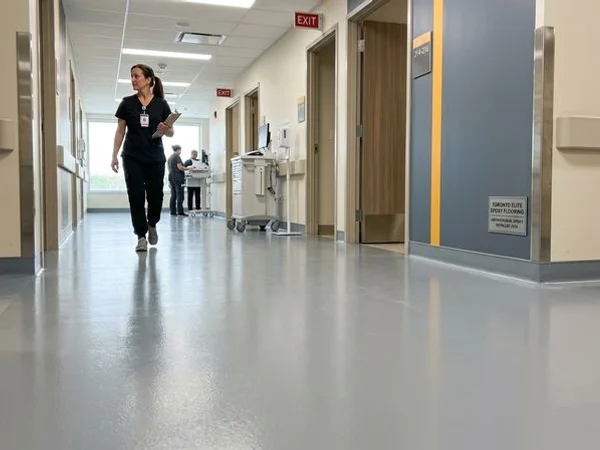
Every hospital corridor, clinic exam room, and school kitchen in the GTA has one thing in common: the floor gets cleaned with aggressive disinfectants multiple times a day, rolled over with heavy carts and gurneys, and scrutinised by infection-control officers who have zero tolerance for cracked tile, open grout lines, or peeling coatings. The only flooring system that survives this cycle long-term is a 100% solids epoxy with antimicrobial additives, installed over a properly prepared concrete substrate and terminated with seamless coving at the wall base.
We apply antimicrobial quaternary ammonium compound additives directly into the base coat and the topcoat during mixing. This is not a surface treatment that washes away - it is bound into the cured film. Health Canada recognises this class of additive for bacteriostatic performance against common healthcare pathogens including MRSA and E. coli. The coving detail - a 4-to-6-inch radius fillet run up the wall - eliminates the wall-floor joint entirely, which is the single most bacteria-harbouring location in any institutional space. Facilities that have switched from sheet vinyl with a flash-cove base to our fully seamless system consistently report faster cleaning times and cleaner environmental swab results.
Surface preparation follows ASTM D4259 and targets a CSP 2 to CSP 3 concrete surface profile, achieved with planetary diamond grinders rather than shot blasters in most occupied buildings. Diamond grinding produces minimal airborne dust, is quieter than blast equipment, and does not vibrate adjacent patient or classroom spaces. The prepared substrate receives a low-viscosity penetrating primer at 200-250 square feet per gallon to seal porosity before the 100% solids antimicrobial base coat is broadcast at 20-25 mils DFT. The system closes with an aliphatic polyurea topcoat that resists yellowing under hospital fluorescent lighting and holds a slip-resistance rating of 0.6 or higher wet, meeting NFPA 101 Life Safety Code traction requirements.
Material Specifications and System Chemistry
The choice between a standard epoxy system and a high-performance medical-grade system comes down to three factors: chemical resistance, topcoat hardness, and cure speed under real-facility scheduling constraints. For hospital operating rooms, sterile processing departments, and pharmacy dispensaries, we specify a novolac epoxy mid-coat. Novolac resins have a higher cross-link density than standard bisphenol-A epoxy, which translates to better resistance to hospital-grade bleach at 5,000 ppm chlorine, isopropyl alcohol at 70%, and quaternary ammonium disinfectants used in high-level decontamination cycles.
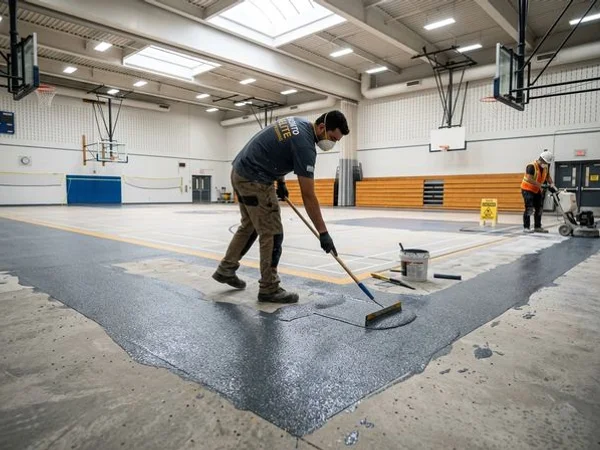
For school gymnasiums, corridors, and cafeteria serveries - the bread-and-butter of our Scarborough and North York institutional work - a standard 100% solids bisphenol-A epoxy base with an aliphatic polyurea topcoat delivers excellent service life at a lower cost per square foot than a full novolac system. The aliphatic polyurea topcoat cures in 4-6 hours at 20 degrees Celsius, which means a night-shift crew can grind, prime, and apply base coat in one overnight window, with topcoat going down the following night. The gymnasium or corridor is back in service before 8 a.m. on day three.
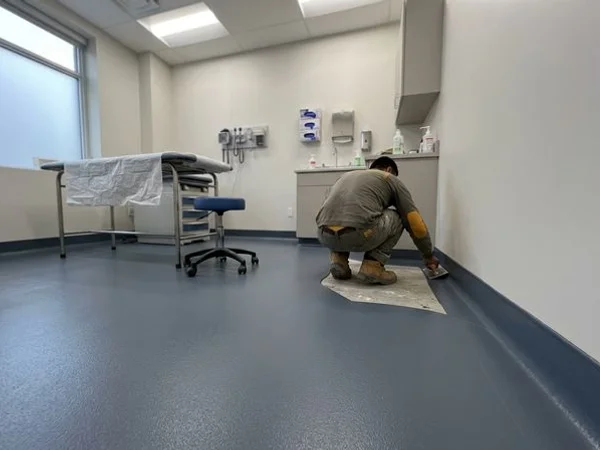
For clinics and medical offices across Etobicoke and Mississauga where budgets are tighter than hospital capital projects, a waterborne epoxy system using zero-VOC resins achieves near-zero odour during application. Waterborne systems cure more slowly and produce a slightly thinner film than 100% solids formulations, but for an exam room that stays dry and sees light rolling traffic, the performance is entirely adequate. Costs for a waterborne antimicrobial system run $8 to $11 per square foot installed, versus $12 to $18 per square foot for a full 100% solids novolac system with coving.
Scheduling Around Clinical and Class Operations
The largest single barrier to institutional floor replacement in the GTA is scheduling. A hospital cannot close a corridor for three weeks. A school cannot shut a gymnasium for a semester. Our section-by-section sequencing model divides the total floor area into zones that can be completed, cured, and returned to service independently, so the facility never loses full access to a wing or department.
We have completed overnight corridor recoats at long-term care facilities in North York where nursing staff and support workers were active in adjacent rooms throughout the shift. The critical controls are ventilation management - negative-pressure blower fans exhausting to the exterior during any solvent-based primer application - and strict sequencing of the zero-VOC waterborne primer and 100% solids low-odour base coat so that no single zone emits odour for longer than the natural air-change cycle of the HVAC system. Our WSIB-certified crew maintains a site safety plan under Ontario Regulation 213/91 for every institutional project.
For school board projects in Brampton and Scarborough, most work runs during the July-August window when facilities are available for consecutive day-shift access. A typical 10,000 square foot elementary school gymnasium - grinding, coving, three-coat system, painted court lines, and clear topcoat - runs 5 to 8 working days with a crew of four. Cost for a full gymnasium system including slip-resistant broadcast aggregate and TSSA-compliant court markings ranges from $45,000 to $80,000 depending on the existing concrete condition and the line-marking scope. We provide a full ASTM D7234 pull-off adhesion test result with the handover documentation, which is increasingly required by TDSB and PDSB facilities departments as proof of system integrity.
Compliance Documentation and Institutional Contracts
Hospitals, school boards, long-term care operators, and municipal facilities departments across the GTA all require a level of documentation that most residential or light commercial epoxy contractors cannot provide. A typical institutional contract package from us includes: a written material specification identifying each product by manufacturer code and SDS number; a concrete surface preparation log with CSP readings taken at minimum 5 locations per 1,000 square feet; a wet film thickness log for each coat; a WSIB clearance certificate; a copy of our $2M commercial general liability certificate; and a five-year warranty document.
The Canadian Inspection Agency certification we carry is relevant for any healthcare facility that processes food - hospital cafeterias, school serveries, and long-term care kitchen areas - where the floor system must meet sanitary surface standards equivalent to CFIA requirements. This is rarely a requirement that institutional procurement teams think to specify in the RFQ, but it consistently comes up during facilities inspections and can delay occupancy if documentation is missing. Having it built into our standard handover package has saved several Etobicoke and Mississauga clients from compliance headaches post-installation.
For public sector tendering, we are set up to respond to RFQ and RFP processes issued through Bids and Tenders Ontario and the Merx national procurement platform. Our compliance documentation package aligns with City of Toronto vendor qualification requirements and TDSB contractor pre-qualification standards. Contact us for a facility survey and a formal quotation that meets your institutional procurement format.
Cost and Procurement for Institutional Epoxy Flooring in Ontario
Institutional epoxy flooring in Ontario is typically procured through a formal tendering or purchasing process, particularly for hospitals, school boards, and municipal facilities. We submit to public tenders through the City of Toronto, Toronto District School Board, and provincial procurement portals, and carry the required WSIB clearance certificates, liability insurance documentation, and product data sheets in a format compatible with most institutional purchasing requirements. Projects awarded through formal tender follow the scope and specifications in the tender documents exactly, with any substitutions or value engineering options presented in writing during the tender period.
For smaller institutions - private clinics, dental offices, long-term care facilities in Etobicoke and Richmond Hill, and private school buildings - procurement is typically direct, with two or three competitive quotes from contractors who can demonstrate the required certifications and prior institutional project experience. We provide a specification document with each quote that describes the system chemistry, antimicrobial additive type and test standards, slip-resistance rating per ASTM D2047, and VOC content per LEED reference guides. This documentation simplifies the approval process for facilities managers who need to defend the specification choice to a board or administration.
Pricing for institutional medical epoxy in Ontario ranges from $6 to $12 per square foot installed, depending on floor area, the antimicrobial system specified, coving height and linear footage, and whether the project is tendered or direct. Operating-room and sterile-field installations at the higher end of that range reflect the tighter material specifications and the scheduling constraints of working in an infection-sensitive environment.
Related Questions Toronto Homeowners Ask
How much does medical epoxy flooring cost per square foot in Toronto?
Institutional and medical epoxy systems in the GTA range from $8 to $18 per square foot fully installed. Waterborne zero-VOC systems for clinic exam rooms sit at the lower end, while full novolac systems with antimicrobial additives and seamless coving for hospital sterile-processing departments sit at the upper end. Concrete condition is the biggest variable - heavily contaminated or structurally cracked slabs add $1 to $3 per square foot in remediation costs before any coating goes down.
What is the difference between epoxy and polyurea for a school gymnasium floor?
A 100% solids epoxy base provides excellent chemical resistance and a hard, impact-absorbing foundation for broadcast aggregate. Polyurea and aliphatic polyurea topcoats cure faster (4-6 hours versus 12-24 hours for standard epoxy), resist UV yellowing, and hold a higher abrasion resistance rating under ASTM D4060 Taber testing. For a gymnasium that needs to return to service quickly and hold up to rubber-soled athletic shoes, the combination - epoxy base, polyurea topcoat - outperforms either product used alone.
How long does institutional epoxy flooring last in a high-traffic hospital corridor?
A properly installed 100% solids system with a novolac or aliphatic polyurea topcoat, over a CSP 2-3 prepared substrate, will typically hold its integrity for 10 to 15 years in a hospital corridor under daily disinfectant cleaning cycles. The topcoat will show wear gloss reduction before structural failure. Most facilities schedule a topcoat refresh at 7 to 10 years - at roughly $3 to $5 per square foot - which resets the service life without requiring full system removal.
Can you coat a hospital floor without shutting down the wing?
Yes, for most corridor and common-area projects. Section-by-section sequencing, combined with zero-VOC waterborne primer and low-odour 100% solids base coats, allows each zone to be worked on overnight and returned to foot traffic by morning. Rooms requiring full closure - sterile processing, operating theatres - are scheduled during planned maintenance windows in coordination with the facilities and infection-control teams.
Do you serve Mississauga and Brampton school boards or only TDSB schools?
We serve institutional clients across the full GTA including Peel District School Board facilities in Mississauga and Brampton, Toronto District School Board and Toronto Catholic District School Board facilities across Toronto, and York Region District School Board sites in North York. Our compliance documentation package meets the pre-qualification standards of all four boards. A Toronto epoxy flooring contractor with institutional-specific certifications and off-hours scheduling capacity is the correct specification for any board facilities project.
Our Medical Epoxy Results in Toronto
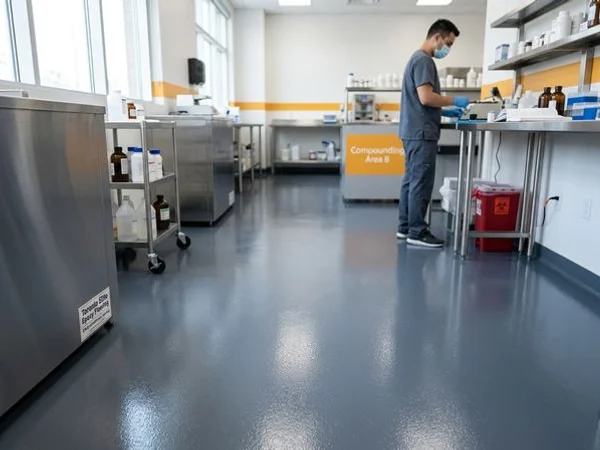
Medical Epoxy Pricing
Why GTA Customers Choose Toronto Elite Epoxy Flooring for Medical Epoxy
Antimicrobial System
Antimicrobial additives in the base and topcoat for active infection control.
Coved Walls
Seamless coving up walls eliminates the wall-floor seam where bacteria gather.
Low-Odour Install
Zero-VOC materials and low-disruption process so facilities can stay operational nearby.
Full Compliance
WSIB, $2M liability, and detailed documentation for institutional and municipal contracts.
How Medical Epoxy Works
Facility Survey
We scope infection-control needs, chemistry, and traffic class with your facilities team.
Off-Hours Prep
Low-odour, low-disruption prep scheduled around clinical or class hours.
Coving + Antimicrobial System
Seamless coving up walls, antimicrobial base, and slip-resistant topcoat.
Inspection-Ready Handover
Documented spec and warranty for facilities and infection-control teams.
Ready for a Free On-Site Assessment?
Same-day quotes across the GTA. WSIB-certified, $2M liability on every project.
What Customers Say About Our Medical Epoxy
"Hospital corridor recoated overnight. Zero odour reached the patient wards, and the floor passed infection-control inspection first try."
"School gymnasium floor. Tough as nails and the kids still haven't worn through it."
"Clinic exam rooms, coved walls. Inspection passed and the cleaning team loves the seamless finish."
Medical Epoxy FAQs
Is your floor system antimicrobial?
Yes. Antimicrobial additives are mixed into both the base coat and topcoat for sustained microbial control - important for hospitals, clinics, and food-handling areas in schools.
Can you install while the facility is in operation?
Yes. We use off-hours scheduling, low-odour materials, and section-by-section sequencing so clinical or class operations continue. We coordinate closely with infection-control and facilities.
Do you do school floors?
Yes. Gymnasiums, corridors, kitchens, and bathroom floors in schools across the GTA. Traffic-durable, slip-resistant, and chemical-resistant systems.
How sanitary is a coved seamless epoxy floor?
The coved seamless detail eliminates the wall-floor joint where bacteria normally collect. Combined with antimicrobial additives, the system meets stringent infection-control standards.
Are you insured for hospital contracts?
Yes. WSIB certified, $2M liability, Canadian Inspection Agency certified, and we provide full compliance documentation.
What does institutional epoxy flooring cost per square foot in Toronto?
Medical and institutional epoxy systems in the GTA typically range from $8 to $18 per square foot installed, depending on concrete condition, coving scope, antimicrobial additive specification, and whether off-hours scheduling is required. A 2,000 sq ft hospital corridor or school hallway will commonly land between $16,000 and $30,000 all-in, including surface prep to CSP 2-3 profile and full compliance documentation.
How does seamless epoxy compare to vinyl composite tile in a hospital setting?
Vinyl composite tile has grout lines and seams where bacteria collect, requires stripping and waxing on a monthly cycle, and typically lasts 8-12 years before cracking under rolling loads. A seamless 100% solids epoxy system with antimicrobial additives has no joints, needs only damp mopping with standard hospital-grade disinfectants, and carries a 5-7 year warranty on the coating itself. Total lifecycle cost over 15 years is generally lower for epoxy in high-traffic health care settings.
What warranty do you provide on medical epoxy floors?
We provide a 5-year material and labour warranty on full-system institutional installs. The warranty covers delamination, hot-tyre transfer, and coating breakdown under normal hospital or school cleaning protocols. It does not cover mechanical damage from heavy impact or improper chemical contact outside the specified cleaning agents list provided at handover.
How long does it take to coat a hospital corridor in Toronto?
A standard 1,500-2,000 sq ft corridor can typically be completed over two or three overnight shifts. Concrete profile grinding, cove forming, and base coat go in on night one; broadcast layer or mid-coat on night two; topcoat and final cure check on night three. The floor is ready for light foot traffic 12-16 hours after the final topcoat and cleared for rolling loads within 72 hours.
Can medical epoxy floors handle autoclave chemicals and bleach cleaning?
Yes. A properly specified novolac epoxy or aliphatic polyurea topcoat resists hospital-grade bleach solutions, quaternary ammonium disinfectants, and isopropyl alcohol at standard cleaning concentrations. We specify the exact chemical resistance class at the facility survey stage and provide a written chemical compatibility list with the compliance documentation package.
Do you work in Mississauga and Brampton hospitals and schools, or only Toronto?
We serve the full GTA including Mississauga, Brampton, North York, Scarborough, and Etobicoke. Institutional and medical projects outside the 416 area code carry a modest travel supplement, but there is no premium for Peel Region or York Region work - contact us for a site-specific RFQ.
Is diamond grinding required before medical epoxy application?
Yes, for any institutional-grade system. ASTM D4259 requires adequate surface preparation, and we target a CSP 2 to CSP 3 concrete surface profile using planetary diamond grinders before any epoxy application. This mechanical bond is the reason properly installed epoxy outlasts paint-grade coatings by decades in high-traffic health care environments.
Related Services
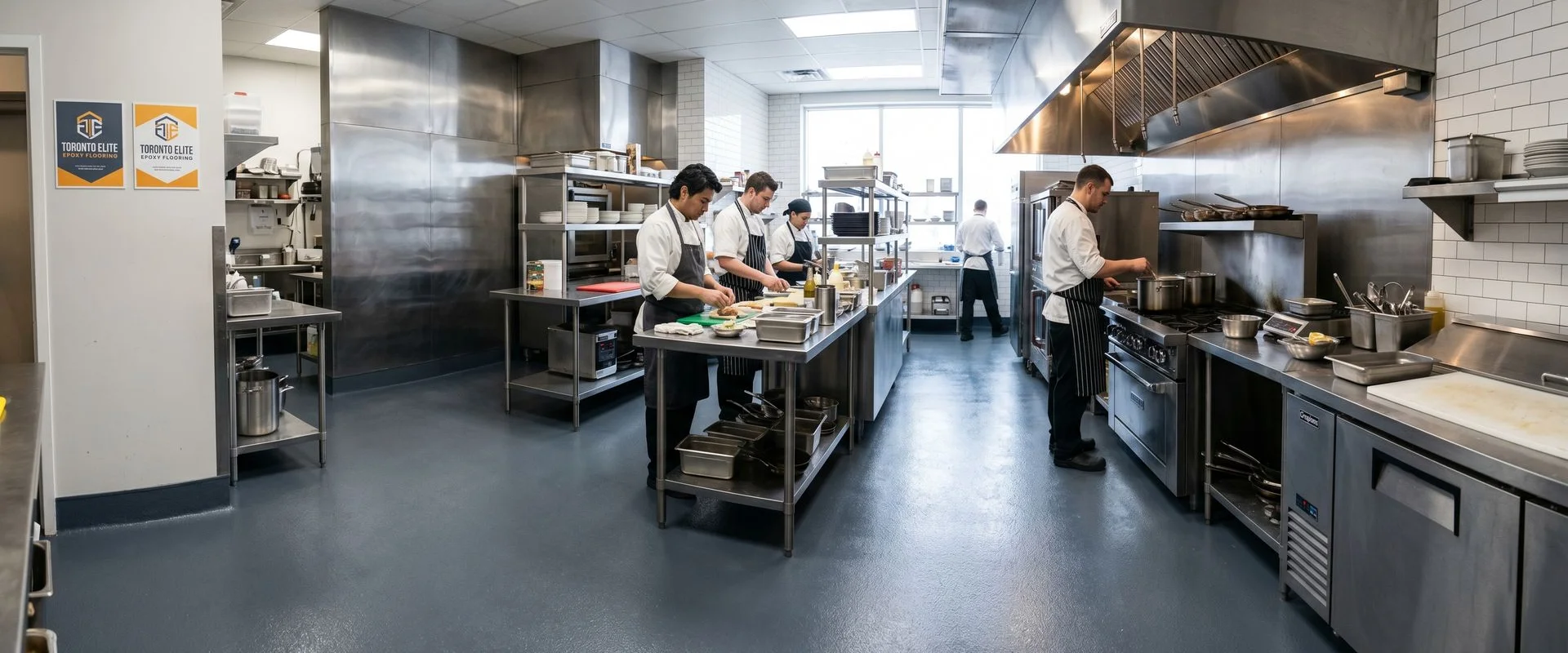
Commercial Kitchen Epoxy Flooring in Toronto, ON
CFIA-compliant seamless epoxy flooring with 4-6 inch coving, quartz anti-slip broadcast, and zero-VOC chemistry for Toronto restaurants and food service facilities. Pricing runs $5-$11 per sq ft installed; most commercial kitchens complete in 2 overnight shifts with no service disruption. Every install includes full health inspection compliance documentation and off-hours scheduling.
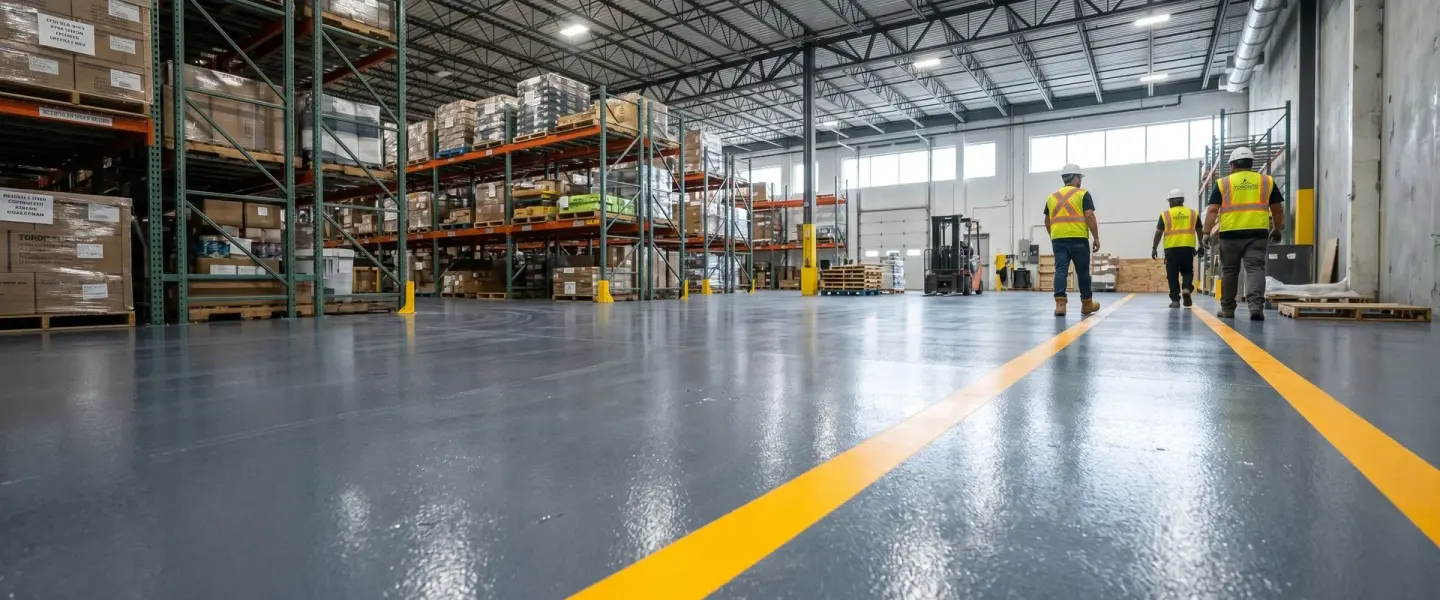
Commercial & Industrial Epoxy Flooring in Toronto, ON
100% solid commercial-grade epoxy systems shot-blast to CSP 3-4 for facilities running forklifts, food production, or 24-hour operations in the GTA. Pricing runs $3.50-$8 per sq ft installed; off-hours scheduling returns your floor before the next shift. WSIB-certified crews, $2M liability, and full compliance documentation on every project.
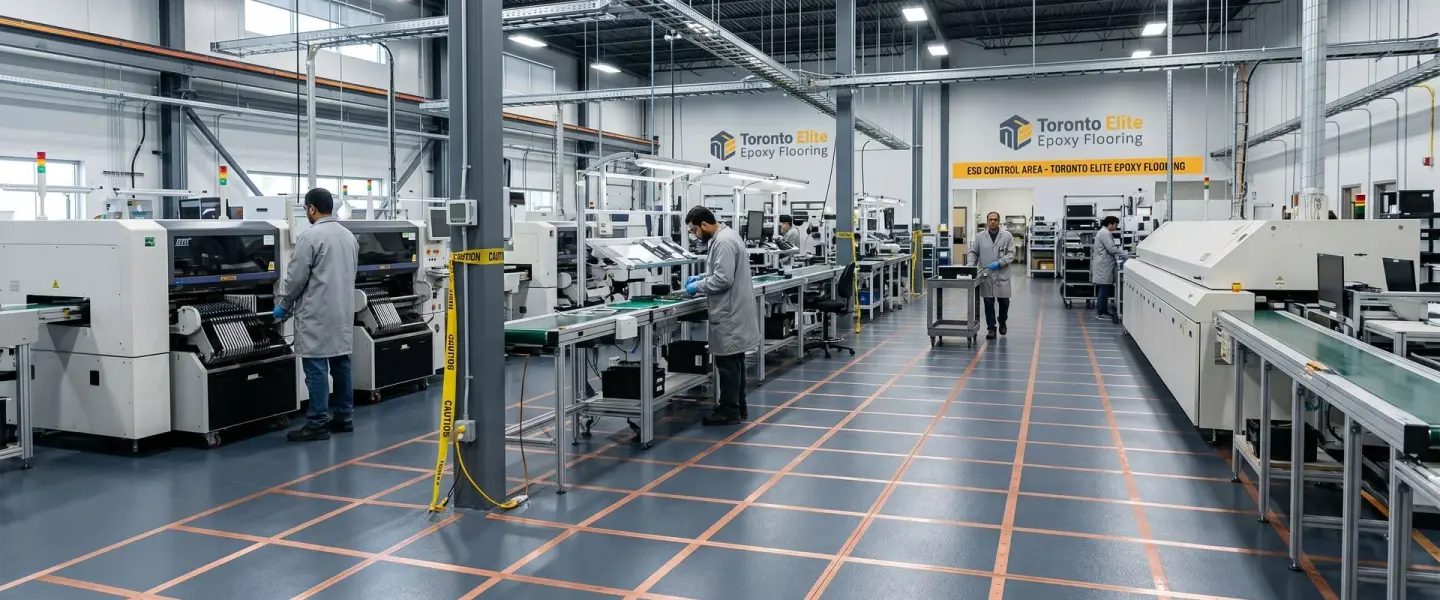
ESD Conductive Epoxy Flooring in Toronto, ON
ANSI/ESD S20.20 certified conductive epoxy with copper grounding grid, verified by megohmmeter to NFPA 99 and EOS/ESD Association STM7.1 standards. Pricing runs $7-$14 per sq ft installed; resistance testing and a full compliance report are included on every GTA install. Used in electronics manufacturing, data centres, and cleanroom environments across Mississauga and Markham.
Ready to Book Medical Epoxy?
Same-day free on-site assessment. WSIB-certified, $2M liability on every project.