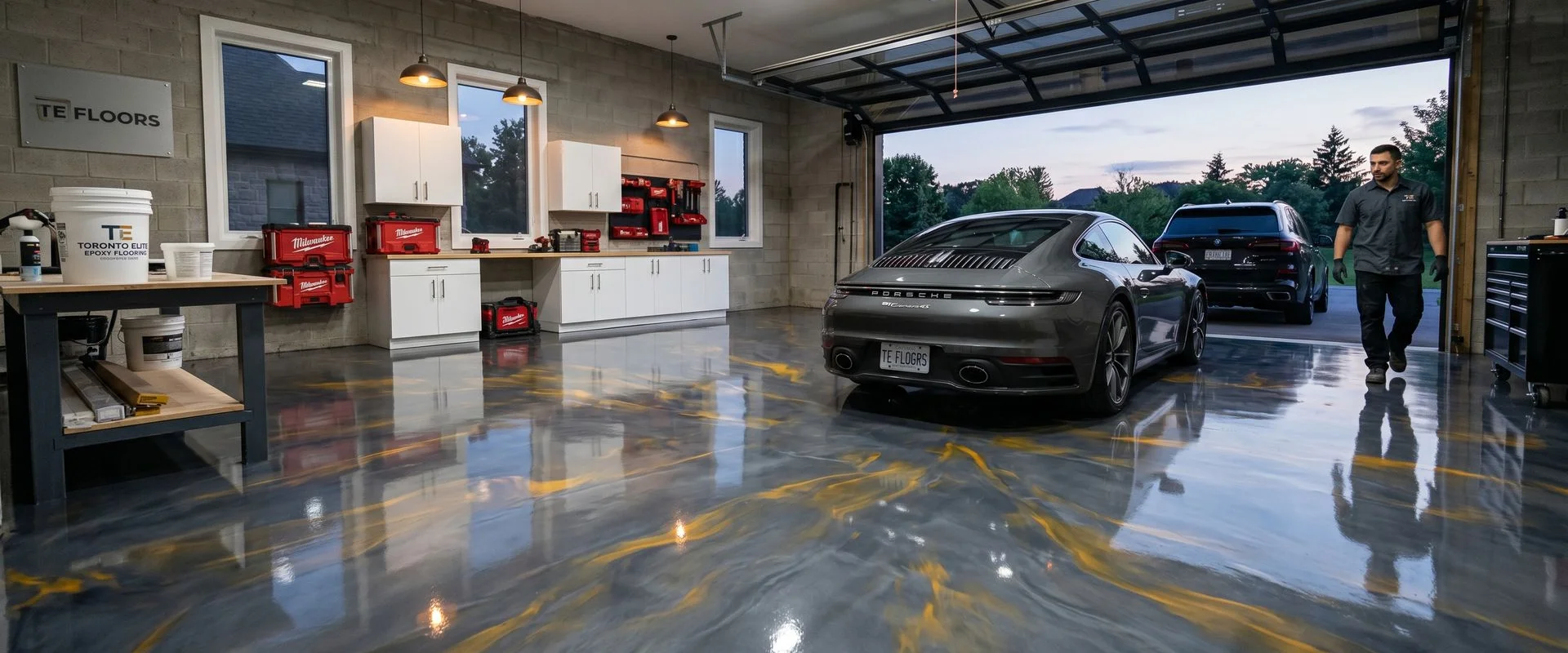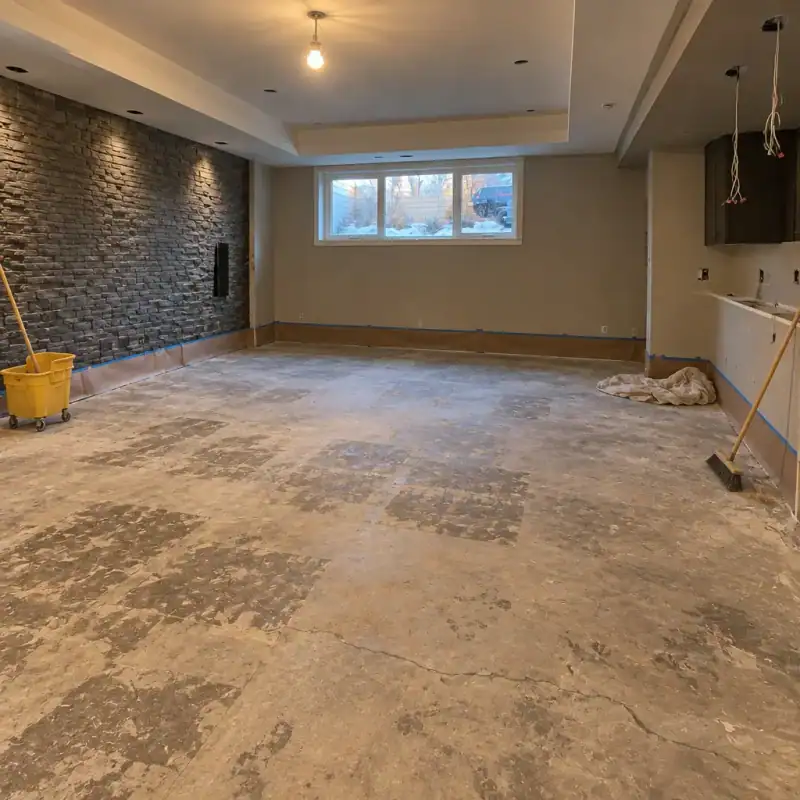
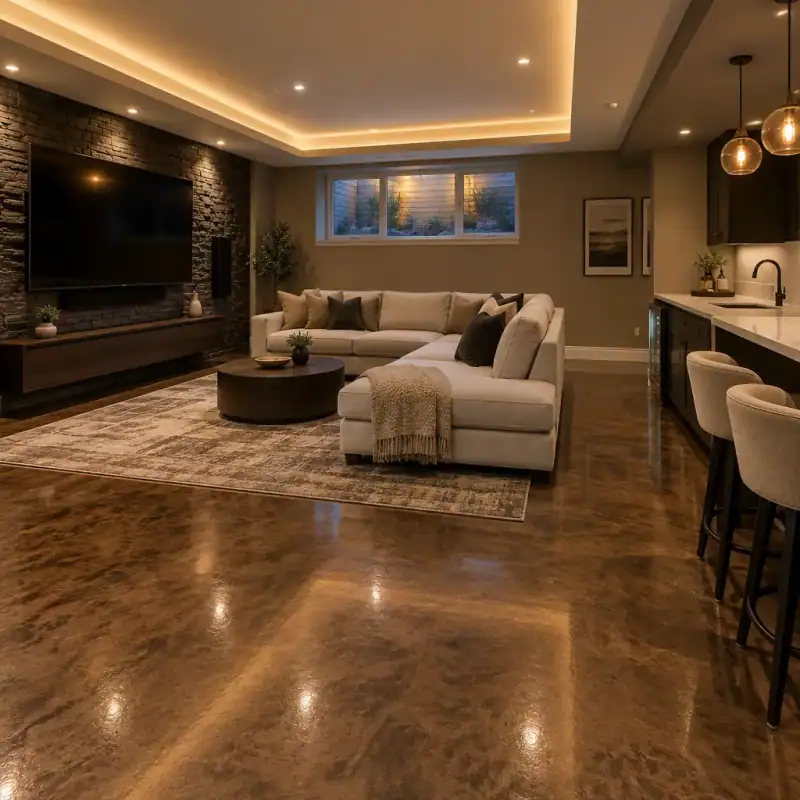
Toronto Elite Epoxy Flooring installs ASTM F2170-tested, vapour-barrier-primed basement epoxy systems for Scarborough homeowners across three distinct substrate zones. The Bluffs edge from Cliffside through Guildwood sits above a ravine system where freeze-thaw cycling drives active slab cracking. Agincourt and the central Scarborough suburb was built in the 1960s and 1970s with builder-grade polyethylene vapour barriers that have now reached end of life. Scarborough Centre and the STC corridor is dominated by 1980s-2000s condo stock with commercial-grade slabs. Each zone gets its own site assessment and moisture profile before we quote. Our same crew services basement epoxy from Birch Cliff east through Agincourt and the Bluffs, up to Malvern and Highland Creek.
Why Scarborough Basements Fail Without Zone-Specific Prep
Scarborough’s housing stock splits cleanly into three construction eras. Pre-war brick detached in Birch Cliff from the 1920s and 1930s was built without any sub-slab vapour barrier - the Ontario Building Code did not require it until the 1970s. These basements have survived nine decades of hydrostatic vapour drive without moisture control, and when a homeowner finishes the basement without pre-test diagnostics, the floor coating delaminates within two spring thaw cycles. We spec a reactive polyurea vapour barrier as baseline for any pre-1950 Birch Cliff or Cliffside home.
Agincourt and the suburban Scarborough belt expanded in the 1960s and 1970s when builders used thin polyethylene vapour barriers under the slab. Those barriers are now 50 to 60 years old. Field testing in Agincourt shows measurable degradation and pinhole failures across most 1960s pours, which allows hydrostatic vapour pressure to migrate up through the slab unchecked. ASTM F2170 readings in these basements routinely sit at 70 to 85 percent RH, right at or above the 75 percent threshold where standard solvent-based epoxy begins to fail.
Scarborough Bluffs and the ravine-edge corridor along Cliffside, Guildwood, and parts of West Hill face a third variable: freeze-thaw cycling at compromised slab interfaces. The Bluffs ravine system drains the entire east Scarborough watershed, and homes along the ravine edge experience more aggressive seasonal moisture cycling than flat-grade properties further inland. The practical consequence is active control cracks and interface stress at the slab-to-wall junction. Polyurea crack stitching is a standard scope item on Bluffs-area basements, not an upsell.
Our Scarborough Basement Install, Step by Step
1. Zone-Specific F2170 Testing
Our Scarborough site visit maps your property to its substrate zone - pre-war Birch Cliff / Cliffside, 1960s-1970s Agincourt, Bluffs ravine edge, or Scarborough Centre condo - and installs three to five ASTM F2170 relative-humidity probes at 40 percent slab depth. For Bluffs-edge properties we add a fifth probe along the ravine-facing exterior wall where moisture cycling is highest. Readings and crack inventory go into the written assessment before pricing is confirmed.
2. Diamond Grind to CSP 3 Plus Crack Routing
Surface preparation uses HEPA-shrouded planetary diamond grinders. Bluffs-area basements typically require 3 to 6 polyurea crack stitches per basement; Agincourt pre-1980s basements run 1 to 3. We document crack count and location in the project file. Scarborough Centre condo work needs minimal crack repair but adds dust-control and off-hours scheduling to the scope.
3. Vapour Barrier, Base Coat, and Polyaspartic Topcoat
Where F2170 readings require it, a two-component epoxy moisture mitigation primer or reactive polyurea vapour barrier is applied first at 8 to 10 mils dry film thickness. The 100 percent solids zero-VOC epoxy base coat goes on at 12 to 16 mils wet film thickness in your chosen colour. Optional quartz or vinyl flake broadcast adds surface texture and visual depth before the aliphatic polyaspartic topcoat seals the system.
Scarborough coverage note: Our crew runs Highway 401, the DVP, and Kingston Road corridors daily, hitting Agincourt, Scarborough Village, Guildwood, Birch Cliff, and Scarborough Centre within the same work day. Highland Creek and Malvern on standard dispatch.
Standard turnaround for a 600-900 sq ft Scarborough basement is 2 days of on-site work plus the 72-hour pre-test probe window. Bluffs-area homes with extensive crack routing run 2 to 3 days. Condo locker and amenity-space jobs schedule across 1 to 2 overnight shifts. Written quote within 48 hours of the site assessment, substrate report included in every project file.
Scarborough Basement Epoxy Pricing
| Project Size | Price Range (CAD) | Timeline |
|---|---|---|
| Standard 600 sq ft basement | $2,700 - $5,400 | 1-2 days |
| Full-home basement (900-1,300 sq ft) | $5,400 - $10,200 | 2-3 days |
| Bluffs-area crack routing (per basement) | Add $400-$1,100 project | Same install window |
| Moisture mitigation primer upgrade | Add $1.50-$2.80/sq ft | +1 day cure |
| Decorative broadcast flake upgrade | Add $1.50-$3.00/sq ft | Same install window |
Serving These Scarborough Neighbourhoods
Common Scarborough Basement Epoxy Questions
Why does the Scarborough Bluffs area need different prep than Agincourt?
The Bluffs edge from Cliffside through Guildwood sits above a ravine system that drains the entire east Scarborough watershed. Freeze-thaw cycling at the slab-to-exterior-wall interface is more aggressive here than in the flat central Scarborough corridor. We see more active control cracks per basement in Cliffside and Scarborough Bluffs homes than anywhere else in east GTA, often 3 to 6 cracks requiring polyurea stitching per basement. Agincourt homes further inland are typically on more stable grade and need fewer crack repairs but often have older builder polyethylene vapour barriers that are now 40+ years old and have degraded. Different problems, different prep scope - the site assessment documents which conditions your slab actually has.
Can you work in a Scarborough Centre condo locker or amenity room?
Yes. We handle condo work across Scarborough Centre, STC area, and the townhouse pockets around McCowan station. Our crew carries building management COI and WSIB documentation, HEPA-shrouded diamond grinders for enclosed-space work, and schedules installs around freight elevator access windows. Typical condo locker job runs 1-2 overnight shifts with full cure before the space reopens to residents.
Are 1960s Agincourt basements worth coating or should I just lay LVP?
It depends on the F2170 moisture reading. Luxury vinyl plank floating floors fail in below-grade installations when sustained slab RH exceeds 60-70 percent at the surface, which it almost always does in 1960s Agincourt homes with degraded builder polyethylene barriers. We see LVP callbacks in Agincourt where the planks have swelled at the seams within 18 months of install because the vapour drive was never addressed. A properly specified basement epoxy with pre-test moisture mitigation handles the vapour condition directly at the slab, which is where the problem originates. On a 600 sq ft Agincourt basement the price difference between quality LVP and epoxy is often less than $2,000 - and the epoxy survives the moisture condition that destroys the LVP.
Related Services in Scarborough
While we are on site in Scarborough we also handle Garage Floor Epoxy in Scarborough, Decorative Metallic Epoxy in Scarborough, Polyaspartic Floor Coating in Scarborough, Commercial Epoxy Flooring in Scarborough, and Warehouse Epoxy Flooring in Scarborough. Same crew, same WSIB coverage, same written quote process.