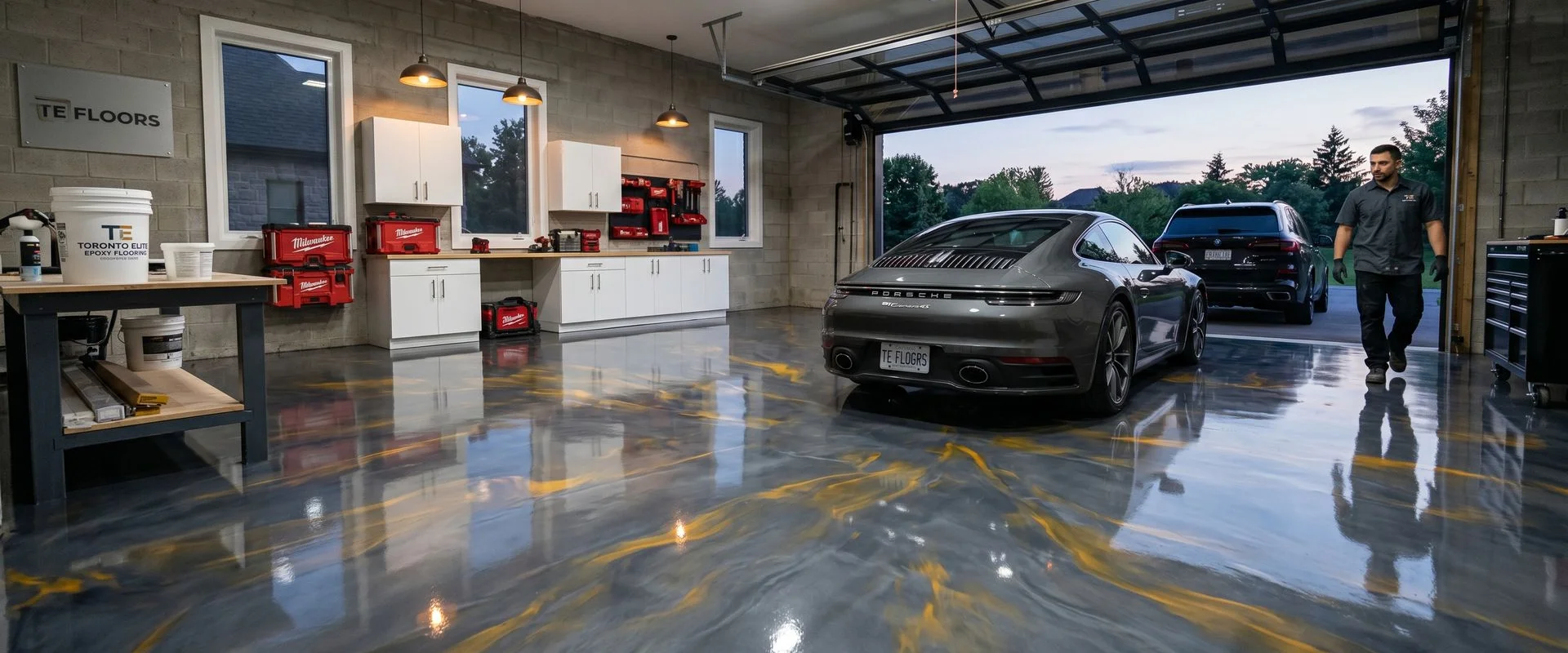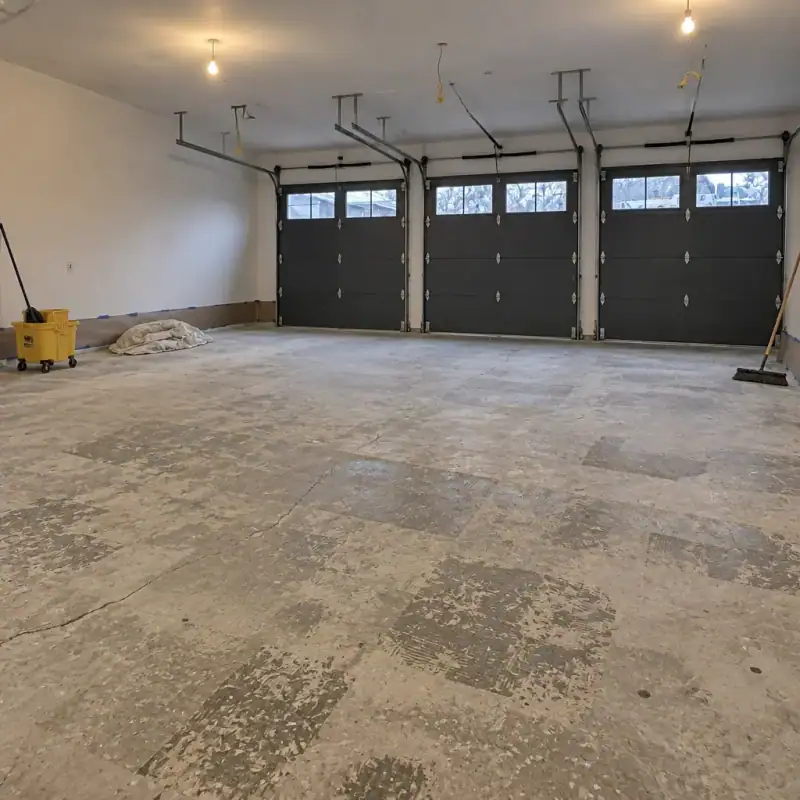
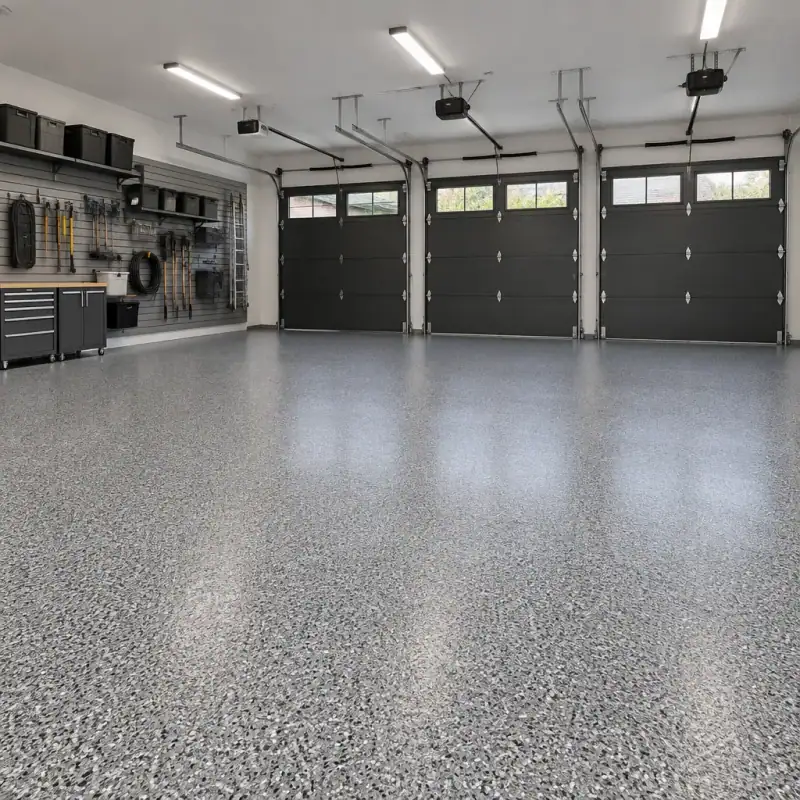
Toronto Elite Epoxy Flooring installs diamond-ground, salt-corridor-rated garage floor epoxy systems for Toronto homeowners across the city’s three dominant garage types: pre-war single-car masonry bays in Leaside and East York, post-war double-car attached garages across York and North York bungalow stock, and downtown condo parking stalls and lockers along the Yonge-King West corridor. Every system includes CSP 3 diamond grinding, polyurea crack stitching where active control joints exist, 100 percent solids epoxy base coat, broadcast quartz or vinyl flake, and an aliphatic polyaspartic topcoat rated for Toronto’s -25°C winters and the 5,600 km of salt-treated road network that feeds brine onto your slab every November through March.
Why Toronto Garages Need the Salt-Corridor Spec
Toronto applies more road salt per lane-kilometre than any other GTA municipality. From November through March the City treats over 5,600 km of streets with sodium chloride and calcium chloride, and every vehicle that enters your garage carries a measurable chloride load on its tires. Chloride ions are small enough to migrate into concrete capillaries wherever moisture allows, and they attack the coating-concrete interface at the molecular level. A standard DIY solvent-based epoxy kit applied over an acid-etched slab in a Toronto garage reaches hot-tire pickup failure within 18 to 36 months in our field observation across the city.
Downtown and inner-core garages add a second variable. Pre-1950 single-car masonry garages in Leaside, East York, Riverdale, and the Beaches typically lack any sub-slab vapour barrier. Hydrostatic vapour pressure pushes upward through these slabs continuously, and when a cheap coating is applied without pre-test moisture mitigation, that vapour pressure lifts the film from below. The combination of salt loading at the surface and vapour drive from beneath is what has destroyed virtually every DIY-kit garage floor we have been called to re-coat across downtown Toronto.
The solution is substrate-first prep. Diamond grinding to CSP 3 removes the salt-carbonated surface layer and exposes fresh aggregate for mechanical bonding. Polyurea crack stitching restores slab integrity across active control joints. A moisture mitigation primer handles any vapour-drive readings above the 75 percent RH threshold. The 100 percent solids base coat and aliphatic polyaspartic topcoat together resist chloride diffusion and UV exposure for 15+ year service life.
Our Toronto Garage Install, Step by Step
1. Diagnostic and CSP 3 Diamond Grind
Our Toronto site visit begins with a visual slab assessment for carbonation, active cracks, oil contamination, and prior coating failures. Pre-war Leaside and East York bays typically show significant surface carbonation from decades of salt exposure, so the grind depth needs to remove the top 1-2 mm of compromised concrete. HEPA-shrouded planetary diamond grinders handle the prep with dust extraction that keeps airborne silica below OSHA permissible exposure limits - important for attached garages where the house interior shares air space.
2. Polyurea Crack Stitching Plus Oil Remediation
Active control joints and hairline cracks get routed and filled with rapid-set polyurea at this stage. Pre-war single-car masonry bays typically need 2 to 4 crack stitches per garage. Any oil-contaminated zones - usually under the engine bay on older residential garages - get a commercial degreaser dwell plus grind-through protocol before coating.
3. Moisture Mitigation Plus Full Build System
Where F2170 or calcium chloride testing shows vapour drive above the 75 percent RH threshold, a two-component moisture mitigation primer goes down first at 8-10 mils dry film thickness. The 100 percent solids epoxy base coat follows at 12-16 mils wet film, broadcast quartz or vinyl flake to full coverage refusal, excess chip swept and vacuumed, and the aliphatic polyaspartic topcoat sealed in at 4-6 mils with anti-slip grit broadcast. Return to vehicle traffic is 24-48 hours depending on ambient temperature.
Toronto coverage note: Our crew dispatches daily across the DVP, Gardiner, and Highway 401 corridors, hitting Leaside, East York, The Beaches, Rosedale, Forest Hill, and the downtown core within the same work day. Downtown condo parking work scheduled off-hours.
Standard turnaround for a single-car Toronto garage is 1-2 days of on-site work. Double-car executive bays in Rosedale or Forest Hill with premium flake broadcast run 2 days. Downtown condo parking stall jobs schedule as 1-2 overnight shifts for building management access coordination. Written quote within 48 hours of the on-site assessment.
Toronto Garage Epoxy Pricing
| Project Size | Price Range (CAD) | Timeline |
|---|---|---|
| Single-car garage (400 sq ft) | $2,600 - $4,000 | 1-2 days |
| Double-car garage (800 sq ft) | $5,200 - $7,500 | 2 days |
| Pre-war masonry single-bay with crack repair | $3,200 - $5,200 | 2 days |
| Triple-car executive garage (1,200 sq ft) | $7,800 - $11,500 | 2-3 days |
| Downtown condo parking stall | Quoted on site | Off-hours scheduling |
Serving These Toronto Neighbourhoods
Common Toronto Garage Epoxy Questions
Why do Toronto garages fail faster than suburban ones?
Two reasons specific to Toronto. First, the city applies more road salt per lane-kilometre than any other GTA municipality - 5,600 km of streets with sodium and calcium chloride from November through March, which means more tracked-in brine on your garage slab than almost anywhere else. Chloride ions migrate into concrete capillaries and attack the coating-concrete interface wherever moisture can penetrate. Second, downtown-core garages built pre-1950 in East York, Leaside, and The Beaches often lack any sub-slab vapour barrier. Combined with salt loading at the slab surface and freeze-thaw cycling at the garage apron, the result is substrate conditions that destroy standard DIY epoxy kits inside 2 to 3 years. Diamond-ground CSP 3 prep plus 100 percent solids base plus aliphatic polyaspartic topcoat is what survives that reality for 15+ years.
Can you work in a downtown condo parking stall or storage locker?
Yes. We handle downtown Toronto condo parking and locker work regularly across King West, Liberty Village, CityPlace, Yonge-Eglinton, and the St Lawrence corridor. Our crew carries building management COI and WSIB documentation, HEPA-shrouded diamond grinders for enclosed-space dust control, and schedules installs around freight elevator access windows. Typical single parking stall or locker job runs 1-2 overnight shifts with full cure before building management reopens the space. Multi-stall allocations for building-wide upgrades are scheduled in sections over consecutive weekends.
What's the deal with pre-war masonry garages in Leaside and East York?
Pre-war single-car masonry garages built 1930s-1950s across Leaside, East York, Riverdale, and the Beaches have three substrate issues most contractors skip over. First, the slabs are typically poured directly over compacted earth without any vapour barrier. Second, decades of exposure to road salt tracked in from narrow garage aprons has carbonated the top 10-15mm of the slab, which means acid etching cannot create a bondable surface - only diamond grinding to CSP 3 removes the carbonated layer and exposes fresh aggregate. Third, the original slabs lacked modern control joint spacing, so hairline cracks have appeared across most of these bays. We stitch active cracks with rapid-set polyurea, grind to CSP 3, and spec the full 100 percent solids + polyaspartic system for these conditions. The result holds up to Toronto salt loading for 15+ years.
Related Services in Toronto
While we are on site in Toronto we also handle Basement Epoxy Flooring in Toronto, Decorative Metallic Epoxy in Toronto, Polyaspartic Floor Coating in Toronto, Commercial Epoxy Flooring in Toronto, and Parking Garage Epoxy in Toronto. Same crew, same WSIB coverage, same written quote process.