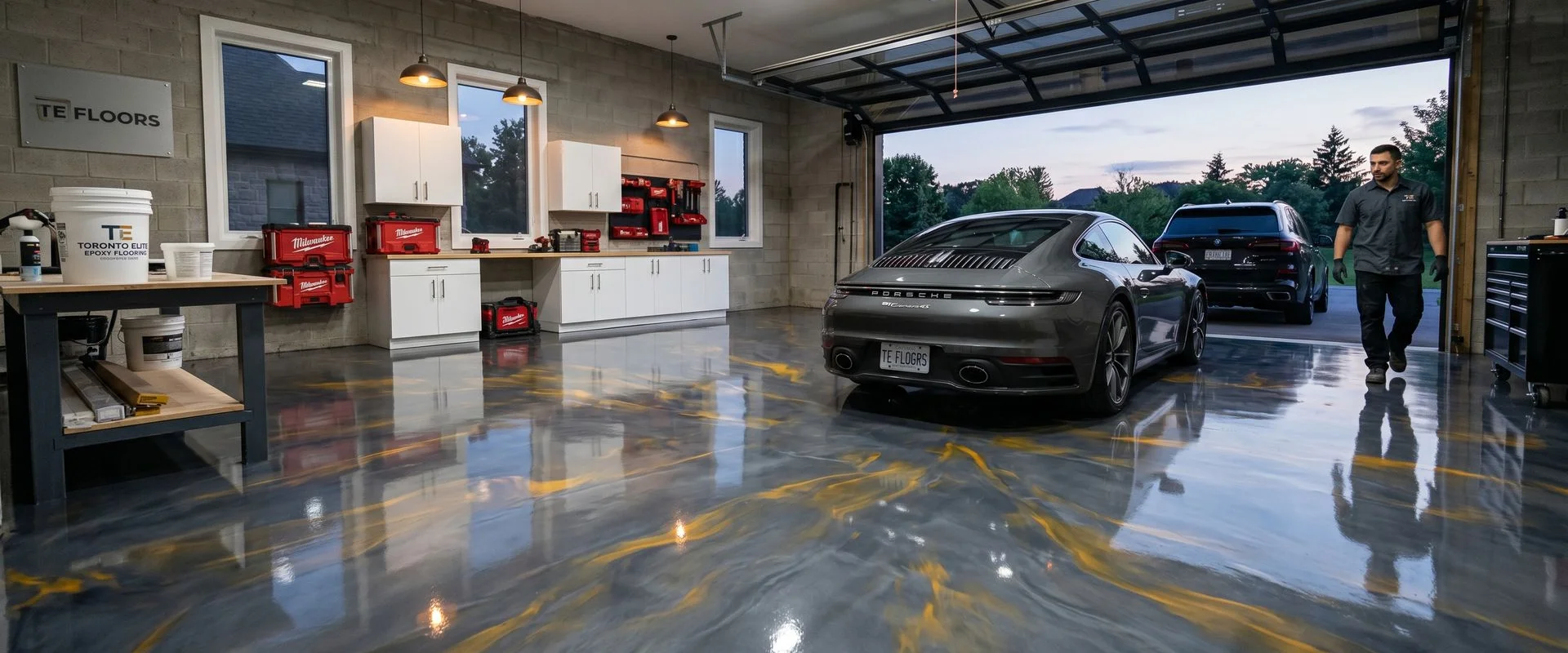
Toronto Elite Epoxy Flooring installs diamond-ground, salt-corridor-rated garage floor epoxy systems for Hamilton homeowners across three substrate environments. Pre-war Westdale and Dundas garages from the 1920s-1940s sit on original slabs without sub-slab vapour barriers and face Niagara Escarpment aquifer drive year-round. Hamilton Mountain and Stoney Creek 1950s-1970s builder-grade stock faces QEW and Lincoln Alexander Parkway salt loading plus 50-to-70-year-old builder polyethylene vapour barrier degradation. Ancaster and Flamborough executive estates combine heated attached triple-car bays with escarpment-aquifer humidity, demanding the premium mitigation spec. Our same crew services garage floor epoxy from Westdale and McMaster east through downtown, up the Mountain, and across to Stoney Creek, Ancaster, Dundas, and the escarpment-ridge pockets.
Why Hamilton Garages Earn Zone-Specific Prep
Hamilton’s garage substrate conditions split by era and geography. Westdale and Dundas pre-war brick stock from the 1920s-1940s predate the Ontario Building Code requirement for sub-slab vapour barriers by roughly fifty years. These original garage slabs were poured directly onto compacted fill or crushed stone with no polyethylene barrier. Combined with Dundas Valley Conservation Area groundwater and the Niagara Escarpment aquifer drive, F2170 field readings on pre-1950 Hamilton garages routinely sit at 80 to 90 percent in-slab relative humidity.
Hamilton Mountain and the lower-city steelworker housing belt from Fennell through Rymal expanded through the 1950s and 1970s with thin builder polyethylene sub-slab vapour barriers. Those barriers are now 50 to 70 years old and showing predictable degradation. Combined with QEW, Red Hill Valley Parkway, and Lincoln Alexander Parkway salt corridor commuter traffic carrying heavy chloride loads from November through March, these garages face a double stressor: escarpment-aquifer moisture drive from below plus salt chloride exposure from above. The reactive polyurea moisture primer plus 100 percent solids base coat plus aliphatic polyaspartic topcoat handles both stressors for 15+ year service life.
Ancaster and Flamborough executive estates on the escarpment ridge add a third variable. 1990s-2010s builder vapour barriers in Ancaster estates are generally in better condition than Mountain stock, but the combination of heated attached triple-car bays plus escarpment-aquifer humidity drive still demands moisture mitigation primer baseline. For escarpment-ridge properties within one kilometre of the escarpment face, this is non-negotiable.
Our Hamilton Garage Install, Step by Step
1. Zone Assessment Plus CSP 3 Diamond Grind
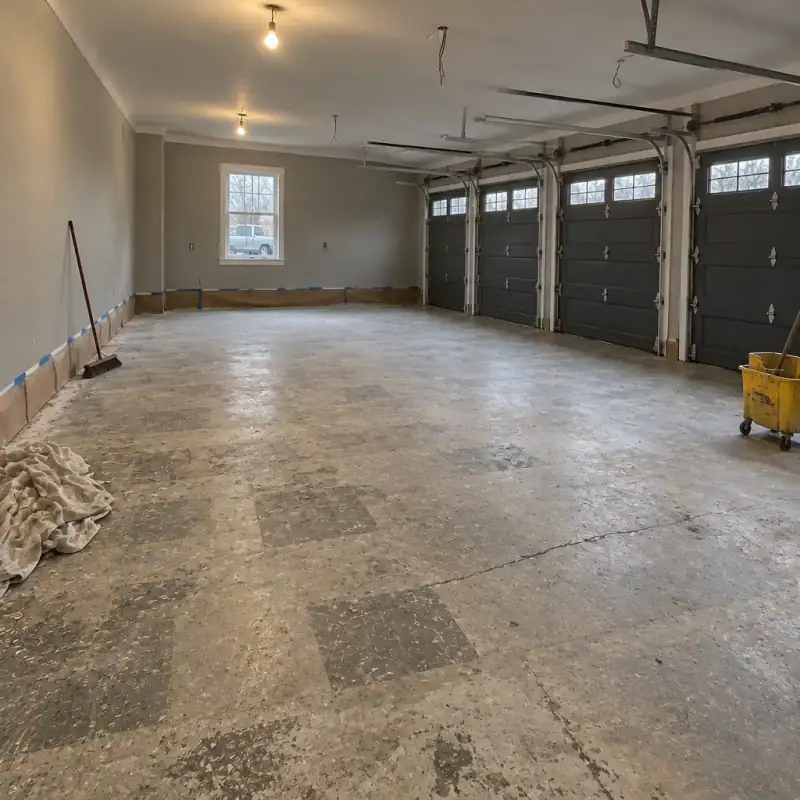
Our Hamilton site visit begins by mapping your property to its substrate zone (pre-war Westdale/Dundas, Mountain post-war, Ancaster/Flamborough executive, downtown urban renewal, or Stoney Creek escarpment-adjacent) and documenting slab condition. Pre-war and escarpment-ridge properties get a calcium chloride surface test plus 72-hour F2170 probes; inland Mountain and Stoney Creek properties get standard Tramex scan. HEPA-shrouded planetary diamond grinders take the slab to CSP 3 profile with dust extraction.
2. Crack Stitching Plus Moisture Primer
Active control joints and hairline cracks get rapid-set polyurea stitching. Westdale and Dundas pre-war bays typically need 3 to 5 crack repairs because original slabs lack control joints by modern standards. For pre-1970 slabs and any escarpment-ridge property within one kilometre of the escarpment face, a reactive polyurea moisture barrier primer goes down after prep.
3. Full System: Base, Flake, Polyaspartic Topcoat
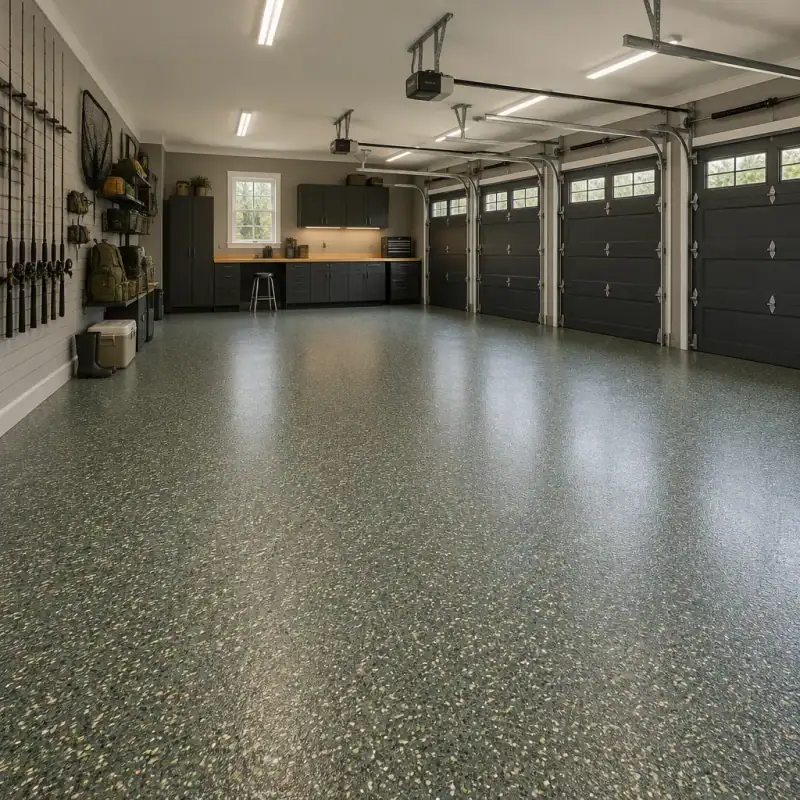
The 100 percent solids epoxy base coat applies at 12 to 16 mils wet film thickness, broadcast quartz or vinyl flake to full coverage refusal, aliphatic polyaspartic topcoat at 4 to 6 mils with anti-slip grit broadcast. For Ancaster and Flamborough executive triple-car bays we specify premium polyaspartic thickness at 5 to 7 mils and often broadcast metallic flake. Return to vehicle traffic 24 to 48 hours depending on ambient temperature.
Hamilton coverage note: Our crew runs the QEW, Red Hill Valley Parkway, Lincoln Alexander Parkway, Highway 403, and Centennial Parkway corridors daily, hitting Westdale, downtown, Mountain, Stoney Creek, Ancaster, and Dundas within the same work day. Flamborough rural estates on standard dispatch.
Standard turnaround for a single-car Hamilton garage is 1 to 2 days. Double-car Mountain or Stoney Creek attached bays run 2 days. Ancaster executive triple-car with premium finish spec runs 2 to 3 days. Westdale and Dundas pre-war bays with moisture barrier upgrade add 1 day for cure. Downtown condo parking stalls schedule as 1 to 2 overnight shifts. Written quote within 48 hours of the site assessment.
hamilton Garage Epoxy Pricing
| Project Size | Price Range (CAD) | Timeline |
|---|---|---|
| Single-car garage (400 sq ft) | $2,200 - $3,500 | 1-2 days |
| Double-car attached (800 sq ft) | $4,400 - $6,800 | 2 days |
| Executive triple-car Ancaster (1,200 sq ft) | $6,500 - $10,500 | 2-3 days |
| Westdale / Dundas pre-war moisture barrier upgrade | Add $1.80-$2.80/sq ft | +1 day cure |
| Downtown condo parking stall | Quoted on site | Off-hours scheduling |
Serving These hamilton Neighbourhoods
Common hamilton Garage Epoxy Questions
What makes Hamilton garages different from GTA core work?
Hamilton faces a specific salt-corridor plus escarpment-aquifer profile. The QEW, Red Hill Valley Parkway, Lincoln Alexander Parkway, and Highway 403 all carry heavy commuter traffic from November through March with sodium and calcium chloride loading on tires. The Niagara Escarpment aquifer feeds the Mountain and Ancaster substrate consistently through spring, pushing F2170 readings 10 to 15 percentage points above equivalent inland suburban garages elsewhere in Ontario. For escarpment-ridge Ancaster and Dundas properties within one kilometre of the escarpment face, we spec a moisture mitigation primer as baseline. The combined salt-plus-escarpment-aquifer environment means our standard spec includes CSP 3 diamond grind, polyurea crack stitching, 100 percent solids base coat, broadcast quartz or vinyl flake, and aliphatic polyaspartic topcoat for 15+ year service life.
Can you work on an Ancaster executive heated triple-car?
Yes. Ancaster executive triple-car heated garages on the escarpment ridge are a regular scope for us. These heated attached bays combine escarpment-aquifer humidity drive with the condensation-cycle variable of a heated interior, so our standard spec includes a reactive polyurea moisture barrier primer plus the full 100 percent solids base coat and a premium aliphatic polyaspartic topcoat at the thicker end of its application range (5 to 7 mils vs standard 4 to 5 mils). Often we broadcast decorative metallic flake for the showroom-grade finish these owners expect. Typical turnaround on a 1,200+ sq ft heated triple-car runs 2 to 3 days with premium finish spec.
Do Westdale and Dundas pre-war garages need special prep?
Yes, mandatory moisture barrier primer baseline. The Westdale and Dundas pre-war inventory from the 1920s-1940s was built out before the Ontario Building Code requirement for sub-slab vapour barriers. These original garage slabs were poured directly onto compacted fill or crushed stone with no polyethylene barrier. Combined with Dundas Valley Conservation Area groundwater drive and Westdale's proximity to the Niagara Escarpment aquifer, F2170 readings on pre-1950 garage slabs routinely sit at 80 to 90 percent in-slab relative humidity. Our pre-war Hamilton garage protocol includes 72-hour F2170 testing, reactive polyurea moisture barrier primer at 8 to 10 mils dry film thickness, 100 percent solids base coat, broadcast quartz, and premium aliphatic polyaspartic topcoat. The upgrade adds $1.80 to $2.80 per sq ft and is non-negotiable on pre-1950 heritage stock.
Related Services in hamilton
While we are on site in hamilton we also handle Basement Epoxy Flooring in Hamilton, Decorative Metallic Epoxy in Hamilton, Polyaspartic Floor Coating in Hamilton, and Commercial Epoxy Flooring in Hamilton. Same crew, same WSIB coverage, same written quote process.